Guide · Bars
A bar email list runs on the licence and the night shift
A bar opens when the offices close and shuts at two in the morning. The owner sleeps through your working day. Everything about reaching them starts there.
Covers Norway, Sweden, Denmark and FinlandNo invented bar countsAn afternoon, pre-service cadence
Read this before you buy any bar list
Two honest limits, up front, so the rest of the page can be useful.
First: FindAndClose covers four countries — Norway, Sweden, Denmark and Finland. Our whole index is 44,684 Nordic records from Google Maps. If you need bars in the US or worldwide, a per-record scraper like Outscraper is the better buy, and we would rather tell you than waste your trial.
Second: we publish live, dated counts for 27 tracked trades, and bars are not one of them yet. So this page carries no bar count. We could type a plausible number here. We will not, because a made-up figure would poison every real one on the site.
You can still search the bar category in the app — every plan searches every Maps category and every country. What follows is what the trade does to your outreach, whichever list you pull.
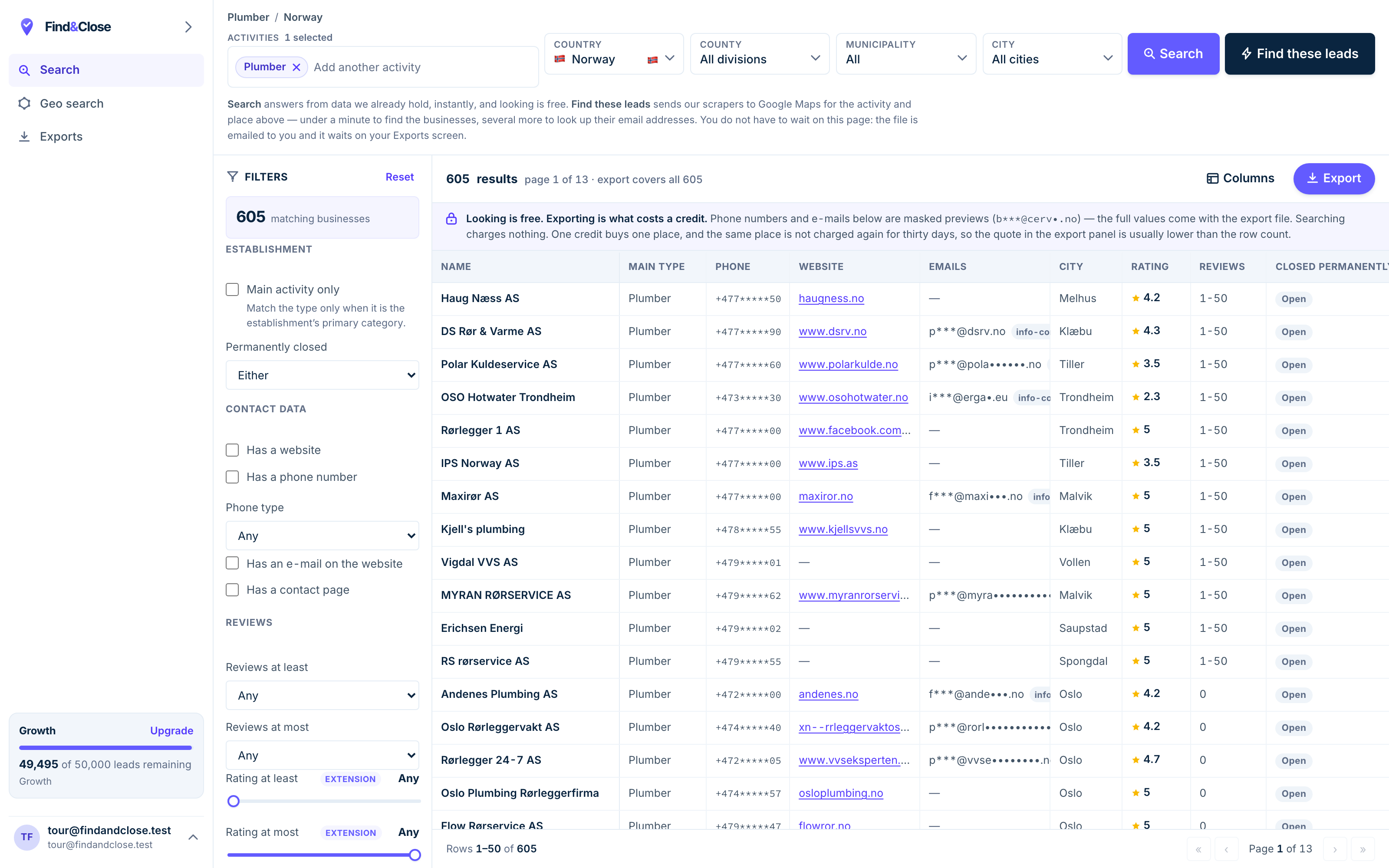
- Pick the trade Type it and take the match. One trade or twenty, on every plan.
- Pick the place Country, county, municipality, city. No plan gates the geography.
- The count moves first The number updates before you spend anything. Looking is free.
- Filter to the ones worth calling Has email, has phone, has a website, has a contact page. Combine them freely.
- Contacts are masked until export You can see a row exists and judge it. The address itself is the product.
- Export what you are looking at The file is exactly this filter set, with nothing dropped in between.
The licence is the first thing you are buying into
Anyone can open a shop. Nobody pours a drink without a licence.
A bar sits behind an alcohol licence, and the licence sits behind a registered business, an address and an inspection. That filters the trade before you ever reach it.
- Fewer ghost listings. A licensed venue is a real firm with a real address.
- A registered company that can hold an account and pay an invoice.
- A public face to protect. A licence is worth too much to risk on a bad review.
- Steady demand from suppliers. Every brewery, wine importer and drinks brand needs licensed venues, by law, in every market they sell into.
That last point is why a bar list gets bought at all. A brewery cannot swap in an unlicensed venue. Nor can a spirit brand or an event firm. The licence is the thing they are paying to reach.
The nearest trade we do count is restaurants. In Norway we hold 320, with 40% carrying an email and 83% a phone. Bars share the licence, the evening floor and the hospitality shape, so treat those figures as a climate, not a bar count. It is a reasoned guess, so read it as one.
The clock is upside down
A bar’s working day starts when yours ends. Aim for the one hour in between.
The floor opens in the late afternoon and runs past midnight. The owner or manager is on it the whole time, pouring, counting, closing.
So the morning is dead. A call at ten reaches a phone nobody is near. The evening is worse — that is service, the busiest part of the shift.
There is one window, and it is narrow.
- Mid to late afternoon, after the stock delivery and before the doors open.
- The owner is in the building, setting up, with the floor still quiet.
- A short email lands well then, read on a phone behind the bar.
- A call at the same hour reaches a person who can actually talk.
Miss that window and you are shouting into an empty room or a full one. Neither hears you. The cold email guide covers the message; the timing is the harder half here.
Who buys, and who just pours
A bar is an independent or a group site. They sign for very different things.
At an independent bar, the owner buys everything — the drinks list, the till, the sound, the supplier. One person, one signature, and often the person behind the bar when you call.
At a group or chain venue, the money splits. Head office picks the drinks range and the national suppliers. The site manager handles the rota, the cleaning and small local costs, and little else.
- Pitch an independent with the drinks range or the tool itself. They can say yes this week.
- Pitch a group site with a central range, and the answer is “you would have to ask head office”.
- Local services still land at group sites: repairs, cleaning, staff hiring, events.
- A Maps row is a venue, not a head office. Sort by name to spot the repeats.
Ten minutes sorting the file by name splits the two piles. A brand across ten towns is a group. A name that shows once is a bet on a single owner who answers their own phone.
A drinks-rep cadence for a night trade
Written for a distributor, brewery or spirit brand pitching independent bars. Time every touch to the pre-service hour. Run it in your own tool — we do not send email.
-
Subject a line for your back bar at [bar name]
Hi — I found [bar name] on Maps and read the room from your reviews.
I supply [your product] to bars in [region]. I can drop a sample by before a shift, not during one.
Worth a taste? If not, reply stop and I will not write again.
Sent to land at four in the afternoon, in the setup hour. A sample offer beats a pitch, because a bar buys a drink by tasting it, not by reading about it.
-
Call at five, after the delivery and before the doors open.
One question: what is missing from your back bar that guests keep asking for?
Every owner has an answer, and the answer is the opening for your range.
The pre-service call is the only one that reaches a bar owner awake and free. The gap question puts them in charge and hands you the pitch.
-
Subject the sample and the trade price
As promised: the sample details and the trade price per case.
No minimum order to start. Put it on for a weekend and watch it move.
If it is not for your room, reply stop and I will close the file.
A single-case trial removes the risk of a full order. A bar guards its licence and its margin, so let it test you at a size that cannot hurt either.
-
Subject closing your file
I will close your file today, so this is the last note.
If a supplier lets you down before a big weekend, my number is below. Have a good season.
Bars switch a drinks supplier on a stockout before a busy night. The breakup leaves your number where they will search for it when that night comes.
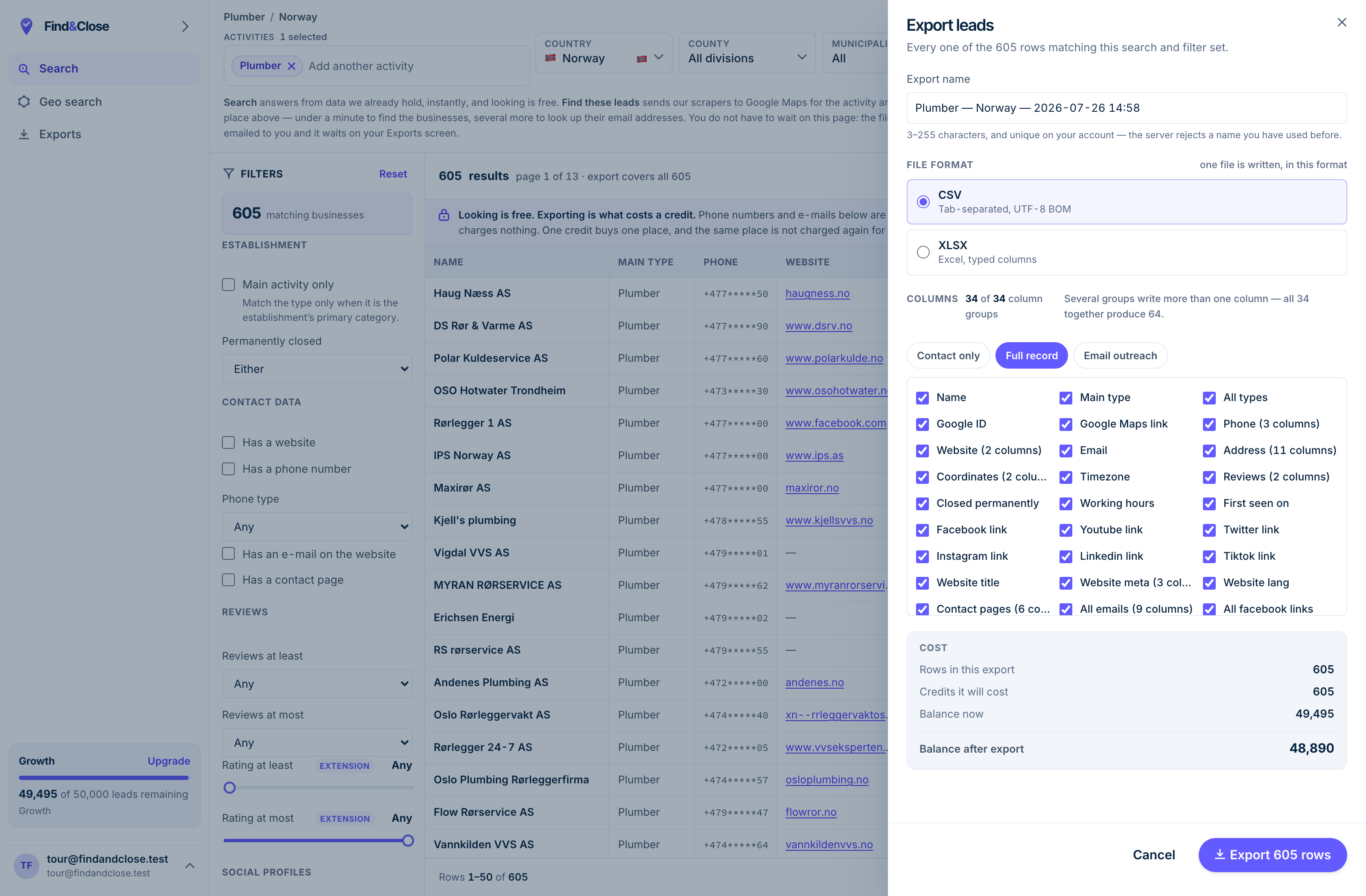
- It exports the whole result Every row the filter matched, not the page you happen to be looking at.
- CSV or XLSX Tab-separated UTF-8, or typed Excel columns. One file per job.
- 34 groups, 64 columns The same 64 on every plan. Nothing is held back for a higher tier.
- Three presets Contact only, full record, or the outreach set. Or tick your own.
- The cost, before you commit One credit per place, once per 30 days. Re-downloading is free.
Bar list questions, answered straight
When does a bar owner actually answer?
Mid to late afternoon, after the stock delivery and before the doors open. That is the one quiet, awake hour in their day.
The morning is dead and the evening is service. A message in either slot reaches nobody who can act on it.
Why is there no live bar count on this page?
Because our tracked set covers 27 trades and bars are not one of them yet. Every count we publish comes from that file, dated, and we do not pad the gaps.
The nearest counted neighbour is restaurants, at 320 rows in Norway. When a bar count lands in the tracked set, this page gets it.
Does the licence make bars a cleaner list than other hospitality?
It helps. A licence means a registered firm, a fixed address and a public face worth protecting, so fewer ghost listings slip through.
It does not tell you who owns the drinks decision. For a group venue that sits at head office, and a Maps row is a venue, not a head office.
Who buys a bar email list?
Drinks distributors, breweries, and spirit and wine brands. Event firms too. And the vendors that sell tills, sound and booking systems.
All of them need the licence, which no unlicensed venue can supply. That is why the list holds its value in this trade.
Is cold email to a bar legal in the Nordics?
B2B outreach to a published business address tends to rest on legitimate interest. You must still name yourself, state where the data came from, and offer an opt-out in the first message.
Many bars are sole traders, which strengthens their protection in some countries. The GDPR guide covers the split. None of this is legal advice.
Where to go from here
The counted hospitality neighbour, the country hubs, and the method guides.
- Restaurant email list The counted licensed neighbour
- Local business leads in Norway Every Norwegian trade we publish
- Local business leads in Sweden Every Swedish trade we publish
- Cold email local businesses Subject lines, length, a full sequence
- GDPR and B2B cold email Legitimate interest, opt-out, suppression
Search the bar category on live Nordic data
Fourteen days, 100 leads, no card. Pick a country, pull the venues, and judge the coverage yourself before anyone pays anything.
- 14-day free trial
- 100 leads included
- No credit card