Guide · Event planners
Event planner email list: a market and a referral hub
A planner buys from you, and a planner refers you. The second is worth more. This page shows how to reach the trade, and how to sell through it.
Covers Norway, Sweden, Denmark and FinlandNo invented planner counts — the trade is not tracked yetA partnership cadence, not a hard-sell one
An event is a project, and projects live in the inbox
A planner does not run a shop. They run a run-sheet. Every event is a project with a budget, a deadline and a web of suppliers.
Think of the planner as a project manager for a party. They win the brief, set the budget, book the room, hire the caterer, brief the florist and hold the timeline. The whole job is coordination.
Coordination is written. Proposals, quotes, supplier briefs, running orders — all in email, all filed, all searchable when the day comes. A planner who lost the thread would lose the event.
So the inbox is the workshop. A clear message from a supplier lands where the planner already works. A cold call interrupts a person mid-brief, on a deadline, and gets nothing.
- Each event is a fixed project, not a rolling service. The planner works to a date.
- The budget is set early, and suppliers are chosen against it.
- A tidy written pitch fits the way a planner already handles suppliers.
- A phone call arrives while the planner is holding six other threads.
Coverage, said early. FindAndClose lists come from Google Maps across Norway, Sweden, Denmark and Finland. For US or global event planners, a worldwide scraper like Outscraper fits better, and our comparison says so.
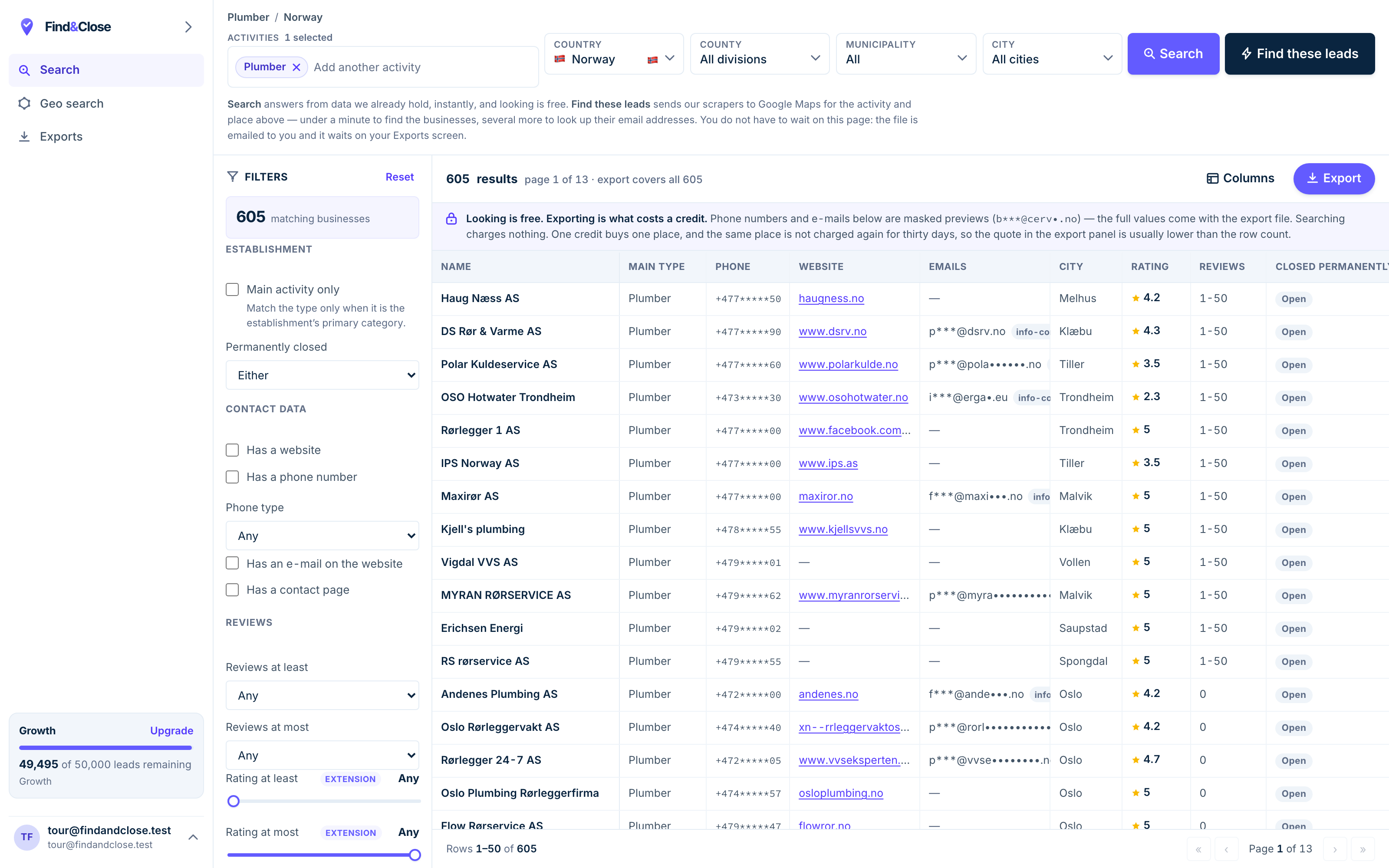
- Pick the trade Type it and take the match. One trade or twenty, on every plan.
- Pick the place Country, county, municipality, city. No plan gates the geography.
- The count moves first The number updates before you spend anything. Looking is free.
- Filter to the ones worth calling Has email, has phone, has a website, has a contact page. Combine them freely.
- Contacts are masked until export You can see a row exists and judge it. The address itself is the product.
- Export what you are looking at The file is exactly this filter set, with nothing dropped in between.
Corporate and private: two buyers under one word
The word planner hides two trades. They run on different money and a different calendar.
The corporate planner runs conferences, launches, away-days and staff parties. The client is a company, the budget is a line item, and the brief arrives by tender. This side buys steadily and thinks in quarters.
The private planner runs birthdays, anniversaries and big personal parties. The client is a household, the money is emotional, and the brief arrives by referral. This side swings with the social season.
The split decides your pitch and your timing.
- Corporate work peaks in the last quarter, with the conference and party season. Pitch it in summer, before the tenders go out.
- Private work follows the party calendar and word of mouth. It rewards a warm introduction over a cold one.
- A corporate planner answers a proposal. A private planner answers a recommendation.
- Many planners do both, so the same row can wear two hats. The reviews and site tell you which leads.
Read the listing before you write. A planner whose reviews talk about conferences and AV wants a corporate pitch. One whose reviews talk about magical days and tears wants the private one. The wrong frame marks you as a stranger.
The planner is a hub — sell through them, not just to them
A planner spends other people’s budgets on other people’s suppliers. That makes them the most valuable referral in the whole events world.
When a planner books an event, they hire the caterer, the venue, the florist, the AV crew and the photographer. One planner can hand a good supplier a stream of work for years.
So there are two ways to use a planner list, and the second is the prize.
- Sell to the planner. Software, insurance, hire stock, marketing — the things a planner buys to run their own business.
- Sell through the planner. If you are a caterer, a venue or a florist, you are not pitching a customer. You are asking to join a preferred-supplier list. One yes becomes many bookings.
The through-the-planner play changes the whole tone. You are not closing a sale. You are starting a partnership, and a partnership pitch is patient, specific and generous with proof.
If you run events yourself and market them, a marketing partner sits close to this trade too. Our marketing agency list covers that neighbour.
Why there is no live planner count here
We publish counts only for the trades our crawl tracks. Event planning is not one of them yet, so this page states no number.
Our page set tracks 27 trades. Event planning is not among them, and we will not invent a figure to fill the gap. One fabricated count and the whole page set is worthless.
The honest context we can give sits at the country level, from our own crawl.
- The four countries hold 44,684 local business records in total.
- Email coverage across the tracked trades runs Norway 38%, Sweden 19%, Denmark 17%, Finland 16%.
- Planners are a deskbound, project-led trade, so expect them near the upper end of those rates — a reasoned guess, not a count.
The category is still searchable in the app on any plan. Pick event planning, pick a country, and the live count shows before you export a row. We track what we can back with depth, and say so where we cannot.
A preferred-supplier cadence
Written for a caterer, venue or florist who wants onto a planner’s list. This is a partnership pitch, not a hard sell. Run it in your own tool — we build the list and send nothing.
-
Subject a supplier for your [event type] work
Hi [name]. I found your studio on Google Maps — [one real detail, like an event they posted].
I run [your service] and I work well with planners: one contact, clear pricing, no surprises on the day.
Worth a look for your next brief? If not, reply stop and I will not write again.
A planner’s worst fear is a supplier who embarrasses them in front of a client. Leading with reliability, not price, speaks to that fear.
-
Subject how I make a planner’s life easier
One page on how I work with planners: what I handle, what I need from you, and the price.
Two events I did with other planners are on there: [link].
If it is not a fit, reply stop and I will close the file.
Planners judge a supplier by how little management they need. Showing the workflow, not just the product, is the real pitch.
-
Call late morning, between the school run and lunch, when a planner is at the desk and not on site.
Ask one thing: “what would a supplier have to do to earn a spot on your shortlist?”
Then listen. The answer is your whole sales plan, in their own words.
A planner who tells you their shortlist rules has already started imagining you on it. The question does more work than any pitch.
-
Subject keeping the door open
I will stop writing now so I am not a pest in your inbox.
When a brief needs [your service], my details are below. I would love to be the easy call.
A partnership is a slow yes. The soft close leaves you top of mind for the next brief, which is when the real decision happens.
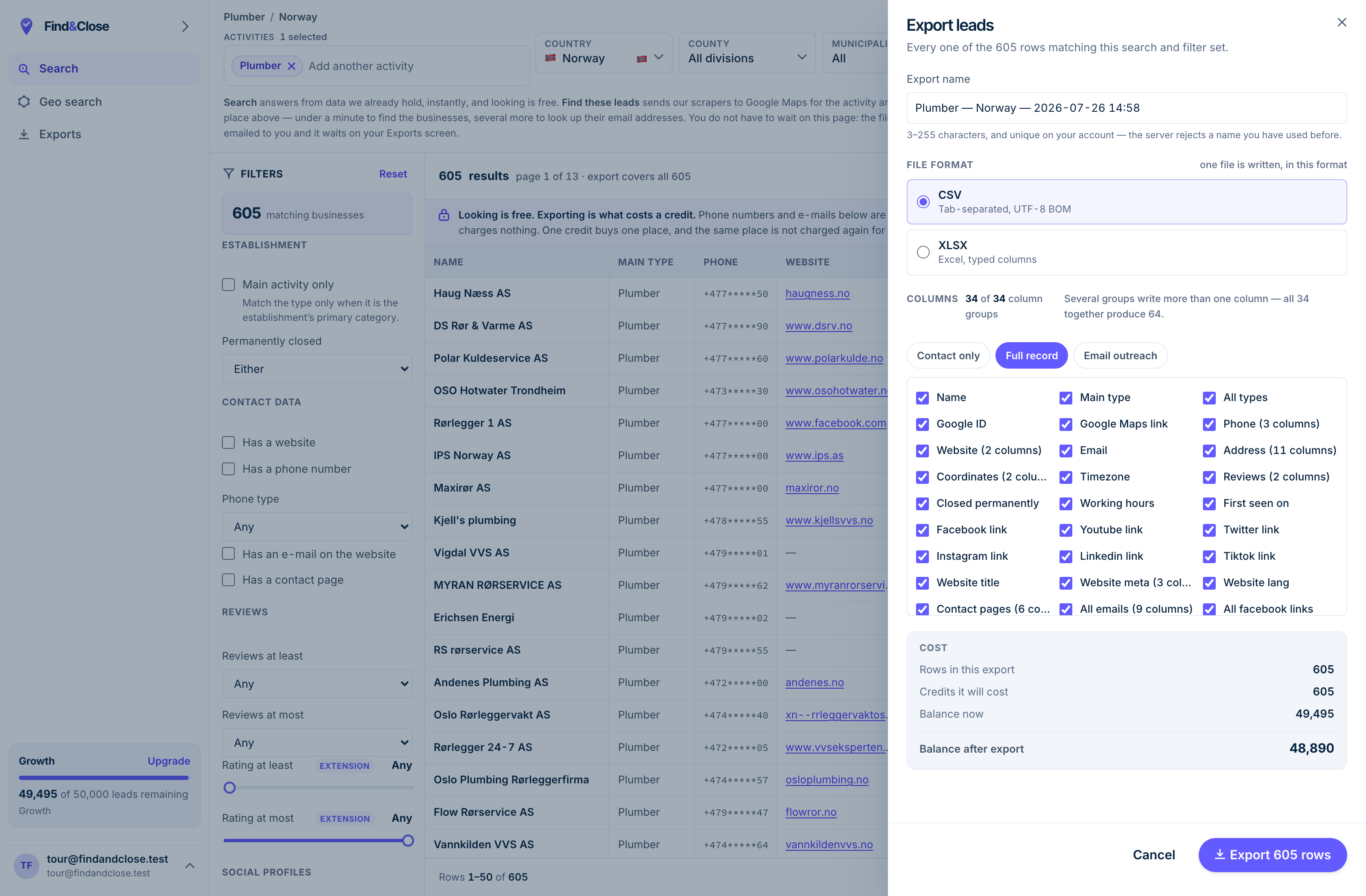
- It exports the whole result Every row the filter matched, not the page you happen to be looking at.
- CSV or XLSX Tab-separated UTF-8, or typed Excel columns. One file per job.
- 34 groups, 64 columns The same 64 on every plan. Nothing is held back for a higher tier.
- Three presets Contact only, full record, or the outreach set. Or tick your own.
- The cost, before you commit One credit per place, once per 30 days. Re-downloading is free.
Questions about event planner lists
What is the difference between an event planner and a wedding planner?
An event planner leans corporate and private parties, on a quarterly, tender-led rhythm. A wedding planner is a narrower, summer-led, referral-driven trade.
We keep them on separate pages because the buyer, the season and the pitch all differ. See the wedding planner list for that trade.
How do I tell corporate planners from private ones?
Read the listing. Reviews about conferences, AV and delegates mean corporate. Reviews about parties and personal moments mean private.
Many planners do both. When in doubt, pick the frame their top reviews lead with, and let the rest follow.
Why would a supplier want a planner list?
Because a planner is a referral hub. One planner books caterers, venues, florists and photographers for every event they run.
Getting onto a planner’s shortlist turns one relationship into a stream of bookings. That is worth more than any single sale.
When is the best time to reach a corporate event planner?
Summer, before the last-quarter conference and party season. The tenders and briefs go out then.
Reach them during the peak and you interrupt someone running six events at once. Reach them early and you are on the shortlist when the brief lands.
Why is there no live count for event planners?
Our tracked set covers 27 trades, and this is not one yet. We publish only counts our crawl can back, and we do not invent the rest.
The category is still searchable in the app. Pick it, pick a country, and the count shows before you export.
Go deeper
The neighbours a planner buys from, the sibling trades, and the country hubs.
- Caterer email list A supplier planners hire on every event
- Event venue email list Where the planner’s events happen
- Marketing agency email list The neighbour that markets events
- Local business leads in Norway The country hub and its live counts
- Local business leads in Denmark The country hub, honest depth
Pull the planner file and start a partnership
Fourteen days, 100 leads, no card. Enough to test the preferred-supplier play on one country before you commit.
- 14-day free trial
- 100 leads included
- No credit card