For developers
Google Maps scraper API: the four routes, priced and compared
You want Maps data over HTTP, not in a browser. Four API shapes exist, and they bill in four different ways. This page prices each and says which build it fits.
Official rates includedOur index covers four Nordic countriesFigures checked at source
The four API shapes, named first
Every Maps data API on the market is one of these. Name yours before you read a pricing page.
First, the official Places API. Google, first party, real time, metered per call.
Second, scraper APIs. Outscraper is the best-known name. You request a scrape, a job runs, and results come back.
Third, platform APIs. Apify is the model: rent an actor, drive it over their API, fetch the dataset.
Fourth, export APIs over a stored index. That is ours. The crawl already ran, so the API is a query, not a scrape.
One scope note before the table. Our index covers Norway, Sweden, Denmark and Finland, and nothing else. For a global build, the second and third routes are your routes.
If your real question is whether to leave the official API at all, that decision has its own page. This page assumes you want scraped or stored data and asks which API to pick.
Route one: the official Places API
The baseline every alternative is measured against. First party, real time, and metered.
Text Search runs $32 per 1,000 calls on the Essentials and Pro tiers. Enterprise runs $35, and $40 with atmosphere fields.
Place Details runs $5 per 1,000 on Essentials, rising to $17 on Pro, $20 on Enterprise and $25 with atmosphere data.
Each SKU carries a free monthly cap: 10,000 calls on Essentials, 5,000 on Pro, 1,000 on Enterprise. A country sweep eats those in a morning.
Two hard limits matter for list builds. The API returns no business email, at any price. And the Maps Platform terms restrict storing most Places content, though place IDs may be stored with no time cap.
Pick it when
- You are shipping a user-facing feature: search, pins, autocomplete
- You need real-time data and an SLA you can escalate to
- You look places up one at a time, not by the thousand
Route two: a scraper API
You send a query, a scrape runs on their machines, and rows come back. Outscraper is the reference.
Outscraper puts an API on every account, with no monthly fee. The first 500 places in a 30-day window are free.
After that it is $3 per 1,000 records, dropping to $1 per 1,000 past 100,000. Prepaid credits do not expire. Output comes back as CSV, Excel or JSON.
The shape to plan around is the queue. Tasks go from queued to running to done, and big jobs can run for hours. Your code waits or polls.
SerpApi-style services sit in this class too. They return live Google results, Maps included, as JSON, priced per search. We have not verified their current rates from a first-party source, so this page names the model and no number.
Pick it when
- Your build needs any country, on demand
- Volume is high and the $1 rate does the arguing
- An async job model fits your pipeline
Route three: a platform API
Apify is the model here. The API drives actors; the actors do the scraping.
The Google Maps Scraper actor starts at $1.50 per 1,000 places. Plans run from free with $5 of monthly credit, through $29 and $199, to $999.
Then the platform lines start. Compute is priced per unit, from $0.20 down to $0.13 as plans rise. Residential proxy traffic runs $7 to $8 a gigabyte.
What you get for that is control. Write your own actor and the API will run any crawl you can code, on any site.
Pick it when
- You need fields or sites no packaged API returns
- You have an engineer to own runs and costs
- Maps is one source among several in your build
The full cost anatomy is on the Apify comparison, and the crawler-with-plumbing variant on the Lobstr page.
Route four: an export API over a stored index
Ours, so read it as a vendor describing his own shop. The claims are narrow on purpose.
FindAndClose crawls Google Maps across four Nordic countries. The result is one deduplicated index of 44,684 records. The REST API queries that index. Nothing scrapes at request time, so there is no queue and no job state.
The API opens on the $99 Growth plan at 10 requests a second. Scale runs at 50 and Enterprise at 200. It returns the same 64 fields as the export, with the email source page and an MX flag on the row.
Formats follow the plan: CSV and XLSX everywhere, JSON from Growth, Parquet on Scale. Credits meter rows, not calls, and unused credits roll over one to three months.
What we do not have: a Python SDK, an MCP server, webhooks, or any country outside the Nordics. Outscraper serves an API to every account, ours starts at $99, and we mark that as their win.
Pick it when
- Your market is Nordic local business
- You want synchronous answers, not job polling
- You want a fixed schema and a bill that never moves
Our export API and Outscraper’s scraper API, row by row
The two routes most builds shortlist. Their figures are reused from our full Outscraper page, read off their own site.
| FindAndClose | Outscraper API | |
|---|---|---|
| What a request doesModel | Queries a stored index | Starts a scrape job |
| Response modelModel | Synchronous, no queue | Queued, running, done |
| GeographyCoverage | Every country, fetched on demand | Worldwide |
| Data sourcesCoverage | Google Maps | Maps and many more |
| API availabilityPricing | From $99 a month | On every account |
| Monthly feePricing | From $49; API from $99 | None |
| Unit ratePricing | Credits inside your plan | $3 per 1,000 records |
| Rate at high volumePricing · past 100,000 records | Up to 250,000 credits | $1 per 1,000 |
| Free to startPricing · no card either way | 14 days, 100 leads | 500 places a month |
| Rate limitSupport | 10 to 200 requests a second by tier | Not stated on their pricing page |
| SchemaExport | 64 fields, fixed | Varies by service |
| Email with source page and MX flagExport | Yes | Email is its own scraper service |
| FormatsExport | CSV, XLSX, JSON, then Parquet | CSV, Excel, JSON |
| Credits expireOwnership | Roll over one to three months | Prepaid credits do not expire |
| Your data after you stop payingOwnership | Yours, we keep nothing back | No plan to cancel |
Outscraper API's pricing and features last checked on 27 July 2026. We re-check every month. Rows shaded grey are ones where they beat us.
Outscraper figures are their published Google Maps rates, reused from our full comparison. Other services of theirs carry their own rates. We re-check monthly.
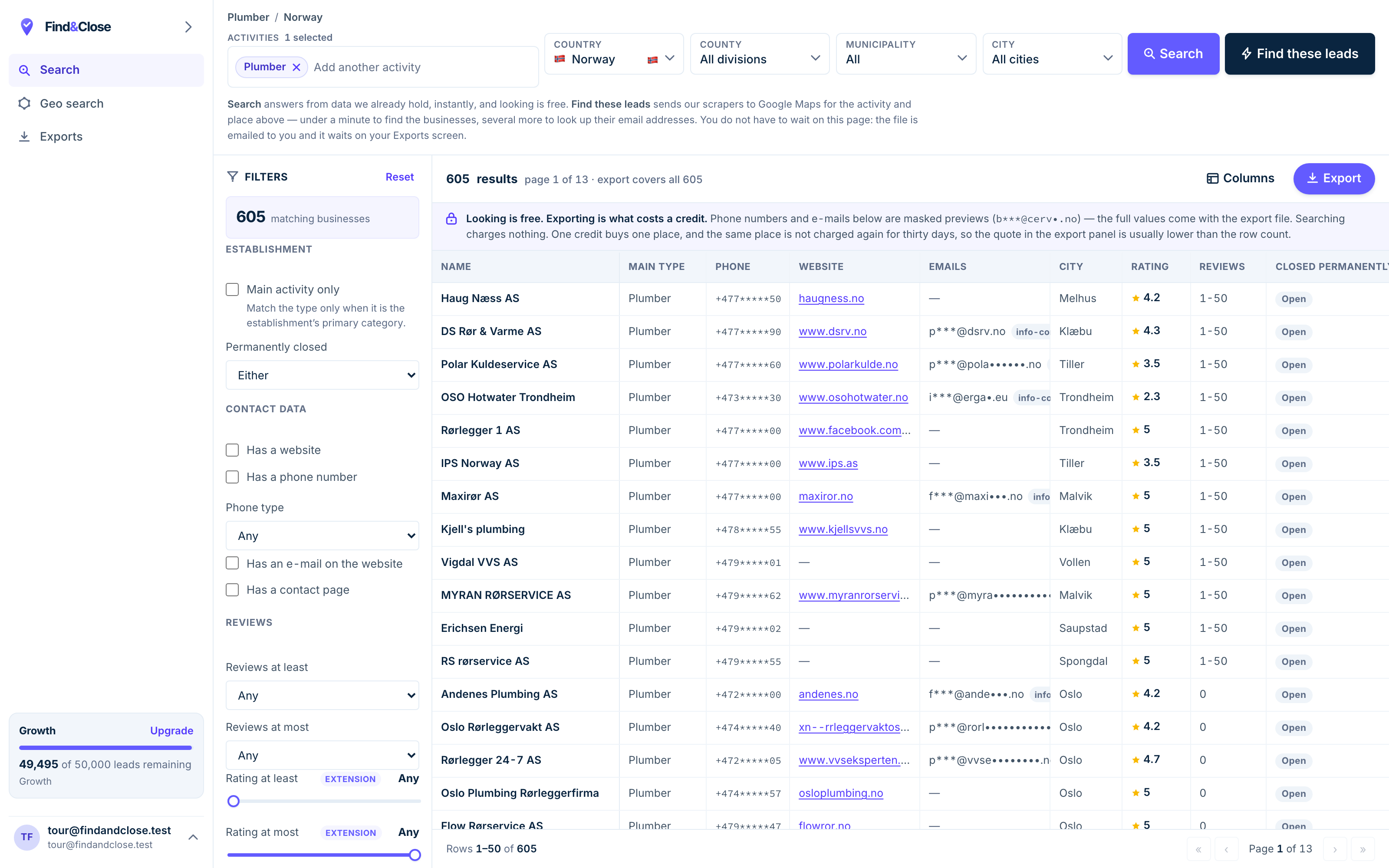
- Pick the trade Type it and take the match. One trade or twenty, on every plan.
- Pick the place Country, county, municipality, city. No plan gates the geography.
- The count moves first The number updates before you spend anything. Looking is free.
- Filter to the ones worth calling Has email, has phone, has a website, has a contact page. Combine them freely.
- Contacts are masked until export You can see a row exists and judge it. The address itself is the product.
- Export what you are looking at The file is exactly this filter set, with nothing dropped in between.
How to choose in an afternoon
Price the job, not the pricing page. Five steps settle it.
- Name the freshness you need. Real time means the official API. This week means any of the rest.
- Name the geography. Nordic only, and route four is in play. Anywhere else, it is not.
- Count the calls, then price them. Search calls plus detail calls, times places. Do the same sum per route.
- Check the storage terms. The official API restricts storing most content. Scraped and indexed data has no such clause from us.
- Prototype the smallest route first. Outscraper’s free 500 places and our 14-day trial both cost nothing.
Most production builds end up with two routes. The official API for the user-facing lookup, and a scraper or export API for the bulk work.
That split is normal, not a failure. The two shapes answer different questions.
Developer questions, answered plainly
Does the official Places API return email addresses?
No. Email is not a field you can request at any price.
Every API that returns one found it on the firm website. Ours names the source page beside each address, so you can audit it.
Is there a free Google Maps scraper API?
Outscraper gives every account 500 free places in a 30-day window, with no monthly fee. Apify’s free plan carries $5 of credit a month.
Our trial is 14 days and 100 leads, no card. The API itself opens on the $99 plan.
What are your rate limits and formats?
Growth runs 10 requests a second, Scale 50, Enterprise 200. Responses carry the same 64 fields as the export.
JSON ships from Growth and Parquet from Scale. CSV and XLSX exist on every plan. See the tiers.
Do you ship an SDK or an MCP server?
No. There is no Python SDK and no MCP server, and we will not imply otherwise.
Lobstr ships all three of SDK, CLI and MCP, and Scrap.io and PhantomBuster ship MCP servers. Those are fair wins for them.
Why is your API not on the $49 plan?
The Starter plan is built for people who export files from the app. The API opens one tier up, at $99 with 50,000 credits.
Outscraper puts an API on every account. If you are a small developer, that is a real point in their favour, and we mark it as one.
Can I store what your API returns?
Yes. The rows you pull are yours, and they stay yours after you cancel. We do not delete customer exports.
The official API works the other way: its terms restrict storing most Places content. That trade has its own page.
Read next
The pages behind the figures above, and the wider guides.
Query the index instead of running a scrape
Fourteen days, 100 leads, no card. Pull a Nordic trade through the app first, and wire up the API when the rows earn it.
- 14-day free trial
- 100 leads included
- No credit card