Guide · Grocery stores
Grocery store email list: chains, independents and the shelf
Most grocery stores cannot say yes to you. The chain owns the buying, and the store is a doorway. The whole job is finding the shops where the owner still decides.
Covers Norway, Sweden, Denmark and FinlandNot a tracked trade, so no live countWritten around who signs the order
Where this list reaches, and where it stops
Say the scope first, so nobody buys the wrong thing.
FindAndClose sells local business lists built from Google Maps. We cover four countries: Norway, Sweden, Denmark and Finland.
If you sell into the Nordics, these are live rows from our own crawl. If you need a US or global grocery list, we are the wrong shop. A worldwide scraper fits that job better, and our Outscraper review says where it wins.
One more line of scope, and it is the important one. Grocery in the Nordics is packed into a few large chains. A store you find on Maps is often one branch of one of them.
That single fact decides whether a grocery list is worth buying. A branch does not choose its own suppliers, software or fittings. Head office does. So the list is only as good as your ability to tell a branch from a shop that still buys for itself.
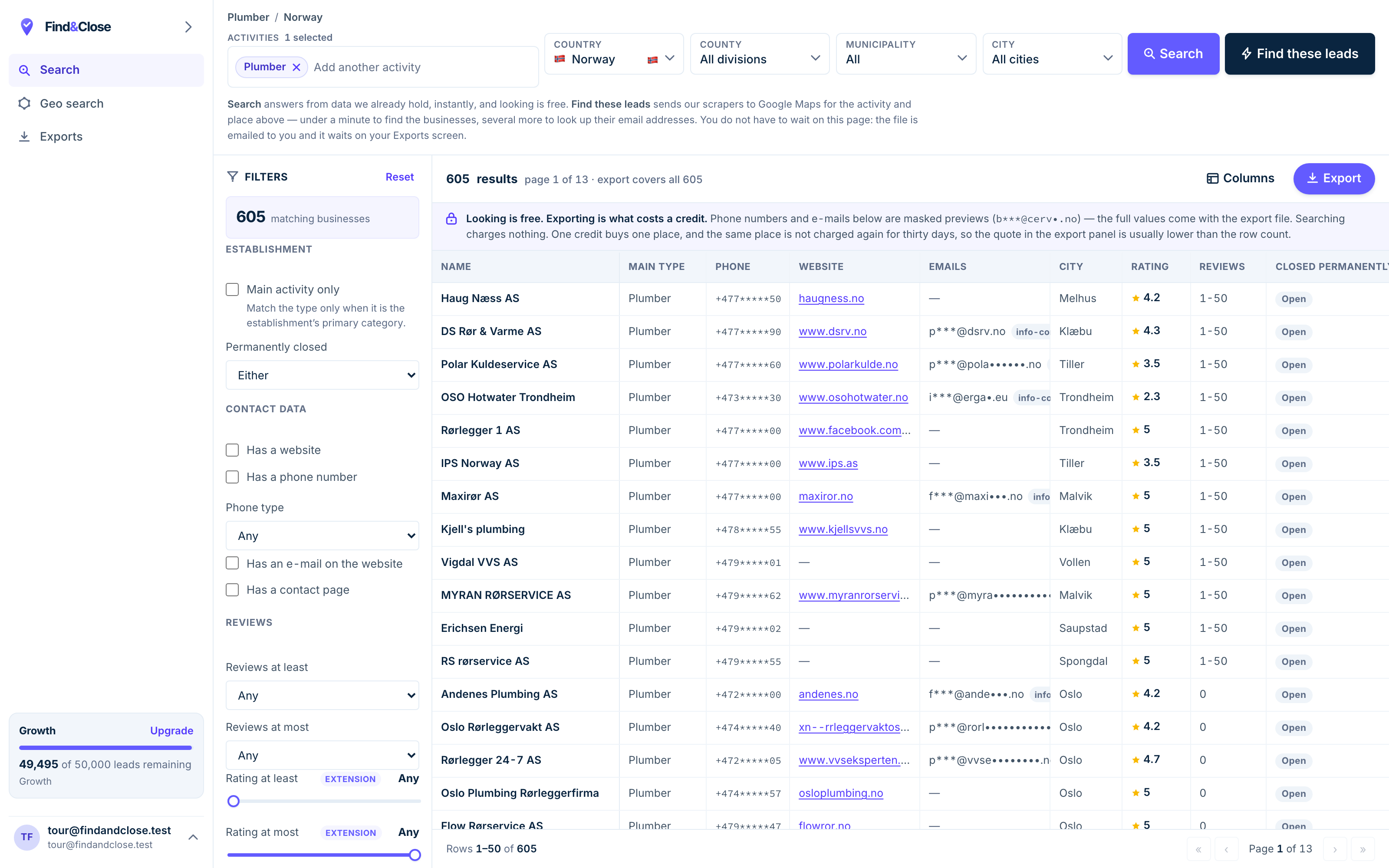
- Pick the trade Type it and take the match. One trade or twenty, on every plan.
- Pick the place Country, county, municipality, city. No plan gates the geography.
- The count moves first The number updates before you spend anything. Looking is free.
- Filter to the ones worth calling Has email, has phone, has a website, has a contact page. Combine them freely.
- Contacts are masked until export You can see a row exists and judge it. The address itself is the product.
- Export what you are looking at The file is exactly this filter set, with nothing dropped in between.
A chain store is an address, not a decision
The word "grocery" covers two businesses. One can buy from you. One cannot.
A chain branch has a store manager. The manager runs the rota, the shelves and the till. The manager does not choose the stock, the checkout system or the freezers. That buying sits at head office, and a Maps pin is a location, not an HQ desk.
An independent grocer is the other animal. The owner is on the floor, and the same person signs off what the shop carries. No procurement team. No review cycle to wait out.
- Pitch a chain branch a central offer, and the best you get is "ask head office".
- Pitch an independent, and the yes can land the same week.
- Branch-level offers still work on chains: cleaning, repairs, local hiring, waste pickup.
- Everything else belongs at HQ, and HQ is a company database job, not a Maps job.
Telling them apart in the export is mechanical. Sort by name. A brand that repeats across a dozen towns is a chain, and all those rows feed one buyer. A name that shows up once is a bet on a single owner.
The independents worth your time cluster in the specialty end: ethnic grocers, health-food shops, farm stores, delis. These carry stock the big chains skip, and the owner picks every line by hand.
Selling to the shelf, or selling from it
Two very different buyers reach for a grocery list. Work out which one you are before you write.
If you sell to the shop, you want shelf space. You are a wholesaler, a local producer, a drinks brand. Your buyer is whoever chooses what goes on the shelf, and for an independent that is the owner at the back of the store.
If you buy from the shop, or serve it, you are after the operator: the till vendor, the payment terminal, the waste hauler, the shop-fitter, the insurer. That buyer is the same owner, wearing a different hat.
- Grocery runs on thin margins. Every pitch has to name the money in the first line.
- Spoilage is the daily enemy. Anything that cuts waste gets a hearing.
- The owner is time-poor and interrupted. Short beats clever, every time.
- A local producer with a story sells shelf space that a faceless brand cannot.
For the shelf-space pitch, the phone is the first move, because the owner is standing three metres from the shelf you want. For the service pitch, email lands better, read after the doors close and the till is counted.
What we can count, and what we cannot
We publish a live count only where our tracked file backs it. Grocery is not tracked yet, so this page carries none.
Our page set follows 27 trades. Grocery is not one of them. There is no grocery row in the file today, and we will not dress a guess up as one.
What we can give you is the ground the trade stands on.
- Our four countries hold 44,684 local business records in total.
- Email coverage across our tracked trades: Norway 38%, Sweden 19%, Denmark 17%, Finland 16%.
- Phone coverage runs well ahead of email in every trade we track.
The nearest food-retail trade we do publish is bakeries. Our Norwegian bakery page holds 332 shops, 145 of them with an email on file. That is a small, owner-run food trade. It previews how a grocery file behaves. Expect strong phone coverage, patchy email, and many shops that never claimed a listing.
You do not have to wait for us to track grocery. The app searches Maps categories beyond our page set, grocery among them. Pick the category, pick a country, and the count shows before you export a row.
A shelf-space cadence for independent grocers
Written for a wholesaler or local producer trying to get a line onto the shelf. Call first, because the buyer stands next to the shelf. Run it in your own tool — we build the list and send nothing.
-
Call mid-morning, after the delivery rush and before lunch. Ask for the owner by the shop name.
One sentence on the line you sell. Then one question: who chooses what goes on the [category] shelf here?
If it is the owner, ask to drop a sample in. A grocer trusts what they can taste or hold.
The owner of an independent grocer is on the floor, near the shelf you want. A call reaches the buyer directly, which a chain branch never lets you do.
-
Subject the sample and the margin
Hi [name] — good to talk. Here is the line, with the trade price and the shelf price.
The number that matters is the margin per facing: [your figure]. That is what the shelf earns you.
If it is not for you, reply stop and I will not write again.
Grocers buy on margin per shelf-inch, not on a nice brand story. Put the money in writing so the owner can compare it to what sits there now.
-
Subject a two-week trial on one shelf
One idea to lower the risk. Take a small case, give it two weeks on one shelf, and judge it on the till.
I will handle the first delivery myself so nothing goes wrong.
Reply yes, or reply stop, and either way I have my answer.
A tiny trial removes the fear of dead stock. A grocer who has been burned by a slow line will only test at a size that cannot hurt.
-
Subject last one from me
I will close your file today and stop writing.
If a gap opens on the shelf, or a supplier lets you down, my number is below. All the best with the shop.
Shelf space frees up on a bad week, not a good pitch. The breakup leaves your number where the owner will look when a line stops selling.
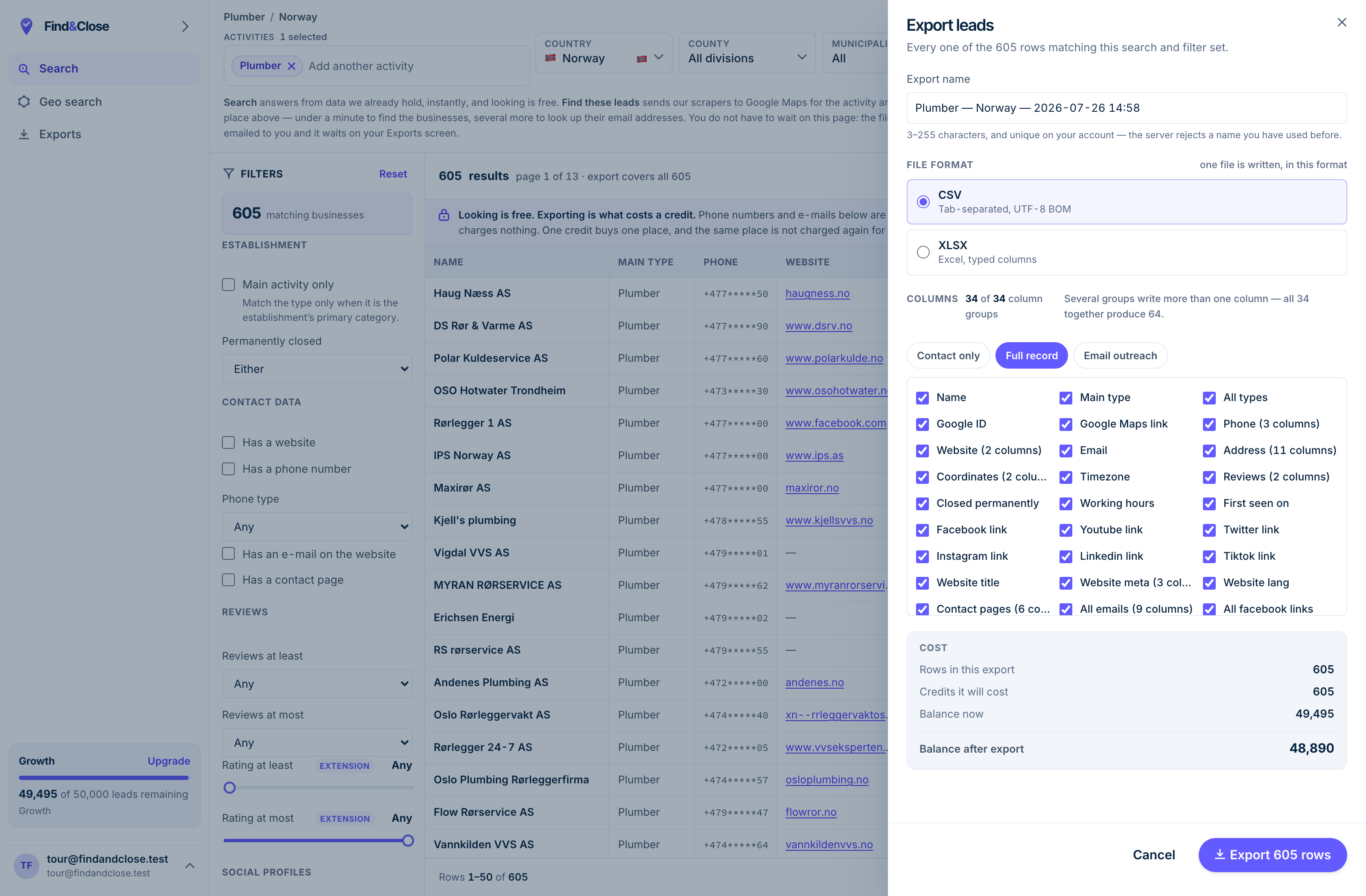
- It exports the whole result Every row the filter matched, not the page you happen to be looking at.
- CSV or XLSX Tab-separated UTF-8, or typed Excel columns. One file per job.
- 34 groups, 64 columns The same 64 on every plan. Nothing is held back for a higher tier.
- Three presets Contact only, full record, or the outreach set. Or tick your own.
- The cost, before you commit One credit per place, once per 30 days. Re-downloading is free.
Straight answers about grocery lists
Can I sell to a chain supermarket branch?
Not the things that matter. A branch manager runs the floor, but head office chooses the stock, the tills and the fittings.
You can still sell a branch local services: cleaning, repairs, waste pickup, hiring. Everything central belongs at HQ, which a Maps list will not hand you.
How do I find the independents in the export?
Sort the file by business name. A brand that repeats across towns is a chain. A name that appears once is likely an independent.
The specialty end is the richest: ethnic grocers, health-food shops, delis, farm stores. The owner there picks every line by hand.
Why is there no grocery count on this page?
Our tracked page set covers 27 trades, and grocery is not one of them yet. Every count we publish comes from that file, dated, and we do not pad the gaps.
You can still search the grocery category in the app and see the real number before you export.
When is a grocery owner reachable?
Mid-morning, after the delivery rush, or mid-afternoon before the after-work crowd. Never at opening or at the evening peak.
The owner is on the floor most of the day. A short call beats a long email for the shelf-space pitch.
Who buys a grocery store email list?
Two camps. First, wholesalers and local producers chasing shelf space. Second, service sellers: till vendors, waste haulers, insurers.
Both are really pitching the same person — the independent owner — so both should filter the chains out first.
Go deeper
The country hubs, a neighbour food trade with a live page, and the guides.
- Bakeries in Norway 332 shops, the nearest food-retail file
- Local business leads: Norway Every tracked trade in one country
- Local business leads: Sweden Coverage and counts by trade
- Email list by industry Pick your trade from the full index
- Buy email lists, honestly What a bought list can and cannot do
Search grocery and sort the chains out
Fourteen days, 100 leads, no card. Pull one region of grocery stores, sort by name, and see how many are independents worth a call.
- 14-day free trial
- 100 leads included
- No credit card