Guide · Hotels
A hotel email list reaches the desk, not the buyer
The published address goes to whoever is on shift at reception. The person who signs is somewhere else, and the season decides when they read.
Norway · Sweden · Denmark · FinlandNo invented hotel countsA shoulder-season cadence
Read this before you buy any hotel list
Two honest limits, up front, so the rest of the page can be useful.
First: FindAndClose covers four countries — Norway, Sweden, Denmark and Finland. Our whole index is 44,684 Nordic records from Google Maps. If you need hotels in the US or worldwide, a per-record scraper like Outscraper is the better buy, and we would rather tell you that than waste your trial.
Second: we publish live, dated counts for 27 tracked trades, and hotels are not one of them yet. So this page carries no hotel counts. We could type a plausible number here. We will not, because a made-up count would poison every real one on the site.
You can still search the hotel category in the app — every plan searches every Maps category and every country. What follows is what the trade itself does to your outreach, whichever list you use.
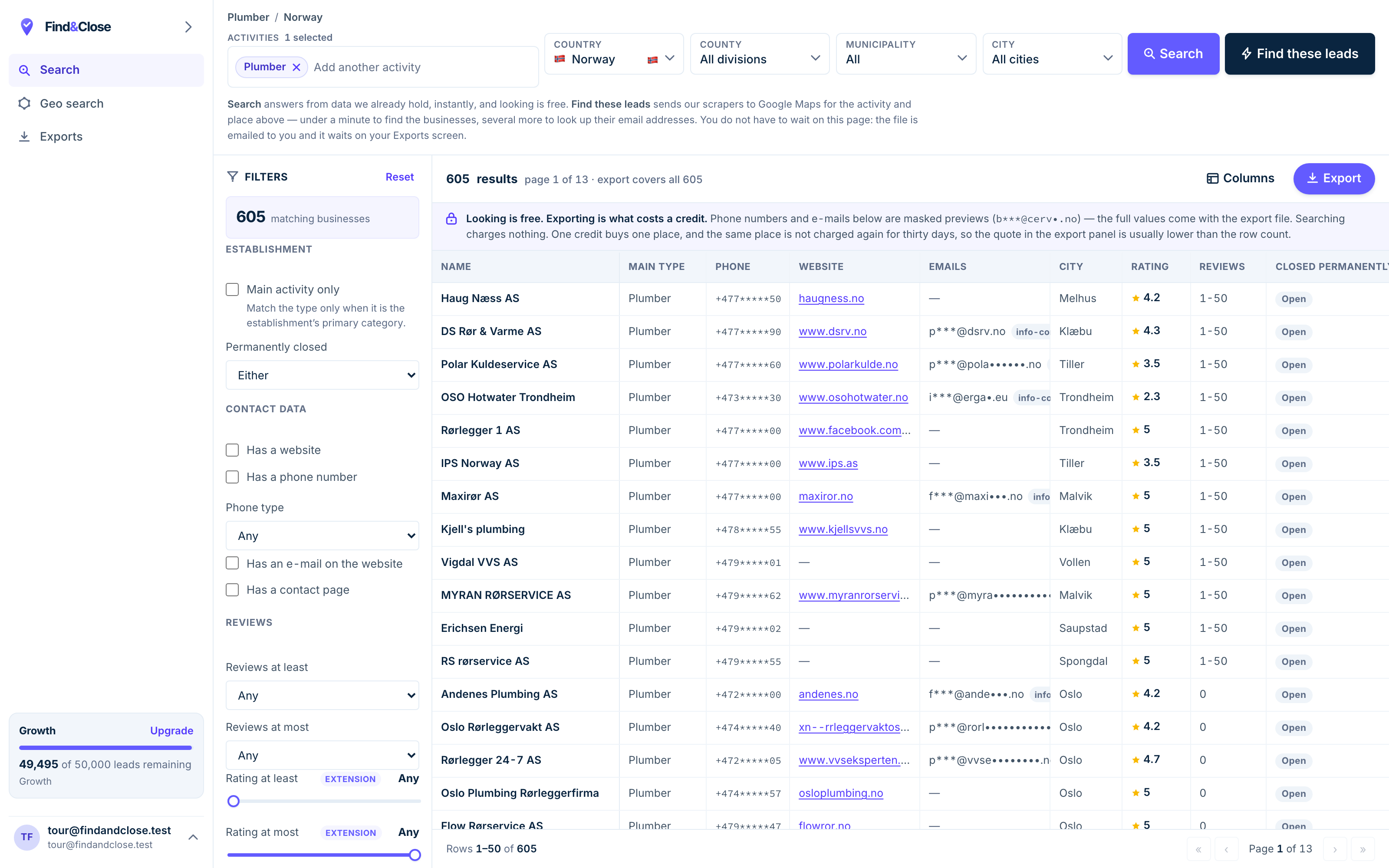
- Pick the trade Type it and take the match. One trade or twenty, on every plan.
- Pick the place Country, county, municipality, city. No plan gates the geography.
- The count moves first The number updates before you spend anything. Looking is free.
- Filter to the ones worth calling Has email, has phone, has a website, has a contact page. Combine them freely.
- Contacts are masked until export You can see a row exists and judge it. The address itself is the product.
- Export what you are looking at The file is exactly this filter set, with nothing dropped in between.
The front desk is a wall with a shift pattern
The address on the listing exists to take guest questions. That shapes everything.
Write to a hotel and a receptionist reads it, between a check-in and a lost-key call. They are trained to protect the manager from exactly your message.
That is not rudeness. Guest traffic drowns everything else, and your pitch sits in the same inbox as tonight's cancellations.
- The published address is a guest-service channel, staffed in shifts.
- The reader changes by the hour, so a thread has no memory.
- Anything longer than a glance gets parked, and parked means gone.
So the first email to a hotel has one honest job: get a name. Ask who looks after the thing you sell, and make that question easy to answer.
Treat reception as a colleague, not an obstacle. A receptionist forwards a short, polite, specific note all the time. They delete pitches addressed to Dear Manager on sight.
Who signs: the desk, the GM, or a revenue manager
A hotel is two different buyers wearing one building.
The independent
At a family-run or independent hotel, the general manager is the whole buying committee. Rooms, rates, breakfast supplier, booking engine — one person, one signature.
That person walks the building all day. They behave like the restaurant owner next door: reachable in the quiet hours, allergic to long email.
The chain property
At a chain, the money decisions split. A revenue manager owns pricing and channels. Procurement at head office owns suppliers. The property manager owns the staff rota and not much budget.
A pitch to a chain property often dies at the desk because the desk knows the decision lives elsewhere. Find the head office and pitch there, or find the one budget the property still controls.
A Maps listing does not tell you which kind you have. The name sometimes does — a brand you recognise is a chain, a family name is a clue the other way. Sort the file by name before you write, and split the campaign in two.
The season decides when anyone reads you
Hotels do not have a busy hour. They have a busy half-year.
In high season the building runs flat out. Nobody evaluates a new tool while every room is turning. A pitch in peak weeks is not rejected. It is never seen.
The window is the shoulder. The weeks after the rush, when occupancy drops and next season's planning starts. That is when a GM has an afternoon to think, and when this year's annoyances are fresh enough to fix.
- Pitch after the season, not before it. Before, they are staffing up. After, they are fixing what broke.
- Nordic seasons cut both ways. Coastal and city houses peak in summer; ski and northern-lights houses peak in winter. One country, two calendars.
- Budgets follow the season too. The buying decision lands in the quiet months, whichever months those are for that house.
This is the biggest practical difference from other local trades. A plumber can say yes any Tuesday. A hotel says yes in its own November, and you have to know which November that is.
A cadence for the shoulder weeks
Written for a supplier or tool vendor pitching independent hotels. Time the whole thing to land after their peak, not before. You run this in your own sending tool — we do not send email.
-
Subject who looks after [the thing you sell]?
Hi — quick question from a supplier, not a guest.
I help hotels with [your offer, one plain line]. Who at [hotel name] looks after that side?
A name is all I need. And if this is unwelcome, reply stop and I will not write again.
The first email asks reception for a name, which is a question they can answer in five words. Pitching the desk wastes the send.
-
Call between eleven in the morning and two in the afternoon. Checkout is done and check-in has not started, so the desk has slack.
Say you wrote on Monday and ask for the person by role: the manager, or whoever buys [your category].
If you get a name and a no, keep the name. Roles at hotels change with the season.
The late-morning lull is the desk's one quiet stretch. A caller who knows that gets treated as someone who knows hotels.
-
Subject for [name] — after the season
Hi [name] — [reception colleague] pointed me your way.
One idea for the quiet months: [one line, tied to their shoulder season].
Fifteen minutes some morning this month? If the timing is wrong, say next season and I will hold it.
Now the message is addressed to a person, carries a referral from their own desk, and offers a season-shaped out instead of a hard no.
-
Subject parking this until [season]
I will stop here and come back when your quiet season starts, unless you tell me not to.
Reply stop and I will not return at all. Otherwise — good luck with the rush.
A hotel no is often a calendar no. The close names the next window and still hands them a real opt-out.
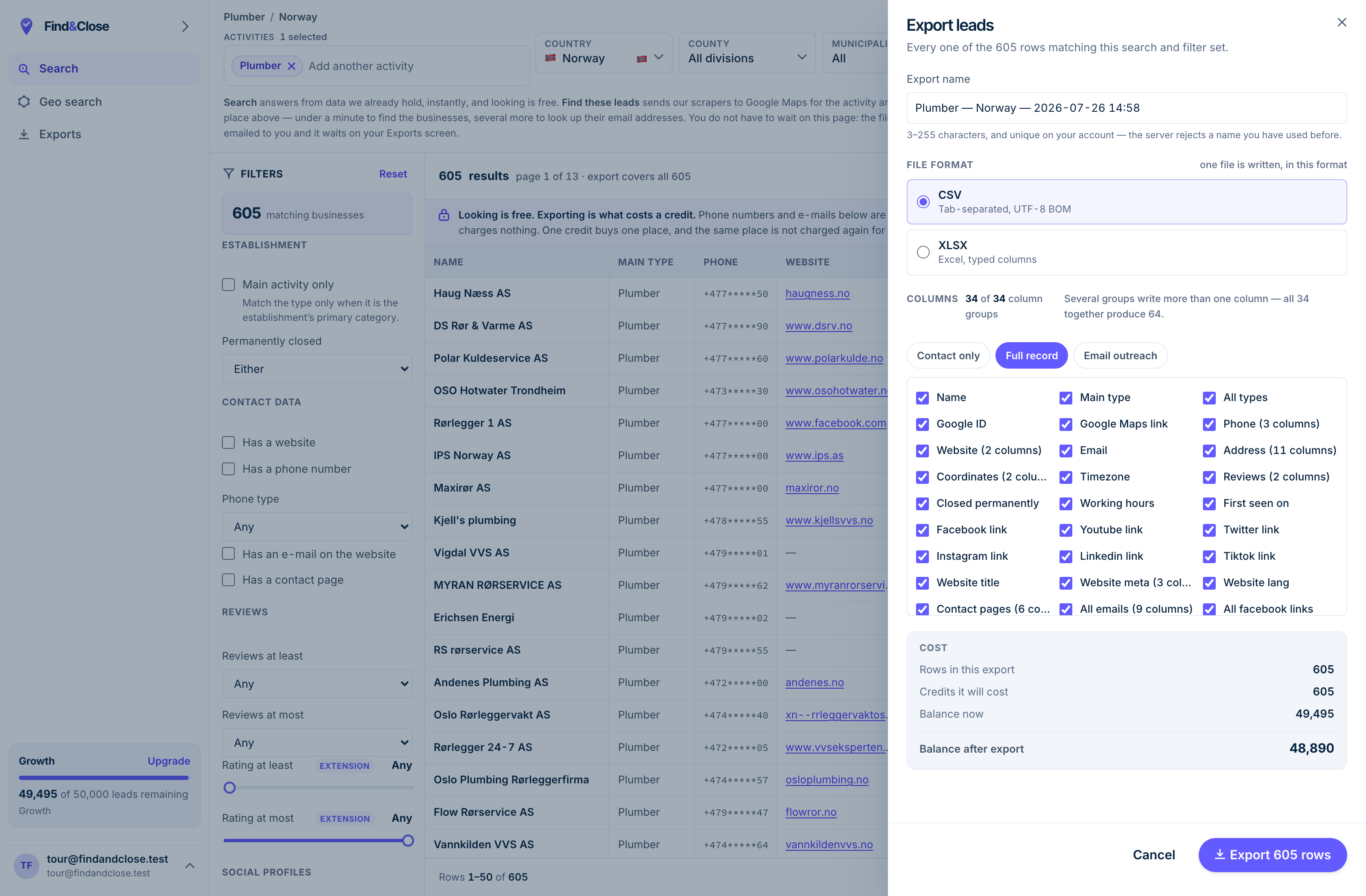
- It exports the whole result Every row the filter matched, not the page you happen to be looking at.
- CSV or XLSX Tab-separated UTF-8, or typed Excel columns. One file per job.
- 34 groups, 64 columns The same 64 on every plan. Nothing is held back for a higher tier.
- Three presets Contact only, full record, or the outreach set. Or tick your own.
- The cost, before you commit One credit per place, once per 30 days. Re-downloading is free.
What our Nordic file gives a hotel campaign today
No hotel counts. Here is what we can put real numbers on.
Our country coverage, counted across the trades we track on 26 July 2026: Norway holds 9,632 records with 38% carrying an email. Sweden holds 6,404 at 19%, Denmark 3,927 at 17%, Finland 3,883 at 16%.
Read those as a coverage climate, not as hotel figures. They tell you what an honest Nordic crawl finds when it reads real listings and real contact pages, trade by trade.
For hotels, the app search works today: pick the hotel category, pick a country or a region, and export the standard 64 columns. What you will not find is a published FindAndClose hotel count to quote — not until hotels join the tracked set and earn a dated number.
The four country hubs below list every trade we do publish, per country, with the counts on the page.
Hotel outreach, asked and answered
Who reads the address on a hotel's Maps listing?
Whoever is on the front desk that hour. It is a guest-service inbox, staffed in shifts, and your pitch shares it with tonight's booking questions.
Use it to ask for a name, not to sell. A five-word question survives a shift change. A pitch does not.
Should I pitch chain hotels at the property or at head office?
Depends what you sell. Pricing, channels and suppliers sit with revenue management or procurement at the top. The property keeps small local budgets.
If your offer needs a signature above the building, the property visit is research, not sales. Get the org right before you spend the sequence.
Do you publish hotel counts for the Nordics?
No. We publish dated counts for 27 tracked trades, and hotels are not in that set yet. We would rather show no number than an invented one.
You can still search the hotel category in the app on any plan and export what is there.
When in the year should I contact a hotel?
In its shoulder season — the weeks right after its peak. That is when managers have time and this season's problems are fresh.
Mind the two Nordic calendars. Summer houses go quiet in autumn; ski and northern-lights houses go quiet in spring. Same country, opposite windows.
Is emailing hotels different under the GDPR?
The rules are the same as for any business: a lawful basis, a named sender, the data source stated, and an opt-out in the first message.
Hotels are mostly limited companies, which simplifies one part of the analysis in some countries. The GDPR guide walks through it. It is not legal advice.
The country files behind this page
We have no hotel pages yet, so start from the country hubs and the method guides.
- Local business leads in Norway Every Norwegian trade we publish
- Local business leads in Sweden Every Swedish trade we publish
- Local business leads in Denmark Every Danish trade we publish
- Local business leads in Finland Every Finnish trade we publish
- Cold email local businesses Subject lines, length, a full sequence
- Build a local business email list Where the addresses really live
Search the hotel category on live Nordic data
Fourteen days, 100 leads, no card. Pick a country, pull the rows, and judge the coverage yourself before anyone pays anything.
- 14-day free trial
- 100 leads included
- No credit card