Email list · Mental health services
Mental health service email list
The same map label hides three kinds of organisation. A private clinic, a charity and a public unit each hold the budget in a different place. Sort them first, or waste the send.
Covers Norway, Sweden, Denmark and FinlandNo live count for this sector yet — the reason is on the pageFor training, software and clinical-supply sellers
Coverage first, and why this is not one market
Say the scope out loud, then say the harder truth: this label is a mixed bag.
FindAndClose builds local business lists from Google Maps. We cover four countries: Norway, Sweden, Denmark and Finland.
If you sell into the Nordics, this is live data from our own crawl. If you need a US or global list, we are the wrong shop. A worldwide scraper such as Outscraper fits that job.
Now the honest part. "Mental health service" is not a tracked trade in our file, so this page carries no count. We publish live counts only where the tracked file backs them, and we will not dress a guess up as one.
There is a second reason we hold back a number here. The label covers organisations that share almost nothing. A private therapy clinic, a suicide-prevention charity and a public outpatient unit all file under it. One count across the three would tell you nothing useful.
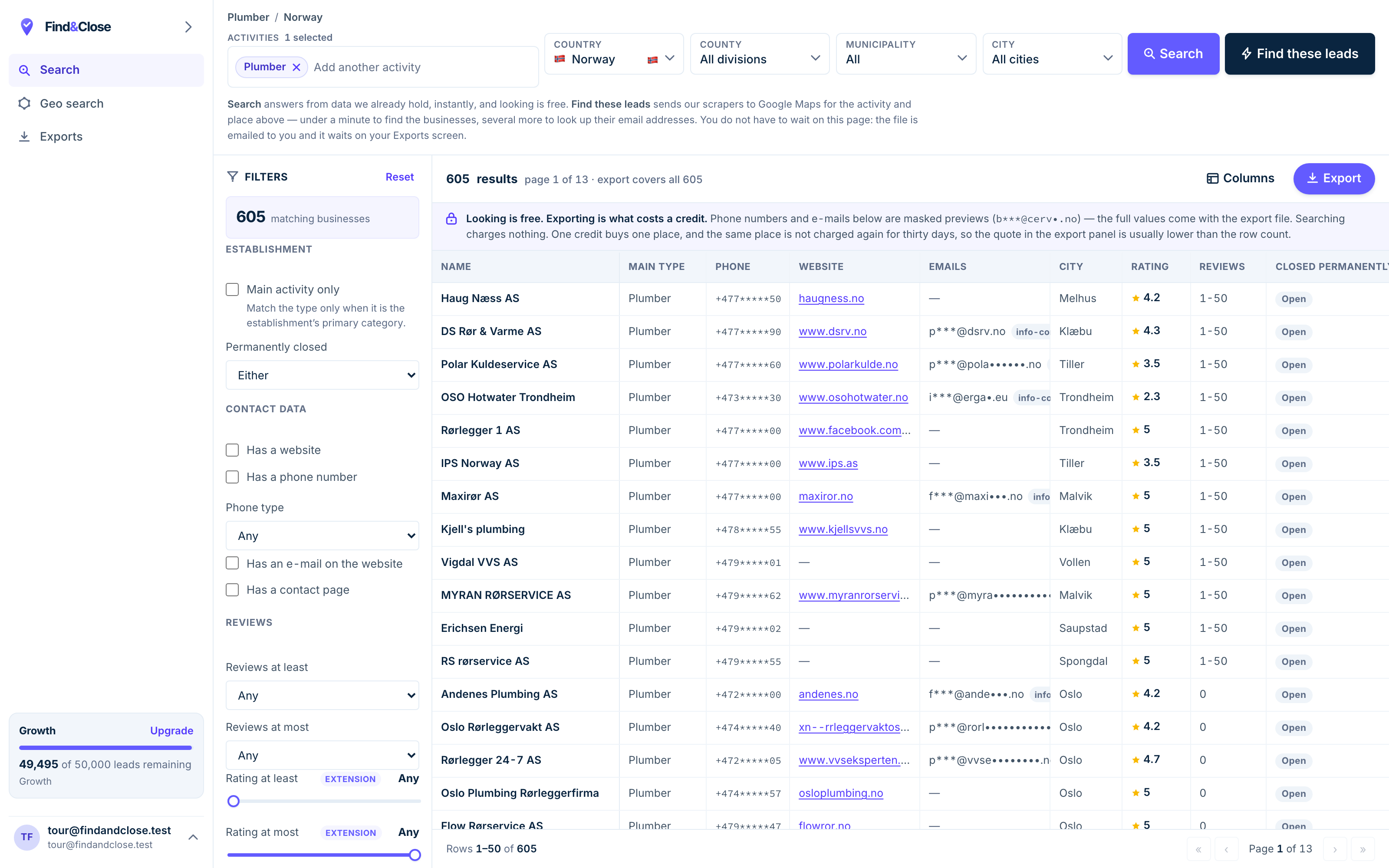
- Pick the trade Type it and take the match. One trade or twenty, on every plan.
- Pick the place Country, county, municipality, city. No plan gates the geography.
- The count moves first The number updates before you spend anything. Looking is free.
- Filter to the ones worth calling Has email, has phone, has a website, has a contact page. Combine them freely.
- Contacts are masked until export You can see a row exists and judge it. The address itself is the product.
- Export what you are looking at The file is exactly this filter set, with nothing dropped in between.
Three organisations wear the same label
Before you write a word, learn to tell the three apart. They do not overlap.
The first is the private clinic. A psychologist or a small group runs it. The owner is the clinician and the buyer at once, so a decision can happen in a week.
The second is the charity or NGO. A helpline, a peer-support group, a grant-funded project. A board signs off spending, and the money arrives in cycles tied to grants.
The third is the public unit. A municipal service, a hospital outpatient team, a school counselling office. Nobody there buys on a whim. Spending runs through tenders and frameworks.
- Private clinic: one owner, fast decision, real budget of its own.
- Charity: a board, a grant calendar, and a hard eye on every krona.
- Public unit: procurement rules, long cycles, and no personal budget.
These are three different sales. Pretend they are one, and your message fits none of them.
Who actually holds the budget
The map row shows a door. It does not show who signs the cheque behind it.
For the private clinic, the owner signs. Write to the practice inbox and the owner reads it between clients. This is the one segment where cold email behaves like it does for any small clinic.
For the charity, the reader is rarely the buyer. A coordinator opens the inbox, and a board or a manager decides. Your message has to survive being forwarded and explained by someone else.
For the public unit, the inbox on the listing is almost never the buyer. Real spending sits with a procurement desk you cannot see from Maps. A cold pitch to the clinical inbox goes nowhere.
So a mental-health file is only as good as your sorting. If your offer needs a named buyer inside a public body, read how to find business email addresses before you spend a credit. The Maps inbox will not get you there alone.
Sort the file before you send
Ten minutes of reading rows saves a whole campaign aimed at the wrong reader.
You cannot filter by funding model. Maps does not carry the field, and we will not fake one. But the rows tell you more than you think.
- Read the name. A personal name or "clinic" points to private practice. "Foundation", "association" or a cause word points to a charity. A place or council name points to a public unit.
- Check the website. A donate button marks a charity. A booking page and prices mark a private clinic. A government domain marks a public body.
- Split into three lists. Write a different message to each. The private list gets a direct owner pitch. The charity and public lists get a slower, named-contact approach.
- Verify before any send. Bounces hurt your domain. The list building guide covers verification and shared inboxes.
The private slice is where a cold campaign pays off soonest. Start there, learn the objections, then take the harder segments on with a warmer approach.
A cadence for the private-clinic slice
Written for a seller of software, training or clinical supervision. The buyer is a private mental-health clinic — one owner, one decision. Run it in your own tool. We build the list and send nothing.
-
Subject a question for [clinic name]
Hi. I found [clinic name] on Google Maps — [one real detail, like your booking page or your waitlist note].
I work with private therapy clinics on [your offer in one plain line]. It costs you no client time to look.
Worth two examples? If not, reply stop and I will not write again.
A private clinic inbox is read by the owner between sessions. One real detail proves a person looked. The opt-out sits in plain words, in the body.
-
Subject the confidentiality question, up front
A quick note on the thing every clinic asks: [one line on how your offer handles client data].
No client records touch our side. Here is the one-page detail: [link].
If it is not for you, reply stop and I will close the file.
This trade lives on confidentiality. Naming it before they ask removes the objection that quietly kills most software pitches to clinicians.
-
Subject what it costs, in one screen
The whole offer in one place, price included: [link].
Two clinics that use it, with what changed: [link].
A no is a fine answer. Reply stop and I will stop.
An owner-clinician has no admin hour to chase a price. Publishing it removes the main reason a small clinic stalls.
-
Subject closing your file
No reply needed — I will close your file today.
If it becomes useful later, my details are below. All the best with the practice.
The breakup costs nothing to answer and ends the thread with your name intact. In a small professional world, that matters more than one more pitch.
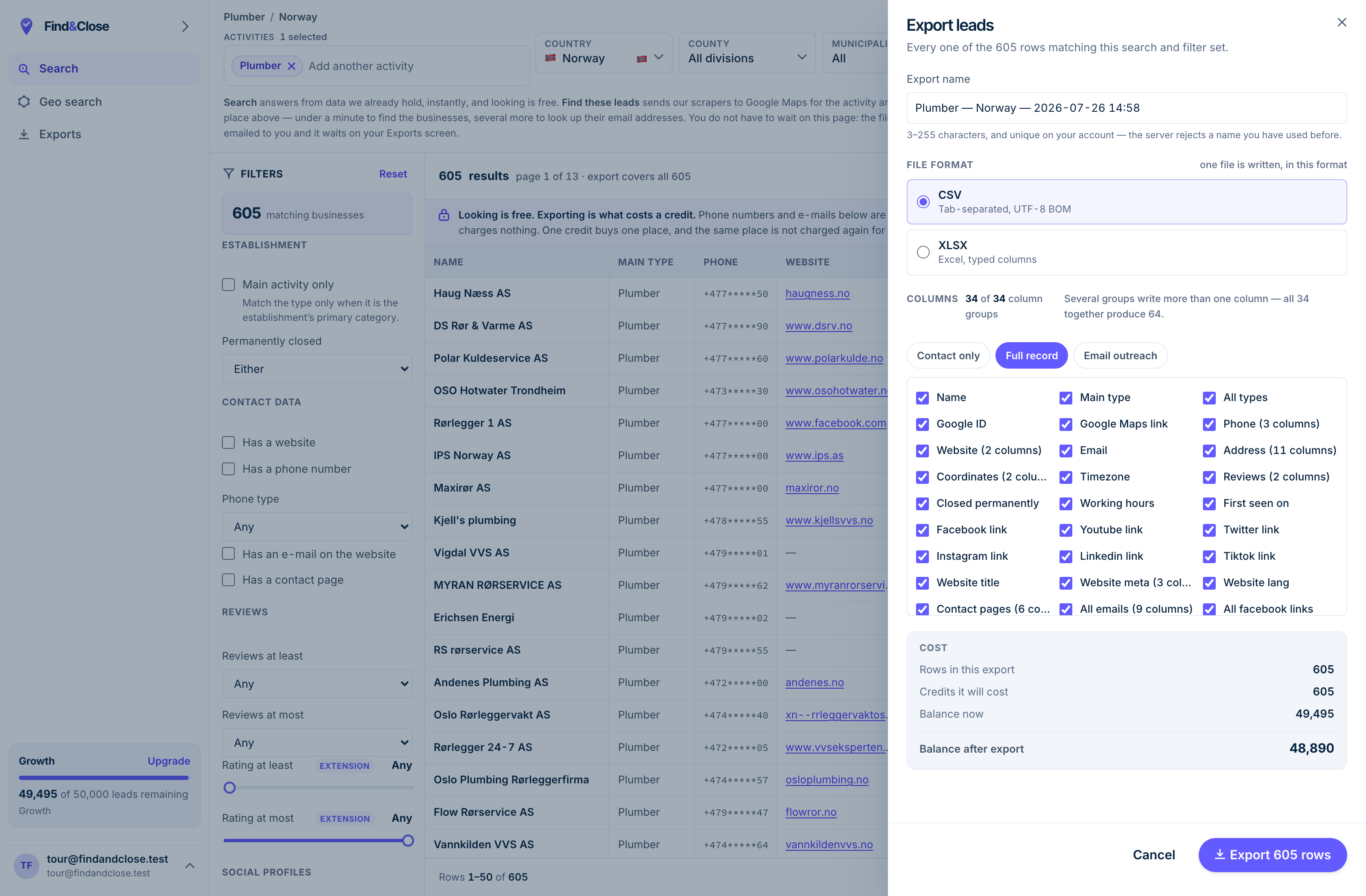
- It exports the whole result Every row the filter matched, not the page you happen to be looking at.
- CSV or XLSX Tab-separated UTF-8, or typed Excel columns. One file per job.
- 34 groups, 64 columns The same 64 on every plan. Nothing is held back for a higher tier.
- Three presets Contact only, full record, or the outreach set. Or tick your own.
- The cost, before you commit One credit per place, once per 30 days. Re-downloading is free.
Questions about mental health service lists
Why is there no count on this page?
Because "mental health service" is not a tracked trade in our file, and we publish counts only where the file backs them.
A single count would also mislead. The label covers private clinics, charities and public units at once, and they share almost nothing.
Which of the three is worth cold outreach?
The private clinic first. The owner is the buyer and the reader, so a clear one-line offer can land in a week.
Charities and public units are slower and need a named contact. The Maps inbox rarely reaches the person who signs.
How do I tell a charity from a clinic in the export?
Read the name and the website. A donate button and words like "foundation" or "association" mark a charity. A booking page and prices mark a private clinic.
It takes minutes by hand for a shortlist. We do not publish a funding-model column, because Maps does not carry one.
Is cold email to a therapy clinic legal in the Nordics?
B2B outreach in the EU and EEA usually rests on legitimate interest under the GDPR. Say who you are, where you got the data, and offer an opt-out in the first line.
Handle any hint of client data with extra care. Our GDPR guide walks through it. It is not legal advice.
Can I reach a public mental-health unit through this list?
You can reach its clinical inbox, but that is rarely the buyer. Public spending runs through a procurement desk you cannot see from Maps.
Use the list to find the units, then do the named-contact work by hand. Finding the right email is the next read.
Go deeper
The neighbour clinician trades, the country hubs, and the guides for a mixed-buyer sector.
- Psychologist email list The individual clinicians behind many of these services
- Counselor email list The neighbour trade, same care sector
- Local business leads in Norway Every tracked trade, one country
- Find business email addresses Reaching a named person inside a body
- GDPR and B2B cold email The rules before you press send
Pull the sector, then sort it into three
Fourteen days, 100 leads, no card. Enough to split private clinics from charities and public units in one country before you write a line.
- 14-day free trial
- 100 leads included
- No credit card