Guide · Trucking companies
Trucking company email list: reach the dispatch office
The driver is on the road. The office books the loads, and it runs on written orders. That one split makes haulage an email trade, and this page shows how to work it.
Covers Norway, Sweden, Denmark and FinlandNo invented trucking counts — the trade is not tracked yetA supplier cadence built for the dispatch desk
The office behind the wheel
A trucking firm is two jobs. One is the driver on the road. The other is the desk that keeps the driver loaded.
The driver cannot buy from you. They are in the cab, on a schedule, with both hands on the job. The dispatch office is the buyer, and the dispatch office sits at a desk.
That desk runs on writing. Loads are booked in email. Rates are agreed in email. The proof of delivery, the invoice, the next job — all written, all filed. Freight is a paper trade wearing a diesel coat.
So the inbox is a work tool here, not an afterthought. That is the opposite of a one-van plumber, whose email is the admin pile they open on Sunday night. Dispatch reads email all day, because email is the job.
- The driver moves the freight. The office sells the space and books the return load.
- A cold call reaches a desk that is mid-booking. A written note waits for the gap between loads.
- Load boards, rate confirmations and delivery notes already train the desk to act on email.
- A clear one-line offer forwards in a click, from dispatcher to owner.
Scope first, so nobody buys the wrong thing. FindAndClose builds lists from Google Maps. We cover four countries — Norway, Sweden, Denmark and Finland. For US carriers or a worldwide haulage list, a global scraper like Outscraper is the right tool. We would rather say so than take your money.
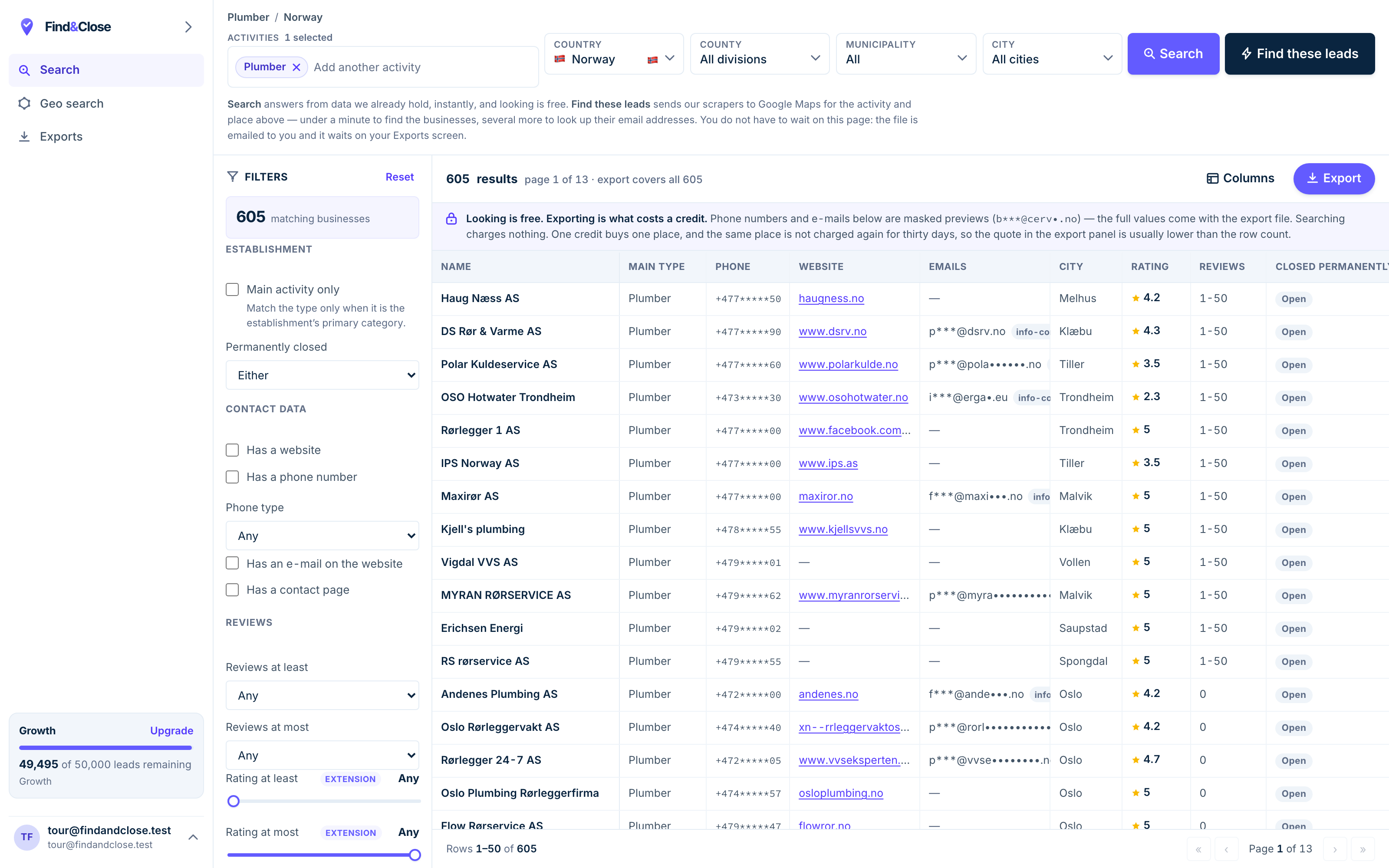
- Pick the trade Type it and take the match. One trade or twenty, on every plan.
- Pick the place Country, county, municipality, city. No plan gates the geography.
- The count moves first The number updates before you spend anything. Looking is free.
- Filter to the ones worth calling Has email, has phone, has a website, has a contact page. Combine them freely.
- Contacts are masked until export You can see a row exists and judge it. The address itself is the product.
- Export what you are looking at The file is exactly this filter set, with nothing dropped in between.
What a haulier actually buys
Read the cost sheet of a fleet and the pitches write themselves. Two lines dwarf everything else, and both recur every month.
Fuel is the first. A fleet burns diesel every day it rolls, so anything that trims the fuel bill has a listener at the desk. Fuel cards, route planning, fill-station deals — the office runs the numbers on these itself.
The trucks are the second. Vehicles, trailers, tyres, parts and the workshop time behind them. A fleet replaces and repairs on a rolling cycle, and the buyer plans those spends months ahead.
Around those two sit a ring of steady needs.
- Fleet software: telematics, tracking, a transport management system to plan the loads.
- Compliance: tachograph handling, driver hours, road-tax and permit admin.
- Insurance and finance: cover on the fleet, leasing on the next truck.
- People: drivers are scarce, so recruiters have a standing market here.
Match your offer to one of those lines and the desk knows why you wrote. Pitch “a quick chat about our platform” and you join the pile of mail dispatch never opens.
One habit sharpens the list. Sort by review count and fleet size cues before you write. A firm with a yard full of trucks has a buyer who plans spend. A single owner-driver is a different sale, closer to a sole trader — the GDPR guide covers why that legal line matters.
Their customers are businesses, and so are you
Freight is B2B by nature. A haulier sells space to shippers, factories and shops. That shapes how they hear a seller.
A haulage firm does not market to the public. It wins contracts from other businesses. A factory ships pallets. A retailer needs stock moved. A builder needs gravel on site.
So the desk speaks the language of contracts, rates and lead times all day. A vendor who does the same reads as a peer. A vendor who pitches like a consumer advert reads as noise.
This also sets the rhythm of the year. Freight swells before the retail peak, when shops stock up for Christmas, and eases in the deep of winter. The desk is busiest when the roads are busiest.
Time your send to the quiet weeks, not the peak. A dispatcher drowning in pre-Christmas loads deletes first and reads never. January and midsummer are calmer, and a planned purchase gets thought about then.
If you sell company data rather than local listings — named buyers at a shipper, say — a Maps file is the wrong shape. Our list gives you the haulier as Maps sees it: name, area, phone, and an email where the firm publishes one.
Why there is no live trucking count here
We publish counts only for the trades our crawl tracks. Trucking is not one of them yet, so this page carries no number for it.
Our page set tracks 27 trades across the four countries. Haulage is not in that set today, and we will not dress a guess up as a figure. A fabricated count is how this whole page type earns a spam penalty.
What we can give you is the ground the trade stands on.
- Our four countries hold 44,684 local business records in total.
- Phone coverage runs far ahead of email in every trade we track.
- Email coverage across the tracked trades: Norway 38%, Sweden 19%, Denmark 17%, Finland 16%.
Trucking has a reason to sit at the upper end of those email rates. It is a deskbound, B2B trade that already trades by written order, so more firms publish a working address than a phone-only van trade does. That is a reasoned expectation, not a measured count, and we mark it as such.
You do not have to wait for us to track it. The app searches Maps categories beyond our page set, haulage included. Pick the category, pick a country, and the live count shows before you spend a credit. The Maps lead-generation guide walks the steps.
A supplier cadence for the dispatch desk
Written for someone selling fuel cards, fleet software or parts to hauliers. Lead with the cost line you cut. Run it in your own tool — we build the list and send nothing.
-
Subject the fuel line at [firm name]
Hi. I found [firm name] on Google Maps — [one real detail, like your fleet size or the routes you run].
I help hauliers cut [the exact cost line, e.g. fuel or tyres]. It takes nothing off the road to look at.
Want the one-page numbers? If not, reply stop and I will not write again.
The desk reads email between loads. Naming a cost line the office already tracks proves you know the trade, and it forwards to the owner in one click.
-
Call mid-morning, once the day’s loads are dispatched and before the afternoon returns.
Give the desk an errand, not a pitch: “I emailed Monday about [cost line] — who runs the numbers on that?”
If the desk is booking a load, you will hear it. Say “I will try tomorrow” and go. They will remember the seller who read the room.
Dispatch screens sellers but routes errands. Naming your own email turns a cold call into a follow-up, and follow-ups get passed on.
-
Subject the numbers, with the price
The one page I mentioned: what you pay now against what this would cost.
The price is on there, so nobody has to ask for it.
If the timing is wrong, reply stop and I will close the file.
A dispatcher decides between bookings, in stolen minutes. Everything they need has to sit in one email, price and all, or the decision waits forever.
-
Subject closing your file
No reply needed — I will stop writing and close your file today.
If diesel jumps or a supplier lets you down, my number is below. Safe roads.
Fleets switch suppliers on a bad week, not a good pitch. The breakup leaves your number where the desk will look when that week comes.
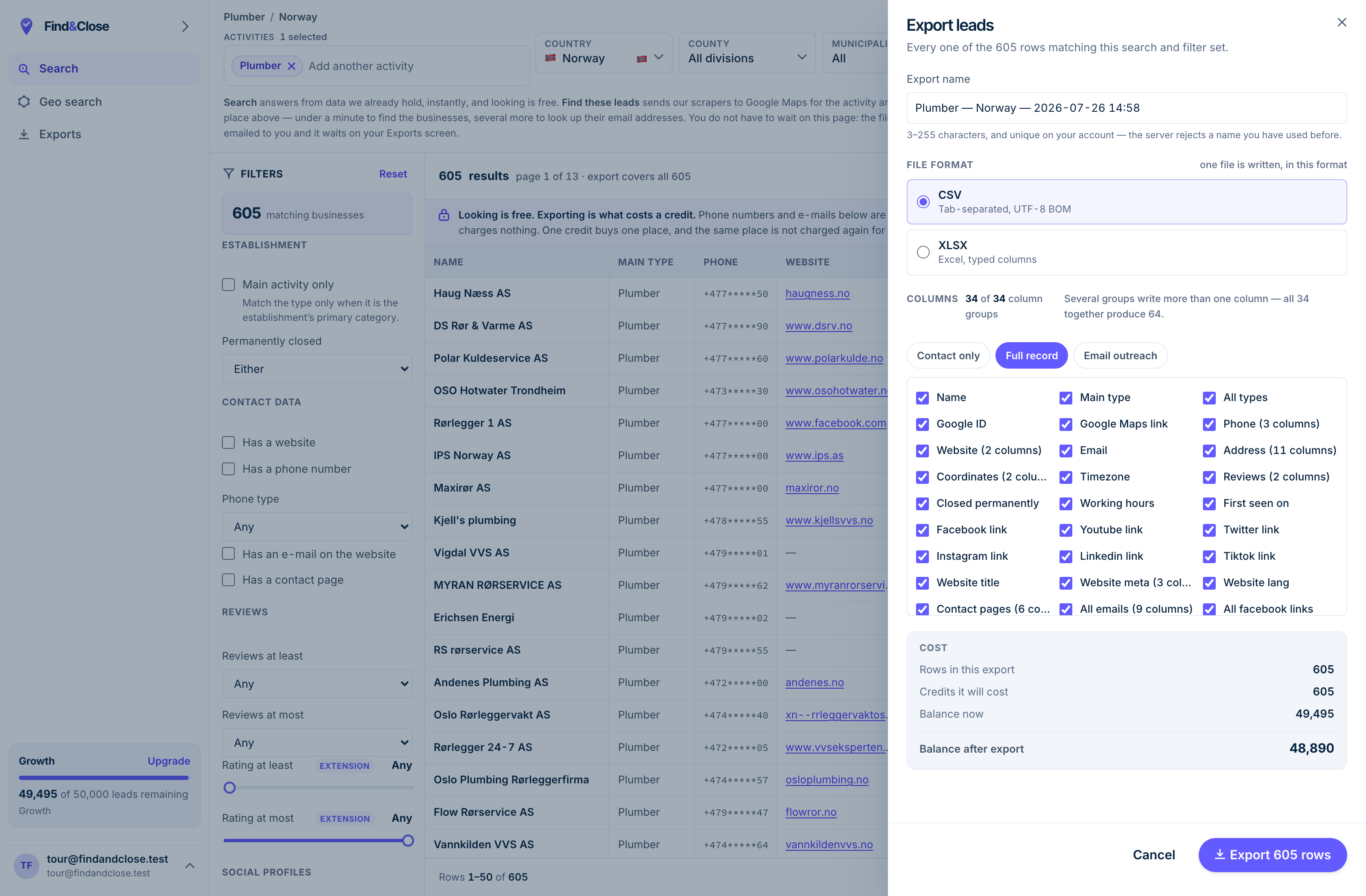
- It exports the whole result Every row the filter matched, not the page you happen to be looking at.
- CSV or XLSX Tab-separated UTF-8, or typed Excel columns. One file per job.
- 34 groups, 64 columns The same 64 on every plan. Nothing is held back for a higher tier.
- Three presets Contact only, full record, or the outreach set. Or tick your own.
- The cost, before you commit One credit per place, once per 30 days. Re-downloading is free.
Questions about trucking company lists
Does the email reach a driver or the office?
The office. The address on a haulage listing is the dispatch or admin inbox, not a cab. The driver is on the road and cannot buy from you.
That is good news. Dispatch reads email as part of the job, because loads and rates already move that way.
Why is there no live count for trucking?
Because our tracked page set covers 27 trades, and haulage is not one of them yet. Every count we publish comes from that file, dated, and we do not pad the gaps.
The category is still searchable in the app. Pick it, pick a country, and the count shows before you export a row.
Who buys a trucking company email list?
Fuel-card firms, fleet-software vendors and parts suppliers. Insurers, leasing firms and driver recruiters.
All of them sell to the desk that runs the fleet. Lead with the cost line you cut, and the desk knows why you wrote.
Is an owner-driver a business or a consumer under the rules?
It depends on the country and how the firm is set up. Some national rules treat a sole-trader driver like a consumer for marketing email.
You cannot read the legal form off a Maps pin, so treat every row with consumer-grade care. Our GDPR guide walks through it. It is not legal advice.
When should I contact a haulage firm?
Avoid the pre-Christmas freight peak, when the desk is buried in loads. January and midsummer are calmer.
A planned spend — fuel, software, the next truck — gets thought about in the quiet weeks, not the busy ones.
Go deeper
The country hubs, a neighbour trade that hires hauliers, and the guides for the campaign.
- Construction company email list Their biggest freight customer, next door
- Local business leads in Norway The country hub and its live counts
- Local business leads in Sweden The country hub and its tracked trades
- Google Maps lead generation How the whole pipeline works
- GDPR and B2B cold email Legitimate interest and the opt-out duty
Search the haulage category and watch the count
Fourteen days, 100 leads, no card. Pick the category, pick a country, and see the real number before you plan a single send.
- 14-day free trial
- 100 leads included
- No credit card