Email list · Construction
Construction company email list
Every site has one firm that won the job and ten that build it. Decide which of the two you are writing to before you pull a row.
Covers Norway, Sweden, Denmark and FinlandCounted from a live Maps crawlHonest about what one category hides
Main contractor or subcontractor: pick your reader
Construction is a chain, not a category. Your email lands in a different world at each end of it.
Coverage first, so nobody wastes a minute. We cover Norway, Sweden, Denmark and Finland. For US or worldwide construction lists, Outscraper suits a one-off export better than we do.
Now the chain. A main contractor wins the job, carries the contract and hires the rest. A subcontractor does one trade on someone else’s site.
- The main contractor has an office, an estimator and a shared inbox that gets read.
- The sub has a van, a phone and an inbox that waits for the weekend.
- The main contractor buys on tender cycles and supplier terms.
- The sub buys when something breaks, wears out or wins them the next job.
Most construction lists flatten that chain into one column. Then the campaign treats a two-hundred-person contractor and a two-man firm as the same reader, and both delete it.
Split the file before you write a word. Office firms get email. Van firms get a call. The split is the strategy; the copy is just what is left.
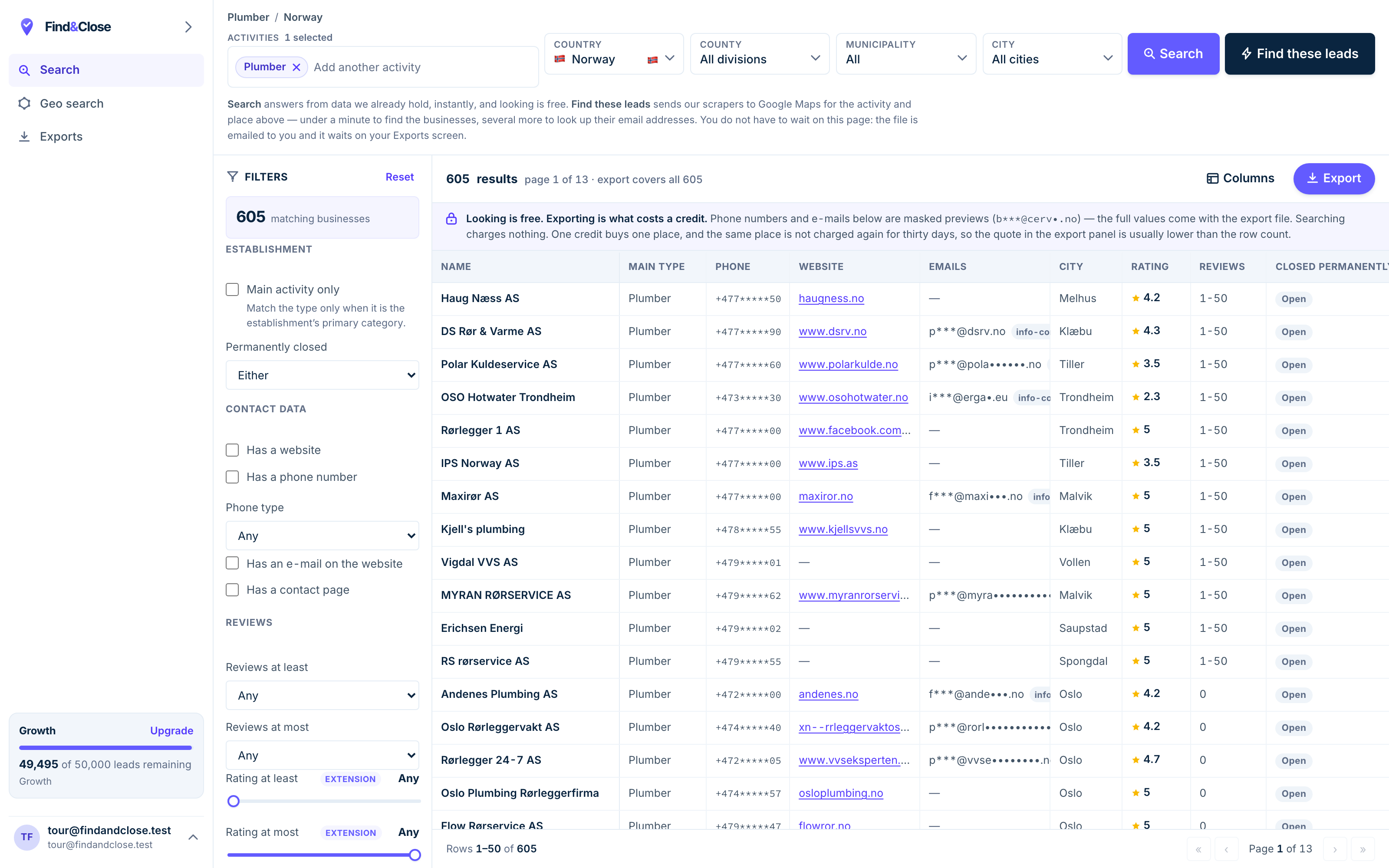
- Pick the trade Type it and take the match. One trade or twenty, on every plan.
- Pick the place Country, county, municipality, city. No plan gates the geography.
- The count moves first The number updates before you spend anything. Looking is free.
- Filter to the ones worth calling Has email, has phone, has a website, has a contact page. Combine them freely.
- Contacts are masked until export You can see a row exists and judge it. The address itself is the product.
- Export what you are looking at The file is exactly this filter set, with nothing dropped in between.
Tender season is when estimators read strangers
For a few weeks around a bid, a main contractor’s office opens mail it would ignore all year.
Public building work in the Nordics runs through open tenders. When one drops, the estimator has to price the whole job in weeks.
That means finding subcontractors, chasing quotes, and checking prices on every material line. During that window, an unknown sender with a relevant price is not spam. It is help.
The rest of the year, the same inbox is a wall. The job list is set, the suppliers are chosen, and your email is a favour they do not owe you.
- Watch the public tender portals for the regions you sell into.
- When a firm bids, its office is pricing. That is your week, not the award date.
- After the award, the winner buys for real. The losers go quiet until the next one.
We do not publish tender dates — they are public, and they change. The habit of watching them is the advantage, and it costs you nothing.
One category on the map, many trades in the file
Google Maps calls it all construction. Our database counts it trade by trade, and the trades disagree with each other.
A “construction company” listing might be a national contractor or a bricklayer with a nephew. The category tells you almost nothing. The trades underneath it tell you a lot.
Take carpenters, the backbone trade of Nordic building, counted on 26 July 2026:
- Norway: 565 carpenters on file. 170 publish an email — 30%.
- Denmark: 379 carpenters. 29 publish an email — 8%.
Same trade, two borders, and the email rate falls off a cliff. We can count that gap; we will not pretend to explain it.
Phone coverage holds up in both countries. 98% of Norwegian carpenters and 94% of Danish ones show a number. The van answers even where the inbox does not exist.
Both carpenter files have their own pages: carpenters in Norway and carpenters in Denmark. The whole four-country database holds 44,684 records, and every count carries its date.
If you want the raw Maps route instead of a counted file, the Google Maps scraper page covers that path and its limits.
Write to the desk, ring the van
The channel is not a preference. It is set by who in the chain you picked.
Selling to main contractors? Email works, but aim it. A message to the shared inbox should name the estimator’s problem: price, capacity, or a deadline you can protect.
Selling to subcontractors? Phone first. The owner prices jobs at night and answers the phone at the merchant’s counter in the morning.
- Sort the file by review count and website. A firm with a staff page and project photos is an office firm. A bare listing with a mobile number is a van firm.
- Send email only to the office half. The van half becomes your call list. Mixing them wrecks both campaigns.
- Lead with the project, not the product. Construction people think in jobs. Name the kind of job you help with, and the size of firm you fit.
- Follow the season of your region. Ground freezes, sites pause, offices plan. The planning pause is a reading pause too.
The wider playbook for turning rows into meetings is in the Maps lead generation guide. This page only adds what is specific to building firms.
A cadence timed to the tender window
Written for a subcontractor introducing the firm to main contractors before bids go in. We do not send email — run it in your own tool.
-
Subject capacity for [region] this year
Hi [name]. We are [firm], a [trade] subcontractor working around [region].
We have capacity from [month], with [crew size] on the tools and our own kit. References from [two recent jobs] on request.
If you price work in [region], may I send our rate card? Reply stop and I will not write again.
An estimator hoards reliable subs the way others hoard leads. Capacity plus a start month is the whole pitch, and the opt-out is in plain words.
-
Ring the office, not the site. Ask for whoever prices tenders.
One question: what do they wish their current [trade] subs did better?
Take the answer down word for word. It is next month’s subject line.
Offices answer office phones. The question flatters no one and tells you the exact gap you are being hired to fill.
-
Subject rates and two references
Rate card attached as one page, plus contacts at [two firms] we sub for now.
We hold our dates. If a bid needs a number from us, it is there in 48 hours.
Not the right fit? Reply stop and I will close the file.
Estimators buy certainty, not talent. A held date and a fast quote are worth more than any project photo.
-
Subject closing your file
No reply needed — I will stop writing and leave you to the season.
If a bid ever needs [trade] capacity in [region], my number is below.
The breakup keeps the door open for the one moment that matters: the week a bid is short one sub. That week always comes.
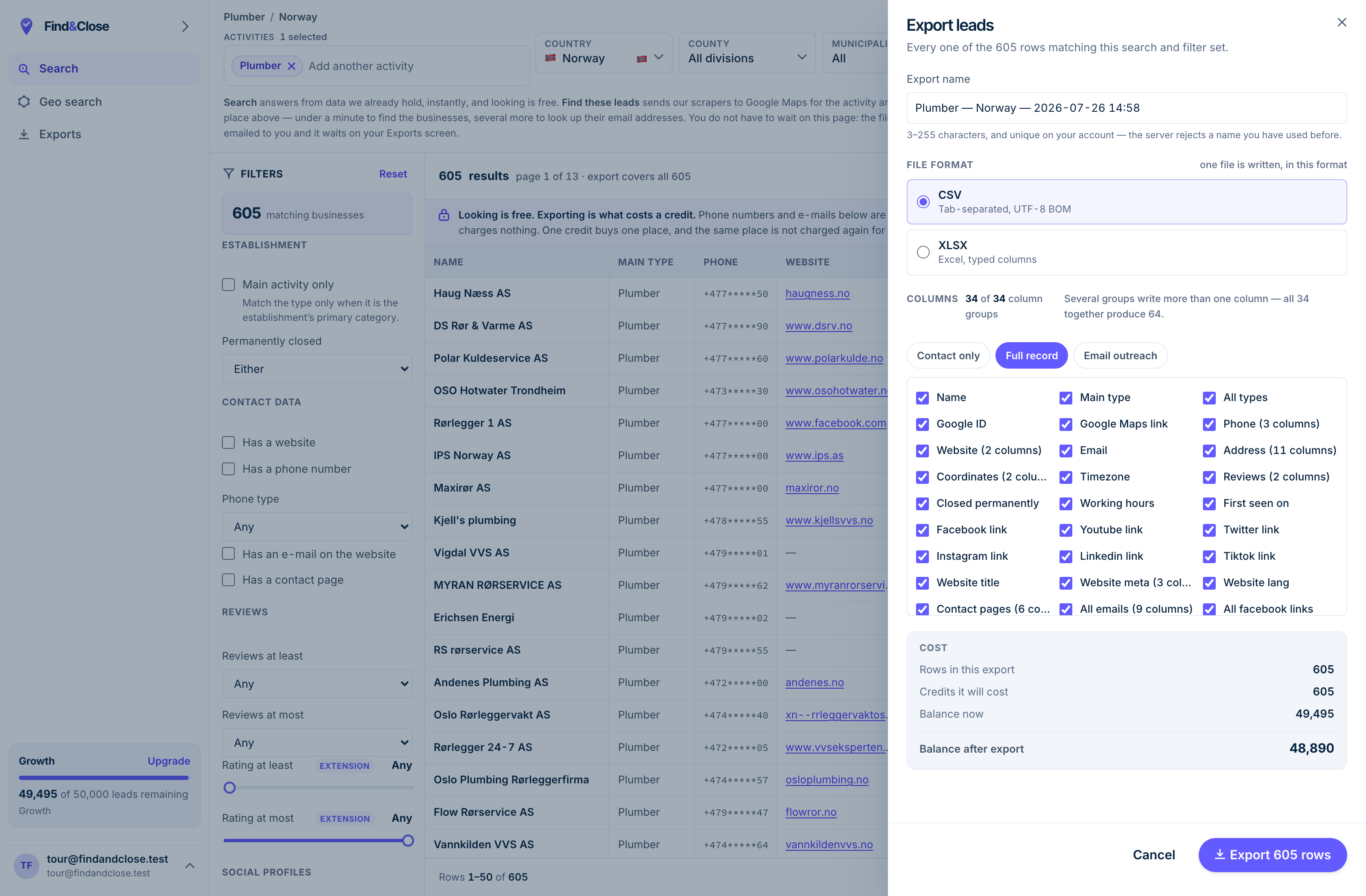
- It exports the whole result Every row the filter matched, not the page you happen to be looking at.
- CSV or XLSX Tab-separated UTF-8, or typed Excel columns. One file per job.
- 34 groups, 64 columns The same 64 on every plan. Nothing is held back for a higher tier.
- Three presets Contact only, full record, or the outreach set. Or tick your own.
- The cost, before you commit One credit per place, once per 30 days. Re-downloading is free.
Questions about construction company lists
Can the list flag main contractors versus subcontractors?
Not as a column, because Google Maps does not carry that split, and we will not guess it for you.
The working signals are on each row: a website with a staff page reads office, a bare listing with a mobile reads van. Sort on those and you are close.
Which building trades do you count one by one?
Carpenters, electricians, plumbers, roofers and painters all sit in the 27 trades our pages track, country by country.
The lists page shows every trade and country we publish, with live counts on each.
Why do Danish and Norwegian carpenters differ so much on email?
We count 30% with an email in Norway and 8% in Denmark, from the same crawl in the same week.
We publish the gap without a theory. A count you can check beats a story you cannot.
Do you sell building permit or project-start data?
No. We hold what a Google Maps listing holds: the firm, its contact fields, its rating and its status.
Permit feeds are a different product from a different kind of vendor. Pairing the two is a fine idea; pretending we are both is not.
How fresh is a construction row when I export it?
Every count we publish carries its crawl date — the ones on this page say 26 July 2026 because that is when we counted.
A row is true on the day we crawled it, not the second you read it. Re-downloads of your exports are free, so refreshing costs nothing.
Neighbour trades with their own pages
The building trades we count row by row, and the plays that go with them.
Split the chain, then pull the rows
Fourteen days, 100 leads, no card. Enough to sort office firms from van firms in one region.
- 14-day free trial
- 100 leads included
- No credit card