Apollo.io · compared
Apollo's index starts at LinkedIn. Ours starts at the map pin.
They're not on LinkedIn. They're on Google Maps. Apollo is a strong tool for selling to firms with staff pages. It has nothing to work from when the target is a two-van plumber.
64 columns on every plan$49 a month, month to monthWe do not send email
What Apollo is genuinely built for
Apollo pairs a very large contact file with a sending tool. That pairing is why so many teams pay for it.
Apollo says its file holds 150 million contacts, with 5.3 million new ones each month. It says the rows come from a contributor network, from public crawling and from outside feeds. It claims a 98% email accuracy rate.
The shape of that file matters more than the size. Apollo hangs each contact on a job title at a company. The company needs a domain. The person needs a title.
That model works, and it works well. Sell software to a head of sales and Apollo is the right tool. It hands you the name, the title, the firm and a route in.
The half of Apollo that people pay for
Most Apollo users did not buy a database. They bought a place to build a list and press send.
Apollo bundles sequences, a dialer, call recording and mailbox warm-up. You pick a filter, save a list and start the emails in one tab. A weak row costs you less when the fix sits one click away.
We do not do that half. FindAndClose has no sequencer, no dialer and no sending. You export a file and run it in the tool you already use.
Read that twice. We are a data source. Apollo is a data source with a sending tool bolted on. If the sending is why you pay Apollo, keep paying Apollo.
Where the model runs out
A contact graph needs a job title to hang a person on. It needs a company page to hang the title on. Most local trade firms have neither.
Think about a plumber in Bergen with two vans and one apprentice. There is no staff page. There is no company page on LinkedIn. There is often no website at all.
What he does have is a Google Maps listing. It carries a name, an address, a phone number and opening hours. It carries a rating and a review count too.
That listing is not a thin LinkedIn profile. It is a different kind of record. We grew our index out from the pin, so the listing itself is the row.
Apollo and FindAndClose, row by row
Grouped the way buyers ask: cover of local firms, contact fields, freshness, price, who owns the export, and sending. Grey rows are the ones Apollo wins.
| FindAndClose | Apollo | |
|---|---|---|
| Where a row comes fromthe thing the index grows out of | The Google Maps listing | A firm with a web presence |
| Firm with no website | Yes | Hard to reach |
| Firm with no LinkedIn page | Yes | Hard to reach |
| Nordic local tradesNorway, Sweden, Denmark, Finland | 44,684 rows today | Aimed at corporate roles |
| Search by Maps category4,000+ categories, every plan | Yes | No |
| Filter on star rating and review count | Yes | No |
| Staff at mid-market and enterprise firms | No | Yes |
| Job titles, seniority and org charts | No | Yes |
| Buying intent signals | No | Yes |
| Technographicswhat software a firm runs | No | Yes |
| The number the shop answers | Yes | Corporate lines and mobiles |
| Mobile number for a named employee | No | Yes |
| Opening hours, rating, review count | Yes | No |
| Columns in the export | 64, on every plan | Set by plan |
| Date stamps on the rowfirst seen and last seen | Yes | No |
| Entry price | $49 a month | Per seat, per month |
| Free tier you can keep | No | Yes |
| Trial | 14 days, 100 leads, no card | Free plan, small credit pot |
| Files you already exported | Yours for good | Also yours once out |
| Email sequences and mailbox warm-up | No | Yes |
| Dialer and call recording | No | Yes |
| CRM sync | No | Yes |
Apollo's pricing and features last checked on 26 July 2026. We re-check every month. Rows shaded grey are ones where they beat us.
Apollo rows come from apollo.io on the date above. Apollo does not show us a price we can read without an account, so we describe the model and stop there.
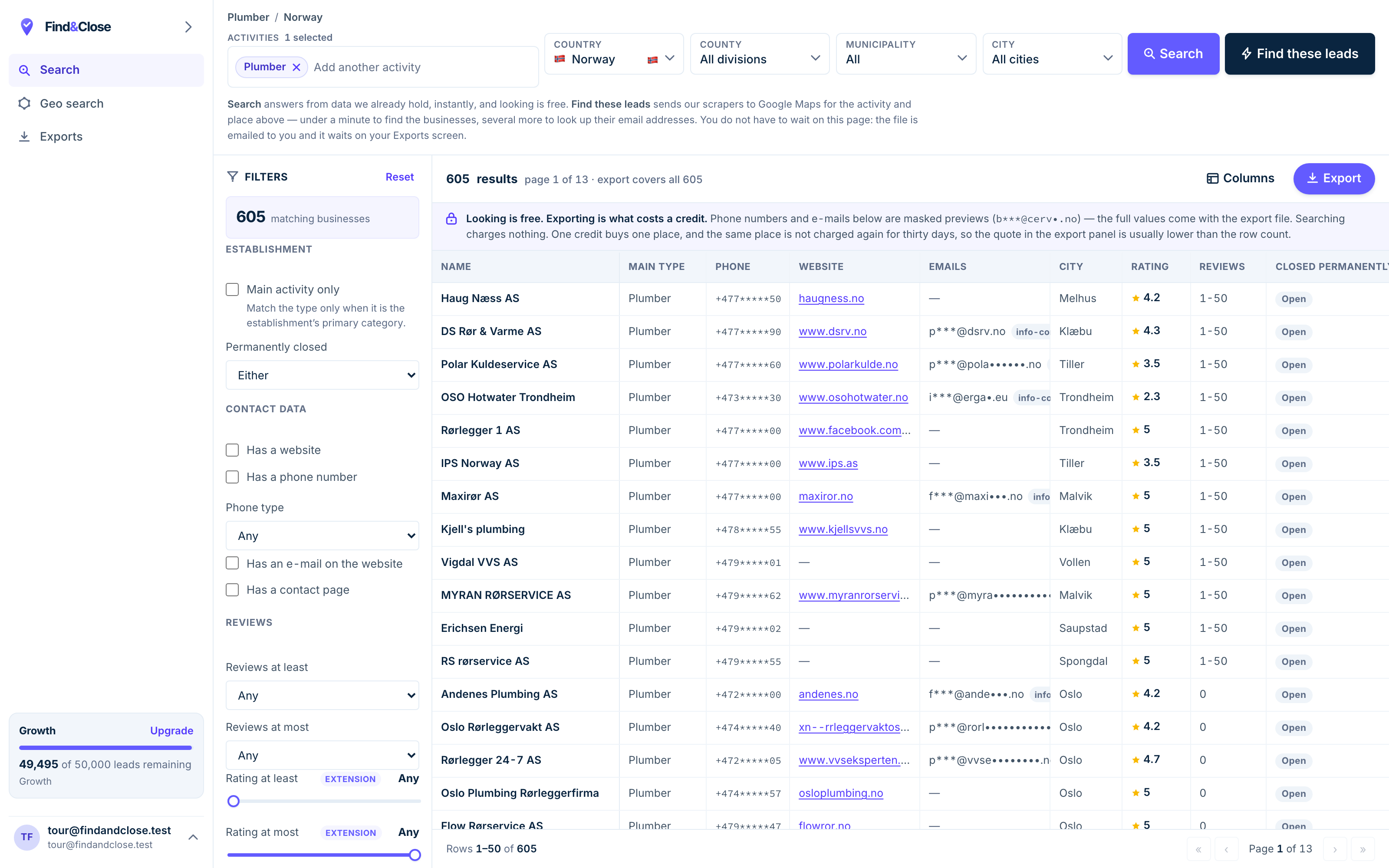
- Pick the trade Type it and take the match. One trade or twenty, on every plan.
- Pick the place Country, county, municipality, city. No plan gates the geography.
- The count moves first The number updates before you spend anything. Looking is free.
- Filter to the ones worth calling Has email, has phone, has a website, has a contact page. Combine them freely.
- Contacts are masked until export You can see a row exists and judge it. The address itself is the product.
- Export what you are looking at The file is exactly this filter set, with nothing dropped in between.
The coverage test — run this before you read on
You do not have to take our word or theirs. Ten minutes inside a tool you already pay for will settle it.
- Pick one trade and one town you know well. A plumber, a dentist or a hair salon in your own city works best.
- Run that search in Apollo. Filter to the country, then the industry, then firms under ten staff.
- Count the rows with a real street address. Not a head office. The address a van drives back to at six.
- Open the same trade on Google Maps. Count the pins. The gap between those two counts is this page.
We think you will find a handful of rows in Apollo and a few hundred pins on the map. We could be wrong in your town. Run it and see.
Then run the same test on us. The trial lasts 14 days and gives you 100 leads with no card. Pull one town and ring five numbers by hand.
This is why we lead with the test and not with a claim. A count you made yourself beats any table we could write.
When to run both
These two tools do not sit in the same slot. Plenty of teams should hold both and use each for what it does.
Keep Apollo if you sell to firms with staff, a domain and a LinkedIn page. Nothing here changes that. The sequencer, the dialer and the CRM sync are real products.
Add us when the target list is a trade in a town. Roofers in Malmö. Dentists in Oslo. Cafés in Aarhus. Those rows live on the map, not in a contact graph.
- Selling software to a VP of sales — Apollo, every time
- Selling websites to salons with no website — us
- Selling to a franchise head office — Apollo
- Selling to the 40 franchisees who each run one shop — us
- Any list where the buyer is the person who answers the phone — us
The join between the two is a CSV. You export from us and load the file into whatever sends your mail. Apollo takes a CSV import, and so does every sending tool we have tried.
One warning, and we would rather say it here than in the small print. We do not send anything. No mail leaves our servers on your behalf, and we have no plan to change that this year.
What people ask before they switch
Should I cancel Apollo?
Most of the time, no. If Apollo sends your email, cancelling it breaks the send, not the data.
The honest advice is to keep Apollo for the sending and for firms with a web presence. Add us for the trades. The two bills together still cost less than one enterprise seat.
Is FindAndClose an Apollo replacement?
No. We replace one half of Apollo and none of the other half.
We give you rows: name, address, phone, email, website, rating and 58 more columns. You still need a tool to send. That could be Apollo, or your CRM, or a $20 sender.
Why is my local plumber missing from Apollo?
Because the index has nothing to hook him on. Apollo starts from a firm with a domain and staff who list a title.
A one-van firm has no domain, no title and no staff page. That is not a flaw in Apollo. It is the shape of the thing they chose to build.
Do you have job titles or a named decision maker?
No. We hold the business, not the staff list. For a shop with three people, the business is the decision maker.
If you need a named head of marketing at a 400-person firm, buy Apollo. We will not pretend to hold that.
Can I load your file into Apollo?
Our export lands as CSV or XLSX, with headers that match the ones Scrap.io uses. Anything that reads a CSV will read it.
We do not build or keep an Apollo integration, so treat this as a file handoff and nothing cleverer.
What does it cost to test both?
Our trial runs 14 days and gives you 100 leads with no card. Nothing turns into a paid plan on its own.
After that, Starter is $49 a month with 10,000 lead credits and one seat. Every country, every filter and all 64 columns sit on that plan. See what each plan holds.
Read the other three, then the lists
The same test runs against each of these tools. The answer changes a little each time.
- ZoomInfo compared The enterprise contract, priced by quote
- Lusha compared Credits burnt per reveal
- Cognism compared Screened mobiles and DNC checks
- Every list we publish Trades, countries and guides
- Plumbers in Norway The file, with counts
- Dentists in Norway The file, with counts
- Accountants in Norway The file, with counts
Pull one town of trades and check it yourself
Fourteen days, 100 leads, no card. Long enough to export one town and ring five of the numbers by hand.
- 14-day free trial
- 100 leads included
- No credit card