Guide · Handymen
Handyman email list: the one-person trade
A handyman is the smallest business there is. One person, one phone, one van. No office, no front desk, and often no website. Email struggles to reach them at all.
Covers Norway, Sweden, Denmark and FinlandNo trade count — we do not track handymen yetPhone-first advice, said out loud
Two limits, said up front
Scope first, then the honest gap in our own file.
FindAndClose builds local business lists from Google Maps. We cover four countries: Norway, Sweden, Denmark and Finland. Nothing beyond the Nordics.
If you need a US or global handyman list, a worldwide scraper fits better. Our Outscraper review says where they win and where they charge for it.
The second limit is our own. Our page set tracks 27 trades, and handymen are not one of them yet. So this page carries no handyman count. We will not invent one.
You can still pull the trade. The app searches Maps categories beyond our page set, handymen included. Pick the category, pick a country, and the count shows before you export a row.
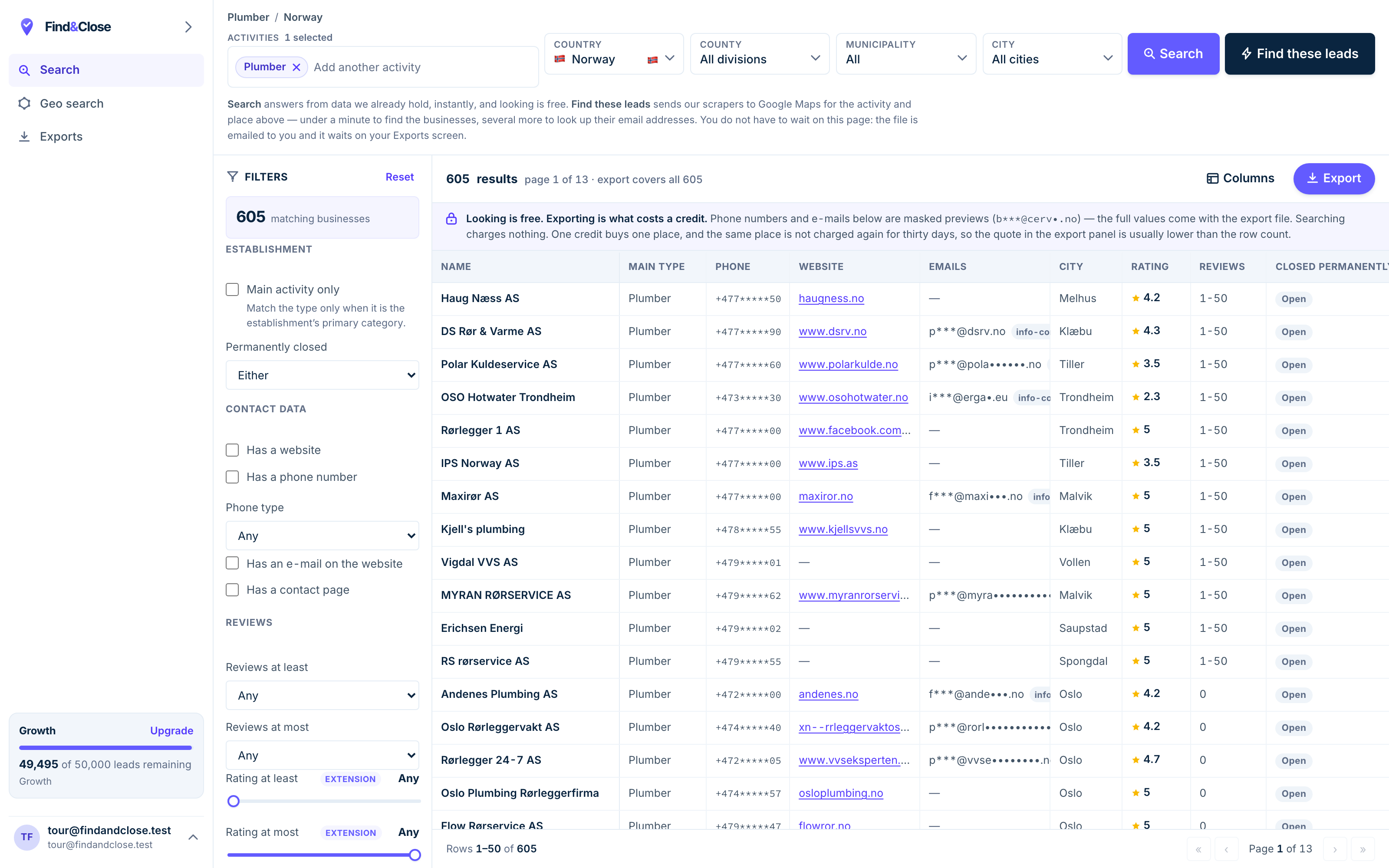
- Pick the trade Type it and take the match. One trade or twenty, on every plan.
- Pick the place Country, county, municipality, city. No plan gates the geography.
- The count moves first The number updates before you spend anything. Looking is free.
- Filter to the ones worth calling Has email, has phone, has a website, has a contact page. Combine them freely.
- Contacts are masked until export You can see a row exists and judge it. The address itself is the product.
- Export what you are looking at The file is exactly this filter set, with nothing dropped in between.
The smallest business you can sell to
A carpenter can grow into a firm. A handyman rarely does. The one-person shape is the whole point of the trade.
A handyman fixes the jobs too small for a specialist. A shelf, a leak, a fence, a flat-pack. The work is broad and the jobs are tiny.
That shape holds the business at one person. There is no crew to manage and no office to keep. The van is the workshop and the phone is the front desk.
- One person does the quoting, the work, the invoicing and the chasing.
- The day is spent on ladders and under sinks, not at a screen.
- There is no admin hour, because there is no admin person.
- Many never build a website, because word of mouth fills the week.
For a seller, this is the hardest trade on the site to reach in writing. There is no inbox that gets read in the working day, because there is no desk to read it at.
Why email barely reaches this trade
Every reason a handyman is a good customer is a reason their inbox stays shut.
The handyman lives on the phone, and only the phone. A job is a call, a quick look, and a price on the spot. Email never enters the loop.
We do not publish a handyman coverage figure, because we do not track the category. But the shape of the trade tells you to expect a low one.
- No office means no work email that gets checked by day.
- Where an address exists, it lands on the same phone that is ringing with jobs.
- A long email loses. It costs a tired reader, at the kitchen table, too much.
- The website that would carry an info@ address often does not exist.
Set your benchmark low and plan for it. Across our tracked trades, email coverage runs at 38% in Norway, 19% in Sweden, 17% in Denmark and 16% in Finland. Phone-first van trades tend to sit under their country line, so treat the email half as a bonus, not the plan.
The right plan splits the file by the phone, not the inbox. The list building guide shows how to work a file that is thin on email.
What actually works on a one-person trade
Sell the handyman one thing: less admin and more jobs. Nothing else fits a person with no spare hour.
A handyman has no time and no staff. So the only offers that land are the ones that give time back or bring work in.
- Lead on the phone, early or late. Before the first job or after the last. Mid-day they are on a ladder with the phone in the van.
- Keep the ask to one line. A person with no admin hour cannot read a pitch. Say the offer in a sentence, or lose them.
- Sell jobs, tools or time back. Lead sources, a booking tool, a supplier account. Anything that fills the week or shortens the paperwork.
- Use email only to confirm. Send the quote or the details after the call, when it is expected. A cold email alone rarely gets opened here.
If you sell reputation or a website, the opening is real. Many handymen have no site and no claimed listing, so a rival with reviews takes the search result they never fought for. The no-website guide is the playbook for that pitch.
A phone-first cadence for a one-person trade
Written for someone selling job leads, tools or a booking tool to handymen. Call first, then use email only to confirm. Run it in your own tool — we do not send anything.
-
Call at 07:15, before the first job. A handyman answers early or not until night.
One sentence on who you are, then one question: are you turning work away, or chasing it right now?
If they want more work, ask to send the details. Now your email is expected.
This trade lives on the phone, so start there. The question sorts them in one line: too busy, or not busy enough, and each needs a different pitch.
-
Subject the details, as promised
Hi [name] — good to talk. Here is [your offer] in one screen, price included.
Nothing to sign. Try it on one job and judge it on that.
If it is not for you, reply stop and I will not write again.
The subject marks the message as the one they agreed to. A promised email gets opened where a cold one dies, which matters double for a trade with no desk.
-
Call again early, and keep it to thirty seconds.
Ask one thing: did the details make sense, or should I answer a question?
If the timing is wrong, ask when to try again, and write down the answer.
A handyman never replies to email, so chasing by inbox is a dead end. A short second call is the only follow-up that reaches them.
-
One last short call, at the end of the day this time.
Say you will stop chasing, and leave the offer open.
Ask if you should call back next season, and note the answer for later.
Ending on the phone fits a trade that never opens its inbox. A polite last call keeps your name in their head, where their whole business already runs.
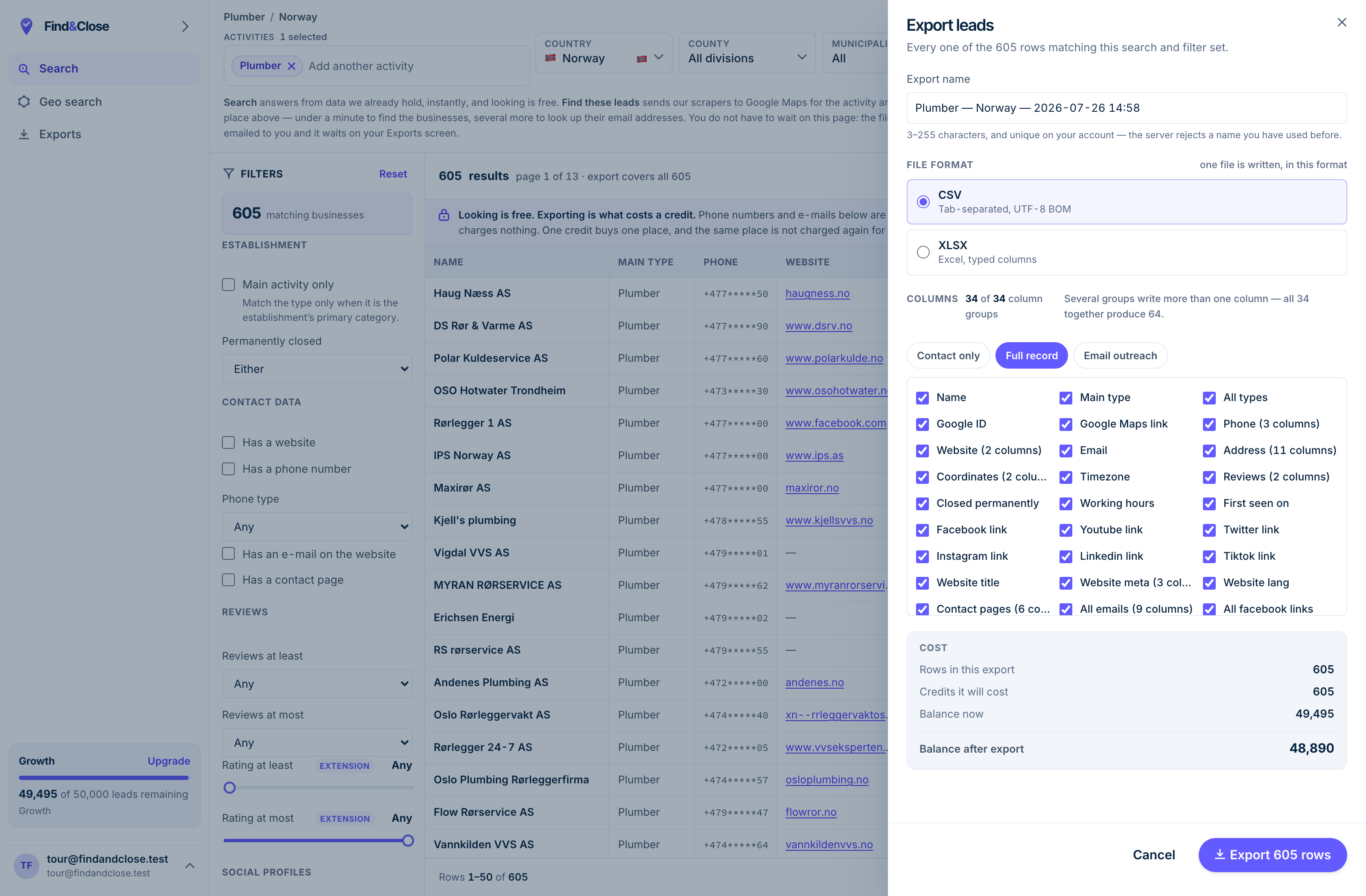
- It exports the whole result Every row the filter matched, not the page you happen to be looking at.
- CSV or XLSX Tab-separated UTF-8, or typed Excel columns. One file per job.
- 34 groups, 64 columns The same 64 on every plan. Nothing is held back for a higher tier.
- Three presets Contact only, full record, or the outreach set. Or tick your own.
- The cost, before you commit One credit per place, once per 30 days. Re-downloading is free.
Straight answers about handyman lists
Why is there no live handyman count on this page?
Because our tracked page set covers 27 trades, and handymen are not one of them yet. Every count we publish comes from that file, dated.
We will not pad a page with a guess. You can still pull the handyman category in the app, where the real count shows before you export.
Can I run an email-only campaign to handymen?
You can, but it will reach few of them. This is the smallest trade on the site, with no office and often no website, so email coverage is thin.
Plan the phone as your main channel, and treat any email address as a bonus. Use email to confirm a call, not to start one.
When does a handyman answer the phone?
Early morning, before the first job, or in the evening once the tools are down. In between they are on site with the phone in the van.
The early call is the good one. You catch them before the day fills up with jobs.
What sells to a one-person trade?
Two things only: more jobs, or less admin. Lead sources, a simple booking tool, a supplier account, a website that wins the search.
Anything that asks for a spare hour will fail, because a handyman does not have one.
Is a one-person handyman a business or a consumer under the rules?
It depends on the country and on how the business is set up. Some national rules treat sole traders like consumers for marketing email.
You cannot tell the legal form from a Maps listing, so treat every row with consumer-grade care. The GDPR guide walks through it. It is not legal advice.
Go deeper
No handyman country page exists yet, so start with the four country hubs and the phone-first neighbour trades.
- Carpenter email list The neighbour that grows into a firm
- Local business leads in Norway The full Norwegian file
- Local business leads in Sweden The full Swedish file
- Local business leads in Denmark The full Danish file
- Local business leads in Finland The full Finnish file
- Find businesses with no website The strongest pitch for this trade
Pull the handyman category and read the real count
Fourteen days, 100 leads, no card. Pick handymen, pick a country, and see the true coverage before you plan the phone list.
- 14-day free trial
- 100 leads included
- No credit card