Guide · Law and ethics
Is scraping Google Maps legal?
Three rulebooks share this question: Google’s terms, data protection law, and the marketing rules on what you send. Plain words on each. None of it is legal advice.
Terms and law are not the same thingThe GDPR reaches public dataNot legal advice
One question, three rulebooks
People ask this as one question. It splits into three, and the answers live in different places.
The first rulebook is Google’s terms of service. A contract between you and Google about how you may use their site.
The second is data protection law. In Europe, the GDPR. It asks whether you may hold and use the rows you pull.
The third is marketing law. It asks whether you may send anything to the addresses in those rows.
Passing one rulebook says nothing about the other two. Most bad advice online mixes all three into one soup.
This page walks the first two. The sending half has its own guide: GDPR and B2B cold email.
A scope note before we start. We sell Nordic business data — Norway, Sweden, Denmark and Finland — so the law talk here leans EU and EEA. Other regions run other rules. And for global scraping needs, Outscraper is the tool page to read, not this one.
We are not lawyers, and this page is not legal advice. We publish it because every second buyer asks, and because the loud answers on both sides overreach. Take advice for your own country before you build at scale.
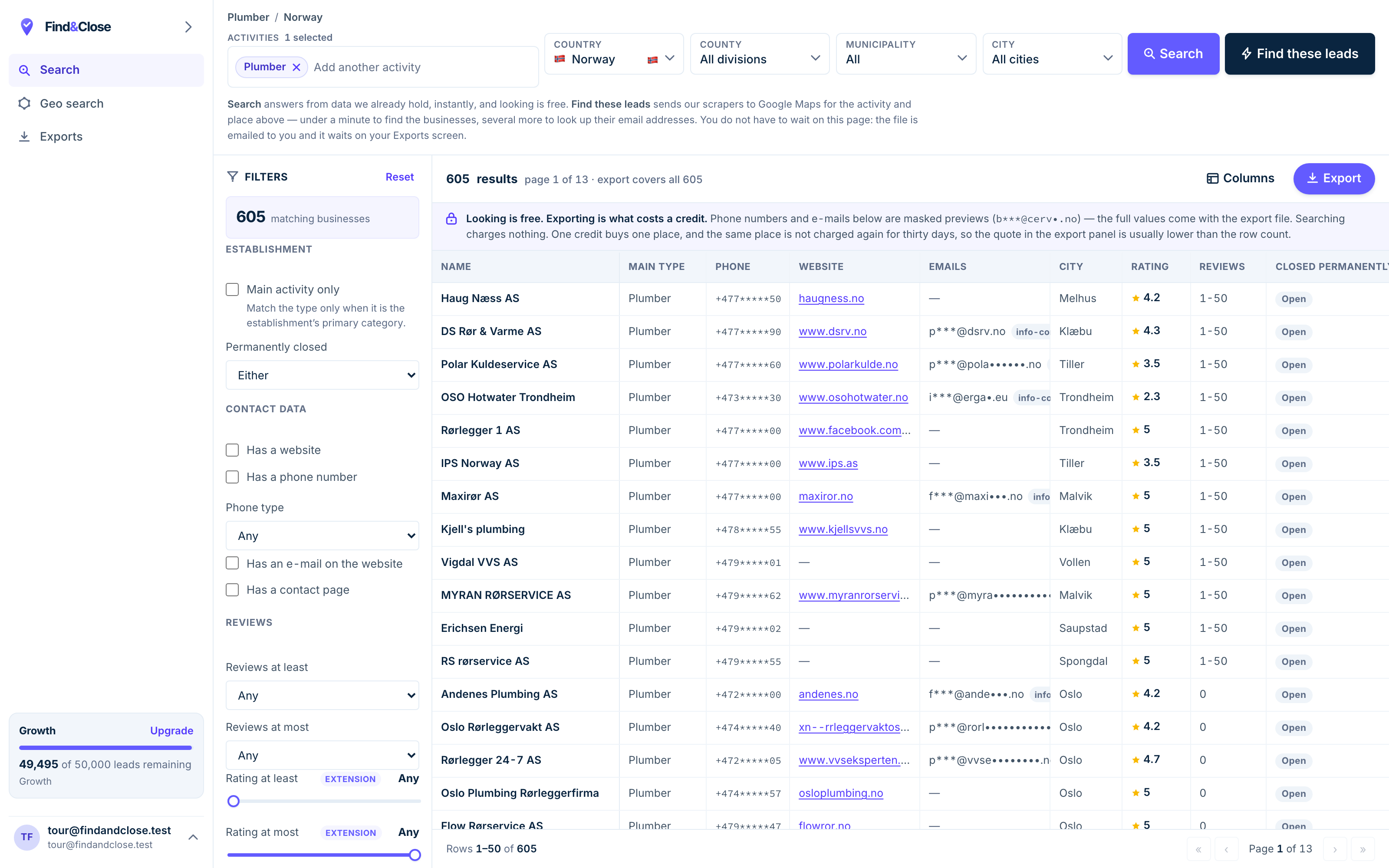
- Pick the trade Type it and take the match. One trade or twenty, on every plan.
- Pick the place Country, county, municipality, city. No plan gates the geography.
- The count moves first The number updates before you spend anything. Looking is free.
- Filter to the ones worth calling Has email, has phone, has a website, has a contact page. Combine them freely.
- Contacts are masked until export You can see a row exists and judge it. The address itself is the product.
- Export what you are looking at The file is exactly this filter set, with nothing dropped in between.
Google’s terms are a contract, not a criminal code
The word “illegal” hides a difference that matters here.
Google’s terms of service set rules on automated access to its services. Read them yourself: Google’s terms, plus the separate Maps Platform terms for the API.
A law binds everyone in a country. A contract binds the parties to it. Terms of service sit in the second bucket.
Break a law and the state can act. Break a term and the counterparty can act. Different rooms, different doors.
What can Google do about scraping? They run the servers. They can block traffic, throttle it, and close accounts. That is the concrete risk, and it lands on whoever runs the crawl.
Whether a terms breach also breaks a law differs by country and by case. We will not hand you a blanket answer, because there is not one.
Where an index vendor changes the picture
Buy from an index instead of crawling, and you never touch Google’s servers. The crawl and its risk sit with the vendor. That is our seat, and we sit in it with open eyes.
What does not transfer is the data side. The moment rows land in your hands, the second rulebook applies to you.
Public data is still governed data
The most common myth in this market: “it is public, so it is free to use.” The GDPR does not work that way.
Anyone can read a Maps listing. Reading rights and processing rights are different rights, and the GDPR governs the second.
Much of a local business file counts as personal data. A one-person firm’s row points straight at its owner. So does an address like kari@firma.no.
To hold personal data you need a lawful basis. For B2B prospecting, the workhorse basis is legitimate interest, under Article 6(1)(f).
The regulation’s own recitals name direct marketing as an interest that can qualify. Can, not does. You weigh your interest against the person’s rights, and you write that weighing down.
The balance tilts your way when the row is a published business contact and the offer fits the trade. It tilts against you with private details, scale for its own sake, or an offer from nowhere.
Duties ride along with the basis. Name your source when you write. Stop when someone objects, with no second try. Keep a suppression list so the stop sticks.
The full walk-through — the three-part test, the first-message duties, the opt-out — lives in the GDPR guide. This page only asks you to accept one point: scraped or bought, public or not, the rows carry duties.
Four cases, and where each one stands
The same rulebooks, applied to the four common ways people get Maps data.
You scrape the map yourself
Both halves are yours. The terms risk, because your machines do the crawling. And the GDPR duties, because you hold the result.
You run a browser extension
The same picture at a smaller scale. The crawl runs in your browser, on your IP address. The file it writes is yours to answer for.
You buy from an index
The crawl risk moves to the vendor. The data duties move nowhere. In GDPR terms you control the rows you export, whoever collected them first.
So question your vendor. Ask where each row came from, and when. A vendor with no per-row answer leaves you defending a file with no papers. Our export names the source page and the date beside every email.
You resell scraped data
The heaviest seat at the table. A reseller is a data vendor, with a vendor’s duties: source records, a lawful basis, and answers when a person objects. Do not drift into this seat by accident.
Questions about scraping and the law
Is scraping Google Maps a crime?
That answer differs by country, and we will not fake a universal one. What we can say: Google’s terms are a contract, and a contract question is not a criminal question.
If you plan to crawl at scale, put it to a lawyer where you operate. That costs less than guessing.
Does the GDPR ban scraping public business data?
No article bans it by name. The regulation asks for a lawful basis, a purpose, and respect for the person’s rights, whatever the collection method.
Legitimate interest can carry B2B prospecting on published business contacts. It is a test you must pass, not a stamp you collect. None of this is legal advice.
Can Google ban me for scraping?
They run the platform, and their terms give them room to act on automated access. Blocked traffic and closed accounts are the tools they hold.
Buying from an index moves that exposure to the vendor. It is one honest argument for not crawling yourself.
Is buying scraped data safer than scraping it myself?
Safer on one front, the same on the other. You step out of the terms question, because the vendor’s crawlers do the work.
You step into the controller’s seat the moment you export. Pick a vendor who can show a source and a date for every row.
Am I allowed to email the addresses I scrape?
That is the third rulebook, and it changes at every border. The GDPR is one regulation, but each country wrote its own electronic marketing rules.
Norway, Sweden, Denmark and Finland each run their own act. The GDPR guide lists the questions to ask for each.
Does FindAndClose make my use of the data legal?
No vendor can promise that, and you should walk away from one who does. Lawful use depends on what you do with the rows.
What we give you is the evidence layer: a source page and a date behind every email, and a suppression list that keeps opt-outs out of every later export.
Read next
The sending rules, the routes to the rows, and the terms in full.
- GDPR and B2B cold email The sending half of the law
- Google Maps scraper Four routes to the rows
- Google Places API compared The first-party route and its terms
- Extract emails from Google Maps The workflow, step by step
- Google Maps lead generation The six-step playbook
- Every list we publish The full index
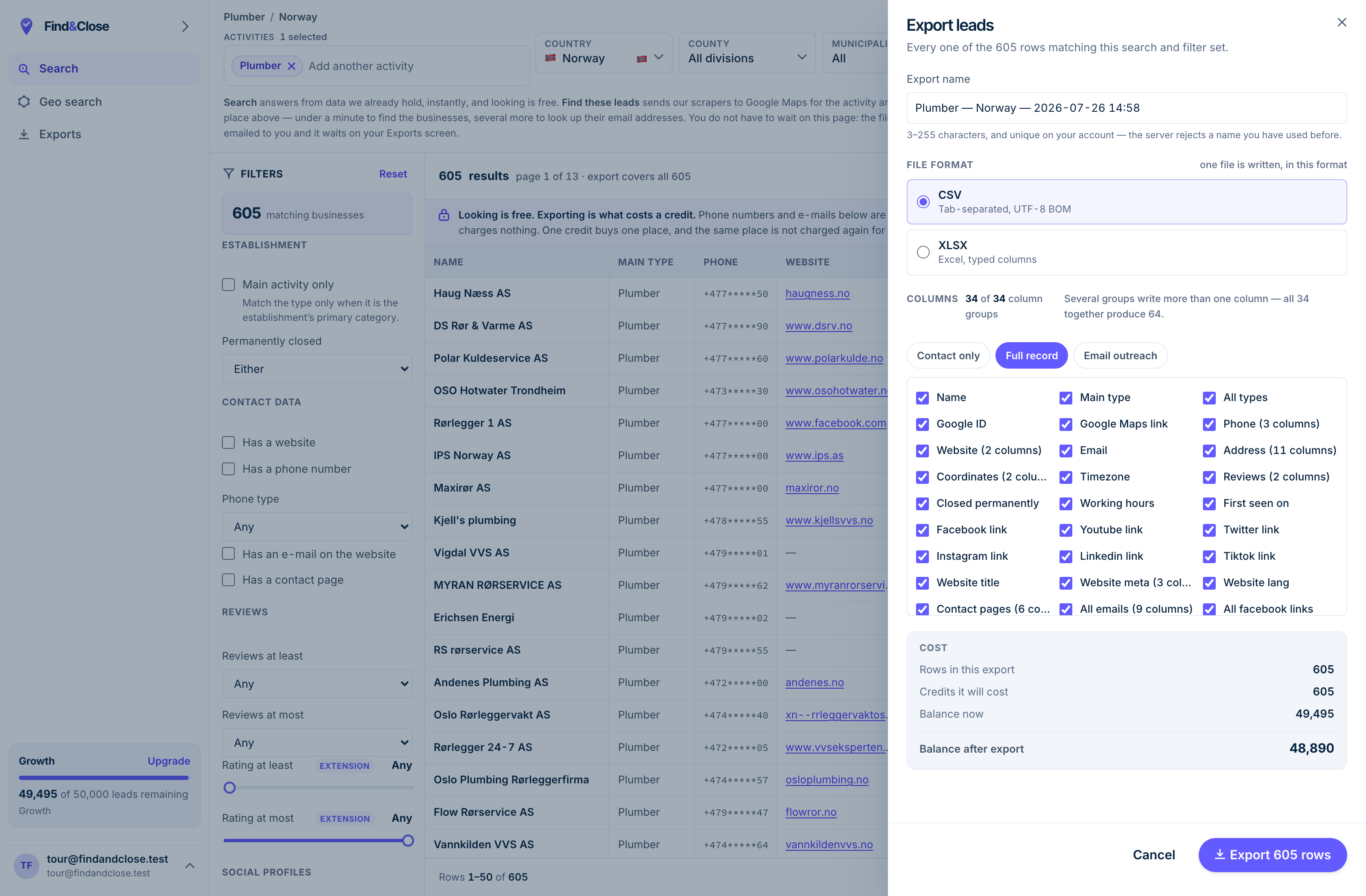
- It exports the whole result Every row the filter matched, not the page you happen to be looking at.
- CSV or XLSX Tab-separated UTF-8, or typed Excel columns. One file per job.
- 34 groups, 64 columns The same 64 on every plan. Nothing is held back for a higher tier.
- Three presets Contact only, full record, or the outreach set. Or tick your own.
- The cost, before you commit One credit per place, once per 30 days. Re-downloading is free.
Buy rows that come with their papers
Fourteen days, 100 leads, no card. Every email names the page it came from and the date we read it there.
- 14-day free trial
- 100 leads included
- No credit card