Guide · Strategy
Local business lead generation
Four channels bring in local business clients: referrals, search, ads and outbound. This page weighs them against each other, so you pick on purpose.
Channel strategy, not scriptsHonest costs and timelinesWhere Maps data fits
Pick channels like a portfolio, not a religion
Most lead-generation advice sells one channel as the answer. There is no such channel.
Every channel trades between three things. Speed to the first lead. Cost per lead over time. And how much control you get over volume.
No channel wins all three. Referrals are near free and slow to command. Ads are fast and stop the day the spend stops. The trick is pairing, not picking.
This page holds the altitude at strategy. For the outbound play in full, read the Google Maps lead generation playbook. To size one market trade by trade, start from a country hub like Norway or Sweden.
Where we fit, said early. We sell lists of local businesses in Norway, Sweden, Denmark and Finland. That serves the outbound channel, in those four countries only. The rest of this page is useful anyway, or it failed.
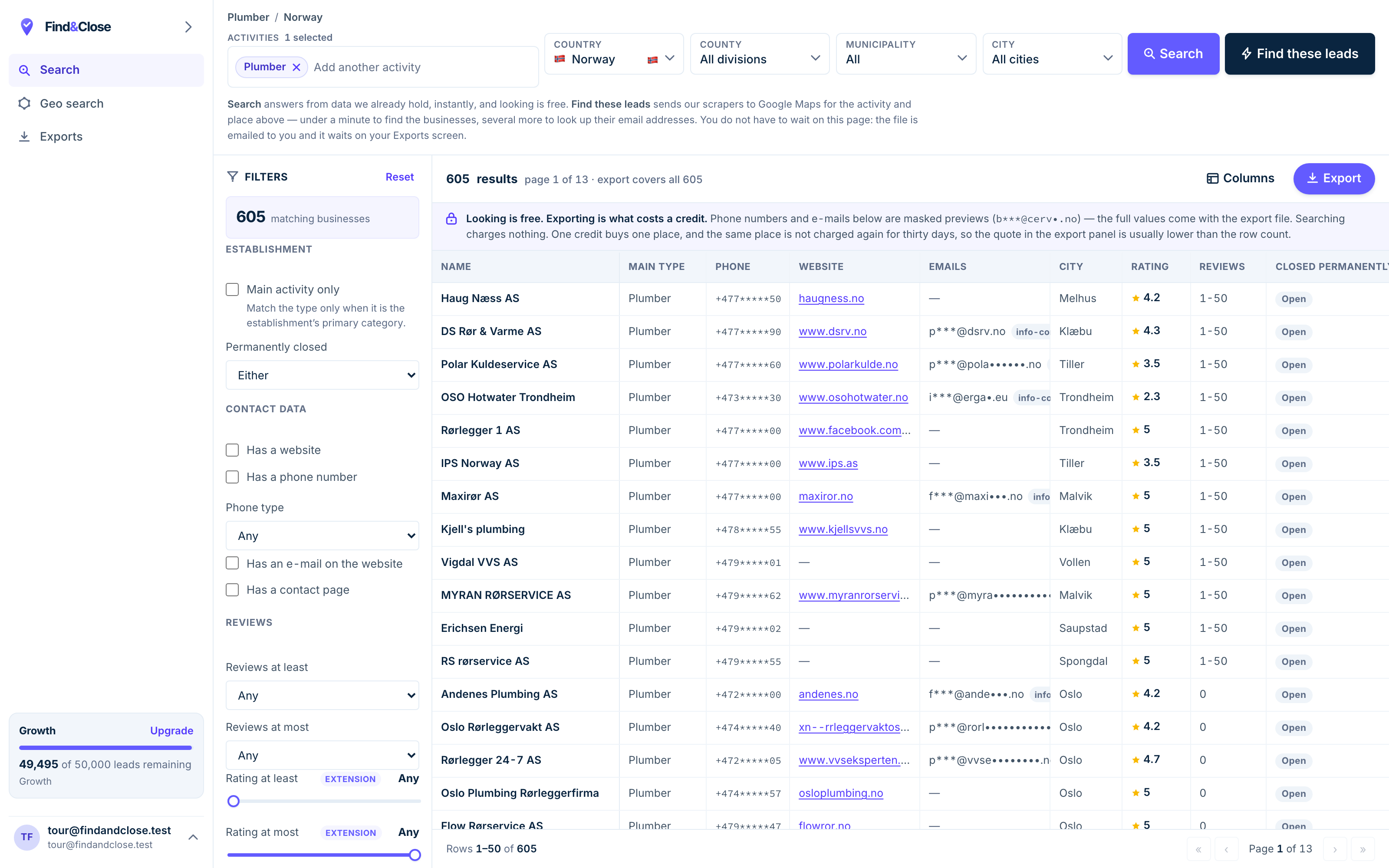
- Pick the trade Type it and take the match. One trade or twenty, on every plan.
- Pick the place Country, county, municipality, city. No plan gates the geography.
- The count moves first The number updates before you spend anything. Looking is free.
- Filter to the ones worth calling Has email, has phone, has a website, has a contact page. Combine them freely.
- Contacts are masked until export You can see a row exists and judge it. The address itself is the product.
- Export what you are looking at The file is exactly this filter set, with nothing dropped in between.
The four channels, one by one
Each one described by what it costs, when it pays, and who it suits.
Referrals and word of mouth
The highest-trust lead there is. A referred prospect arrives half sold, and the sale costs almost nothing.
The catch is control. You cannot order referrals up in a slow month. They follow good work, on a delay you do not set.
The fix is to make asking systematic. Ask at the moment of delivered value, name the kind of client you want, and thank every referrer. That turns a lucky channel into a slow, steady one.
Verdict: everyone should run this. Nobody should depend on it alone.
Local SEO and your own listing
Inbound compounds. A page that ranks, or a Maps profile that shows up, produces leads while you sleep, and the marginal lead costs nothing.
The price is time. Rankings move on a scale of months, and rivals fight over every term with buying intent. A new firm can wait a long time for the first inbound lead.
Start with the free part: claim your own profile, keep hours and photos current, and gather reviews. We spend our days reading Maps data, and unclaimed, stale listings are everywhere. A tended profile alone puts you ahead of many rivals.
Verdict: plant it early, expect nothing from it this quarter.
Paid ads
The fastest meterable channel. Spend goes in, clicks come out, and you can read the cost per lead off a dashboard.
The price is permanence: it never stops costing. Ad auctions price intent at market rate, and the moment you pause, the leads pause with you.
Ads punish weak follow-up hardest. A paid lead that waits a day for a reply was money spent on a rival’s customer.
Verdict: strong once you know your close rate and job value. Expensive tuition before that.
Outbound on public data
The control channel. You choose the trade, the region and the signal, and you set the volume by deciding how many rows to work.
Most of the cost is effort: a list, a sending tool or a phone, and the discipline to follow up. The lead itself is the cheapest of the four channels.
The trade-off is trust. A cold message starts colder than any referral or search visit. Relevance closes that gap — which is why outbound lives or dies on list quality, not on copy.
Verdict: the fastest channel to test an offer, and the only one you can point at a chosen market on demand.
A fifth option people ask about: buying leads
Marketplaces sell you inquiries, often shared with other bidders. You pay for access to demand someone else generated.
The same trade-offs apply as with any bought data: freshness, exclusivity and provenance decide the value. Our guide to buying email lists covers how to vet that kind of deal.
How to choose your mix
Pair one compounding channel with one controllable channel. That is most of the answer.
- Time to first lead: ads and outbound are days. Local SEO is months. Referrals arrive on their own schedule.
- Cost per lead over time: SEO and referrals fall as they compound. Ads and outbound stay roughly linear.
- Control of volume: outbound is highest, then ads. You cannot order up inbound or referrals.
- Failure mode: ads fail loud and fast. SEO fails quiet and slow. Outbound fails cheap. Referrals just go quiet.
A new firm needs cash flow before it needs compounding. So the common-sense order: outbound first. Wire in the referral ask from the first delivered job. Plant SEO alongside. Add ads once you know your numbers.
An established firm often has the opposite gap: inbound and referrals humming, and no way to steer growth toward a chosen market. Outbound is the steering wheel.
The mistake to avoid is serial monogamy — one channel at a time, each abandoned at the first slow month. Channels pay on different clocks. Judge each on its own clock.
Where Maps data fits in
One channel above runs on fuel you can buy: outbound needs a list, and the map is the honest place to get one.
A Maps listing is public business data the firm wrote about itself. Name, address, phone, website, rating, hours. For local trades, no directory is more complete or more current.
Better, the listing carries signals. A missing website, a weak rating, an unclaimed profile — each one tells you what that business needs before you write a word. The playbook turns those signals into campaigns, step by step.
Our part is the list itself. We hold 44,684 local business records across Norway, Sweden, Denmark and Finland. The index comes from Google Maps. You read live counts before you spend anything.
The boundaries: four countries, and we do not send anything. The outreach runs in your tools, under your name. For markets beyond the Nordics, a global scraper like Outscraper supplies the same fuel.
And if email is your outbound medium, mind the legal frame. EU cold email to businesses runs on legitimate interest, with real duties attached — the GDPR guide walks them.
Questions about local lead generation
What is the cheapest source of local business leads?
Referrals, per lead, every time. The work was already paid for, and the recommendation costs nothing.
But cheap is not the same as plannable. A pipeline built on referrals alone has good months and empty ones, and you control neither.
What is the fastest way to get local business leads?
Outbound and ads, and outbound is cheaper to try. A list of fifty well-chosen firms can produce conversations this week.
Speed comes from segment quality, not volume. Fifty rows sharing one visible problem beat five hundred mixed ones.
Should a new agency start with SEO or outbound?
Outbound pays this month; SEO pays next year. A new firm needs this month first.
The honest answer is both, at different sizes: most of the effort on outbound, a steady trickle into content and the firm’s own listing. Swap the weights as inbound grows.
Are purchased leads from marketplaces worth it?
Sometimes, if you price them with open eyes: a shared lead is a race, and the win rate reflects that.
Compare the all-in cost against outbound on your own list, where the lead is exclusive by construction. Our buying guide shows how to vet any data deal.
Is cold outreach to local businesses allowed in Europe?
B2B outreach on public business data runs on legitimate interest under the GDPR. Duties come with it: identify yourself, name your source, offer an opt-out and honour it.
National rules differ on top, and phone rules differ from email rules. The GDPR cold email guide separates the threads. Not legal advice.
What part of this does FindAndClose do?
One thing: the list. Live, filterable local business data for Norway, Sweden, Denmark and Finland, exported as a 64-column file.
Everything else on this page — the sending, the calling, the ads, the site — happens in your tools. We think that split keeps everyone honest.
Read next
The tactical layers under this page, and the data that feeds them.
- Google Maps lead generation The outbound playbook, end to end
- Local business leads in Norway One market, sized trade by trade
- Find businesses with no website The strongest outbound signal
- Cold email local businesses Subject lines and a full sequence
- GDPR and B2B cold email The legal frame for outbound
- Should you buy an email list? Vetting any data deal
- Every list we publish The full index
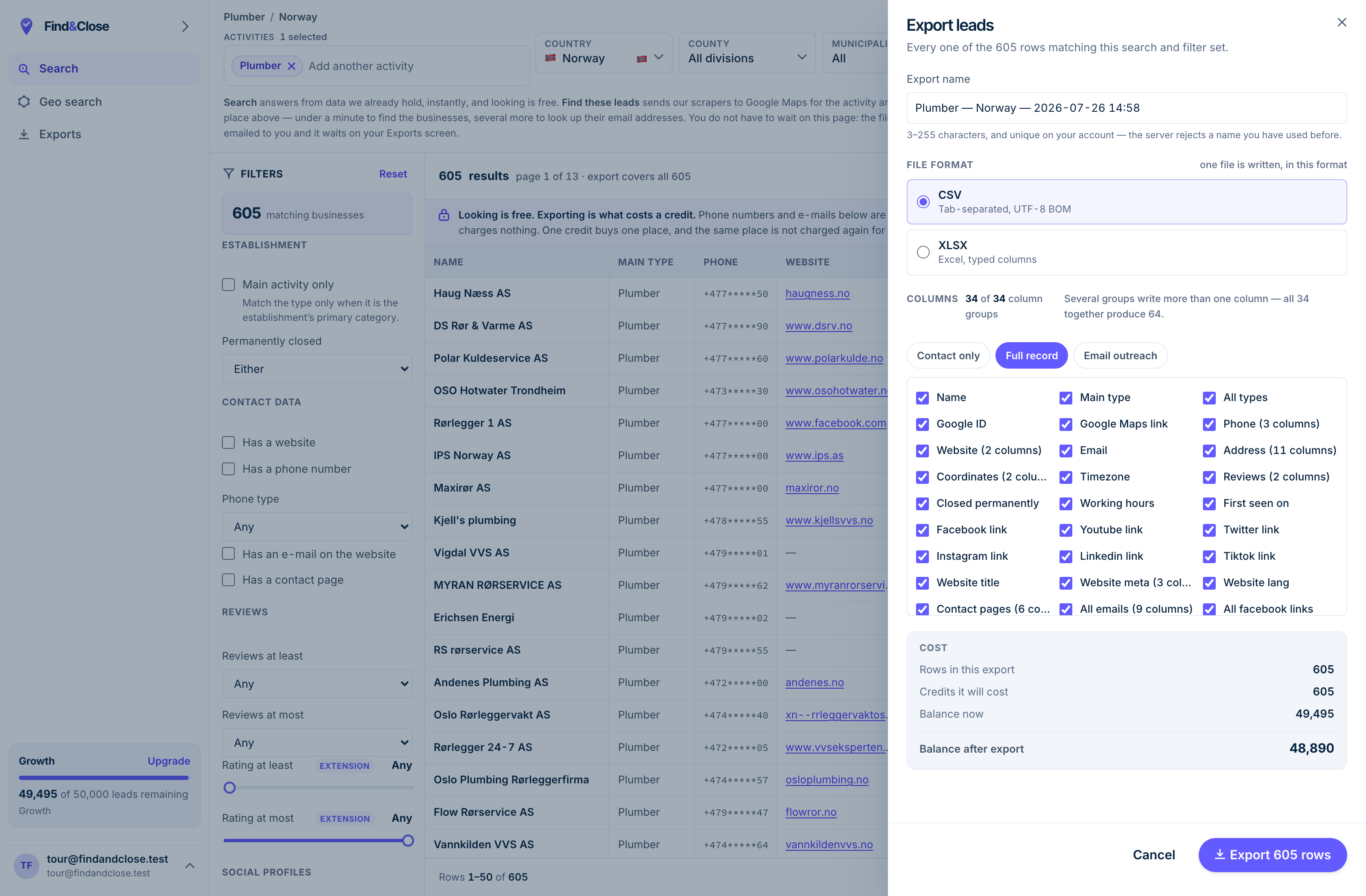
- It exports the whole result Every row the filter matched, not the page you happen to be looking at.
- CSV or XLSX Tab-separated UTF-8, or typed Excel columns. One file per job.
- 34 groups, 64 columns The same 64 on every plan. Nothing is held back for a higher tier.
- Three presets Contact only, full record, or the outreach set. Or tick your own.
- The cost, before you commit One credit per place, once per 30 days. Re-downloading is free.
Point the outbound channel at a real market
Fourteen days, 100 leads, no card. Pick one Nordic trade and region, read the live count, and start the channel you control.
- 14-day free trial
- 100 leads included
- No credit card