Guide · Developers
Real estate developer email list: few firms, big projects
A developer is not a shopfront trade. There are not many of them in any one market. Each firm runs projects worth millions and buys from a long chain of suppliers.
Covers Norway, Sweden, Denmark and FinlandA short, high-value listNo live count for this trade yet
The coverage, and the honest gap
Scope and the missing count go first, before any pitch.
FindAndClose builds local business lists from Google Maps. We cover Norway, Sweden, Denmark and Finland, from our own crawl.
For a US or global developer list, we are the wrong tool. A worldwide scraper such as Outscraper fits that job better.
Now the gap. Real estate development is not a tracked category in our page set. So this page carries no live count, and we will not guess at one.
The app still finds the category on Maps. Pick development, pick a country, and the count shows before you export. On a trade this small, that preview matters more than usual — you will see in one glance how short the list is.
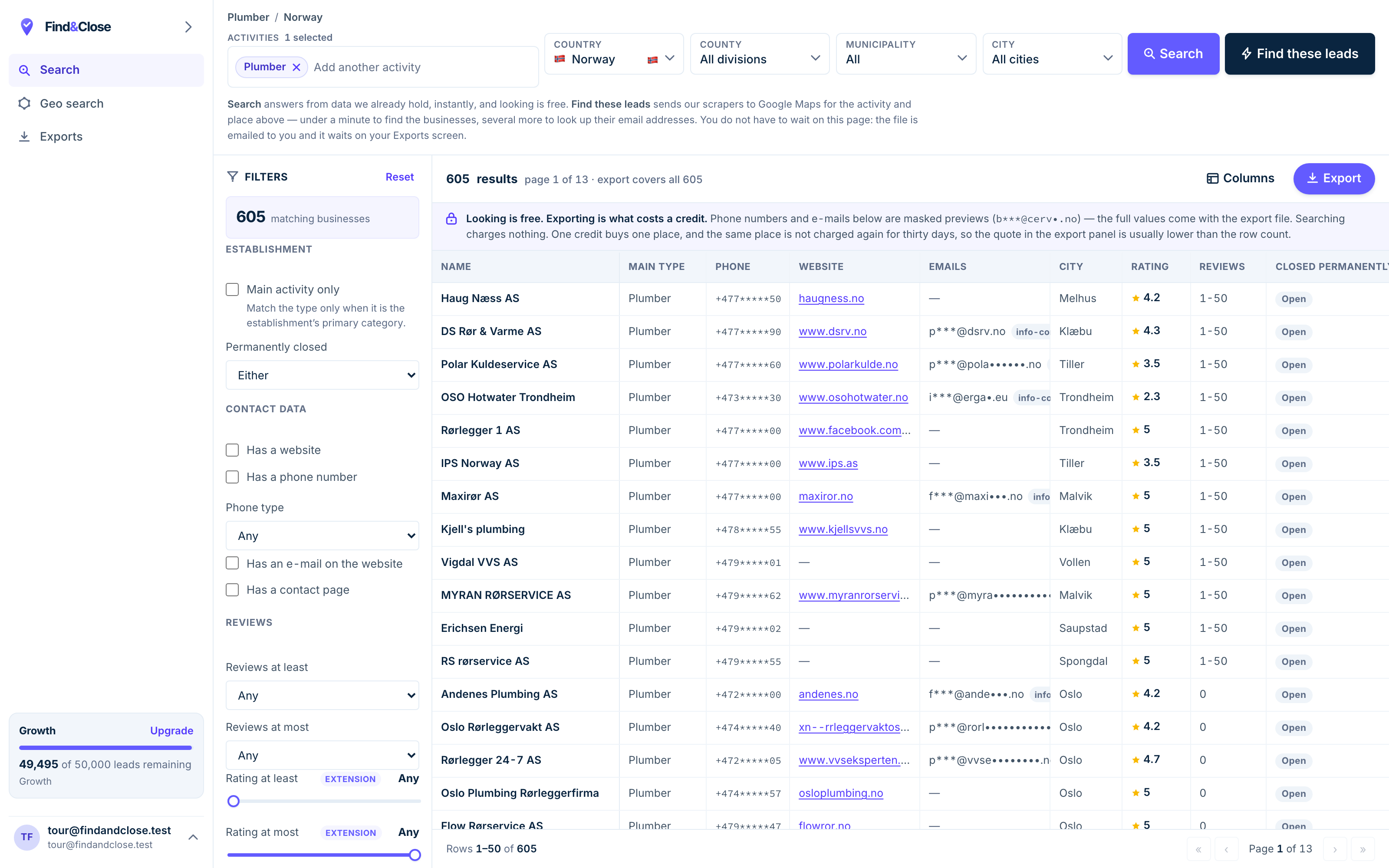
- Pick the trade Type it and take the match. One trade or twenty, on every plan.
- Pick the place Country, county, municipality, city. No plan gates the geography.
- The count moves first The number updates before you spend anything. Looking is free.
- Filter to the ones worth calling Has email, has phone, has a website, has a contact page. Combine them freely.
- Contacts are masked until export You can see a row exists and judge it. The address itself is the product.
- Export what you are looking at The file is exactly this filter set, with nothing dropped in between.
A short list with heavy rows
Do not judge this trade by the length of the file. Judge it by the size of one deal.
Most lists we sell run to hundreds or thousands of rows. A developer list does not, and that is the trade, not a hole in the crawl.
A country holds many plumbers and many cafes. It holds few firms that buy land, plan a scheme and build homes on it.
The value flips the other way. One plumber job is worth a few thousand. One development scheme is worth millions.
- The list is short. Each name on it commands a large budget.
- A single won account can outweigh a whole trade’s worth of small ones.
- So research beats volume here. You can read every firm before you write to any of them.
That changes the whole method. A cafe campaign is a numbers game. A developer campaign is a named-account game, closer to sales than to marketing.
They buy up the chain and sell down it
A developer sits in the middle of the industry. Two very different sellers can target the same list.
Look at what a developer buys. It is the whole build.
- Land and the finance to buy it.
- Architects, engineers and planning consultants.
- Main contractors and the trades under them.
- Marketing and sales to shift the finished units.
Then look at what a developer sells: the units. Homes to buyers, floors to investors, whole schemes to funds.
So the same short list serves two kinds of seller. One sells into the build — materials, services, software. The other sells the sale — unit marketing, CRM, show-home work.
Know which one you are before you write. The build sellers talk to the project team. The sale sellers talk to the marketing side. A pitch aimed at the wrong half of the firm reads as a stranger.
The project clock, phase by phase
A developer’s appetite is not a season. It is the phase of the project in front of them.
Development runs in phases, and each phase buys different things. Time your pitch to the phase and the same message lands like a different one.
- Land and planning. The firm buys advice: consultants, surveys, feasibility, legal. Sell certainty here.
- Design and finance. Architects, engineers and lenders. The scheme takes its shape and its budget.
- Build. Contractors, materials and site services. The spend is at its heaviest.
- Sales and handover. Marketing, show homes, CRM, snagging. The firm turns units into cash.
You cannot read a firm’s phase from a Maps row. But you can read it from the news, the hoarding on the site, and one question on a call.
This is the opposite of the estate agent, who works a fast listing cycle measured in weeks. A developer works a project cycle measured in years. Our estate agent list covers that faster trade.
A named-account cadence for a developer supplier
Written for someone selling into the build or the sale — a subcontractor, a material supplier, a proptech firm. On a list this short, every touch is researched. Run it in your own tool; we send nothing.
-
Subject your [scheme name] scheme
Hi [name]. I saw [firm] is behind [named scheme].
I work with developers at the [phase] stage on [your offer in one line].
Worth a short call while the scheme is at that stage? If not, reply stop and I will leave it.
Naming the actual scheme proves you did the homework. On a short list, the developer can tell a researched note from a blast in the first sentence.
-
Call the office and ask for the project or development team by role.
One question: which phase is [scheme] at right now?
The answer tells you whether to pitch, to wait, or to ask about the next scheme in the pipeline.
Phase is the whole qualifier in development, and no column holds it. A single call places the firm on the clock and saves months of mistimed sends.
-
Subject a fit for the [phase] stage
Following our call. Here is how [your offer] fits a scheme at the [phase] stage: [link].
Two developers we have done this for are on the page, with what changed.
If the timing is wrong, say which future phase suits, and I will come back then.
A developer thinks in phases, so offer phase-shaped options. “Come back at build stage” is a real answer here, not a brush-off.
-
Subject parking this until your next scheme
I will close this thread today so I am not cluttering your inbox mid-project.
When the next scheme reaches [phase], my number is below. Good luck with the build.
Developers buy again on the next project, not the next week. Ending on the pipeline keeps you in mind for a scheme that has not broken ground yet.
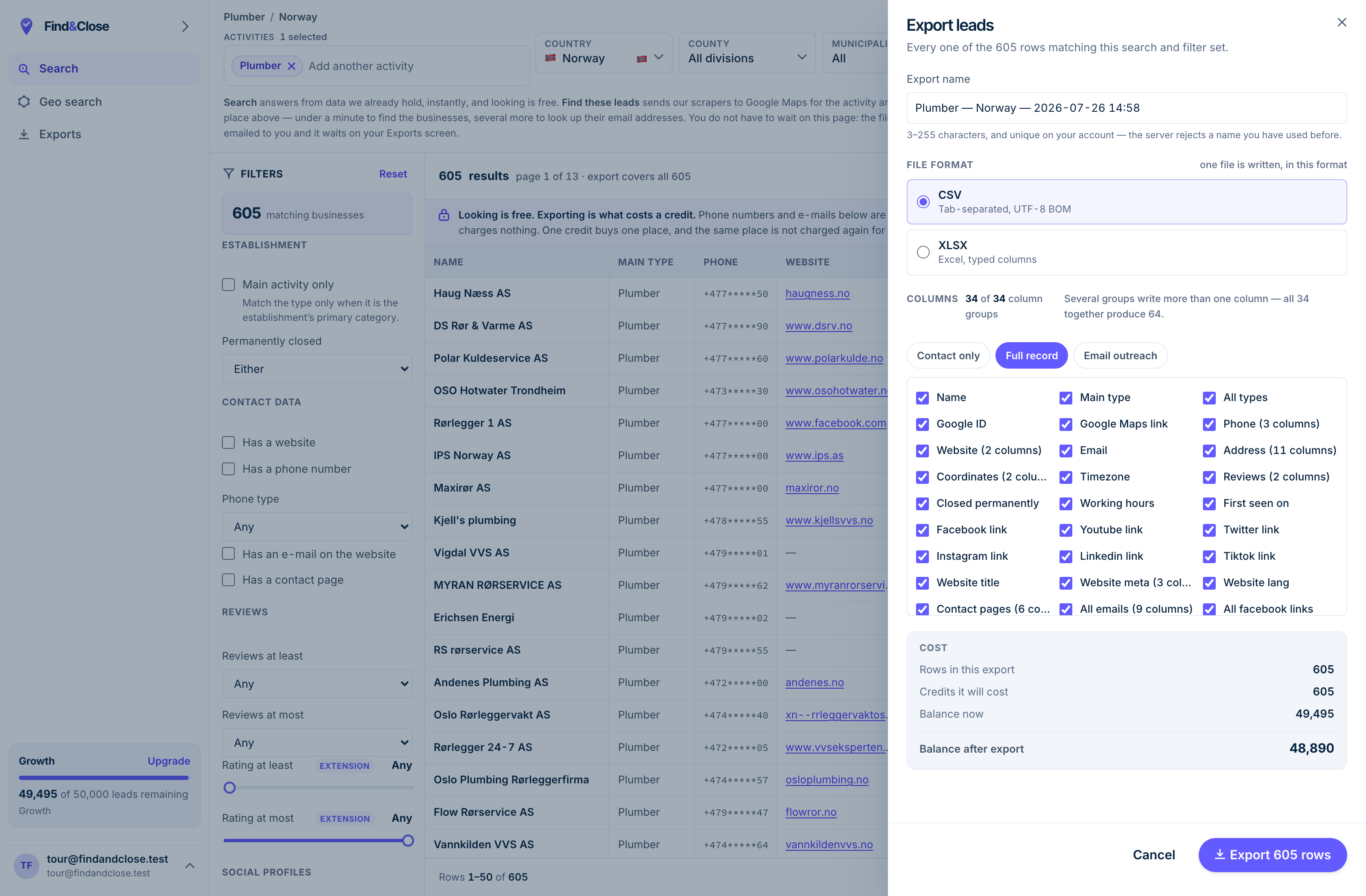
- It exports the whole result Every row the filter matched, not the page you happen to be looking at.
- CSV or XLSX Tab-separated UTF-8, or typed Excel columns. One file per job.
- 34 groups, 64 columns The same 64 on every plan. Nothing is held back for a higher tier.
- Three presets Contact only, full record, or the outreach set. Or tick your own.
- The cost, before you commit One credit per place, once per 30 days. Re-downloading is free.
Questions about developer lists
Why is a developer list so short?
Because there are few developers in any one market. That is the shape of the trade, not a gap in our crawl.
A country has thousands of shops and a small number of firms that buy land and build on it. Judge the list by the size of a deal, not the length of the file.
Why is there no live count on this page?
Development is not a tracked category in our page set, so we publish no count for it. Every figure we print comes from the tracked file, dated.
You can still search and export the category in the app. On a list this small, the count preview tells you almost everything before you spend a credit.
What do real estate developers buy?
Up the chain: land, finance, architects, engineers, contractors and materials. Down the chain: marketing, CRM and sales support to shift the units.
Decide which half you sell to. The project team and the marketing side are two different readers inside one firm.
When is the right time to pitch a developer?
At the phase your offer fits: planning, design, build or sales. A pitch aimed at the wrong phase is not early, it is invisible.
You cannot read the phase from a Maps row. You can read it from the local news and one question on a call.
How is a developer different from an estate agent or property manager?
A developer creates the buildings, on a project cycle measured in years. An agent sells them, and a manager runs them.
Three trades, three clocks. See the estate agent list for the transactional one.
Around the trade, and into the method
The neighbour trades, the four markets, and the guides for a named-account campaign.
See how short the developer list really is
Fourteen days, 100 leads, no card. Pick the category and one country, and the count preview shows the whole trade before you export.
- 14-day free trial
- 100 leads included
- No credit card