Email list · Retirement homes
Retirement home email list
A care home is a building with a budget and a buying calendar. Food, medical supplies, software and maintenance all go through procurement. The cycle is slow, and it rewards patience.
Covers Norway, Sweden, Denmark and FinlandNo live count for this sector yet — the reason is on the pageFor catering, supply, software and facility sellers
Coverage, and the count we will not fake
Scope first, then the honest gap.
FindAndClose builds local business lists from Google Maps. We cover Norway, Sweden, Denmark and Finland.
If you sell into the Nordics, this is live data from our own crawl. For a US or global list, a worldwide scraper like Outscraper is the right buy.
Retirement and care homes are not a tracked trade in our file, so this page carries no count. We publish counts only where the file backs them, and we do not pad a gap with a guess.
The app still finds these homes today. Pick the care-home category, pick a country, and the count shows before you export a row. The floor gates our published pages, not your search.
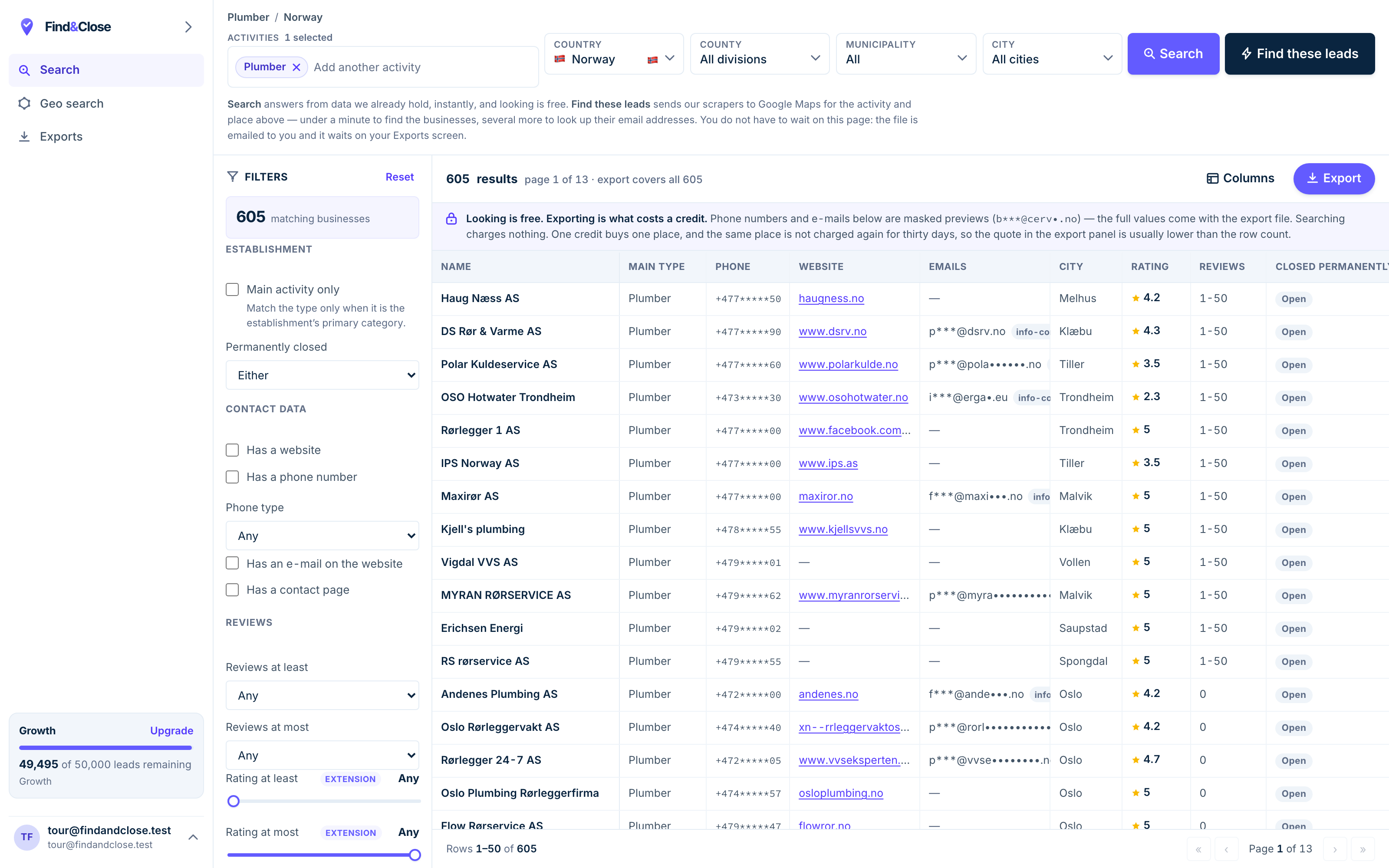
- Pick the trade Type it and take the match. One trade or twenty, on every plan.
- Pick the place Country, county, municipality, city. No plan gates the geography.
- The count moves first The number updates before you spend anything. Looking is free.
- Filter to the ones worth calling Has email, has phone, has a website, has a contact page. Combine them freely.
- Contacts are masked until export You can see a row exists and judge it. The address itself is the product.
- Export what you are looking at The file is exactly this filter set, with nothing dropped in between.
Procurement, not persuasion
This is the slowest sale in the care sector. A clever email will not shortcut it.
A care home does not buy on a good pitch. It buys on a budget line, a contract, and a facility manager who has to justify the spend.
Public and larger private homes run purchasing through procurement rules. That means quotes, comparisons, and sometimes a formal tender. None of it moves fast.
- The buyer is a facility or operations manager, not the person who answers the phone.
- Budgets are set once a year. Land outside the window and you wait for the next one.
- Switching a supplier means paperwork, so the incumbent has a real head start.
- A single home may sit inside a group that buys for all its sites at once.
So plan a long game. The list gets you the door. The sale is months of named-contact work behind it. If you need speed, this is the wrong sector.
What a care home actually buys
The building runs on a handful of repeating spends. Find yours, and pitch only that.
Food is the biggest and steadiest. A home feeds residents three meals a day, every day. Catering, fresh supply and kitchen equipment all sit here.
Medical and hygiene supplies come next. Dressings, incontinence stock, cleaning and PPE. This is a reorder, so reliability wins the account over a low headline price.
Then the systems. Care-management software, rota and medication tools, call systems and alarms. These are slower, bigger decisions with more people in the room.
- Food and catering: daily, high-volume, and always under budget pressure.
- Medical and hygiene supplies: a reorder cycle that rewards a steady supplier.
- Software and care systems: a slow, multi-person decision, sold on trust.
- Facility and maintenance: heating, laundry, safety work, planned once a year.
Services also get bought in. A home hires physiotherapists, activity leads and counsellors for its residents. If that is your work, the home is a venue, not just a buyer.
The slow sale, and how to survive it
A Maps row gives you a building. It does not give you the manager who signs.
The general inbox on the listing lands at reception. Your message to the buyer has to travel from there, and most do not make it.
So the first job is the name. Find the facility or purchasing manager by hand, then reach them direct. Finding the right email ranks the methods and their failure rates.
For a home that belongs to a group, the real buyer may sit at head office, not on site. A Maps row is a location, not a headquarters. A company database is the better tool for that layer — see the Apollo comparison.
Then be patient and be present. Send useful things, not chase-ups. When the budget window opens, the supplier already in the manager's inbox wins the quote.
A named-account cadence for a slow buyer
Written for a catering or care-supply seller working one home at a time. The pace is weeks, not days. Run it in your own tool — we build the list and send nothing.
-
Subject for the facility manager at [home name]
Hi. I supply [your category] to care homes, and I found [home name] on Maps.
I am not asking for a switch today. I know supply runs on a budget cycle.
When does your buying window open? I will send one useful thing before then, and nothing else.
Naming the budget cycle proves you understand procurement. Asking for the window, not the order, marks you as a supplier who plays the long game.
-
Call and ask reception one thing: who handles purchasing, and how do they prefer contact?
Do not pitch. Take the name and the channel, then thank them and go.
A named manager and a preferred channel is a good week's work in this sector.
The buyer is hidden by design. One patient call turns a building into a named person, which is the whole battle here.
-
Subject one thing worth keeping
As promised, one useful thing: [a spec sheet, a saving breakdown, or a sample offer].
No reply needed. I will check back near your budget window.
If you would rather I stop, reply stop and I will close the file.
Sending value with no ask builds the trust a slow sale runs on. You become the name in the inbox when the window finally opens.
-
Subject your window is open — here is the quote
You mentioned your window opens now, so here is a full quote: [link].
Everything is on one page: price, terms and how a switch would work.
If the timing slipped, tell me the new date and I will come back then.
Arriving exactly when the budget opens, with the quote ready, is the payoff for weeks of patience. This is the message the whole cadence was built to earn.
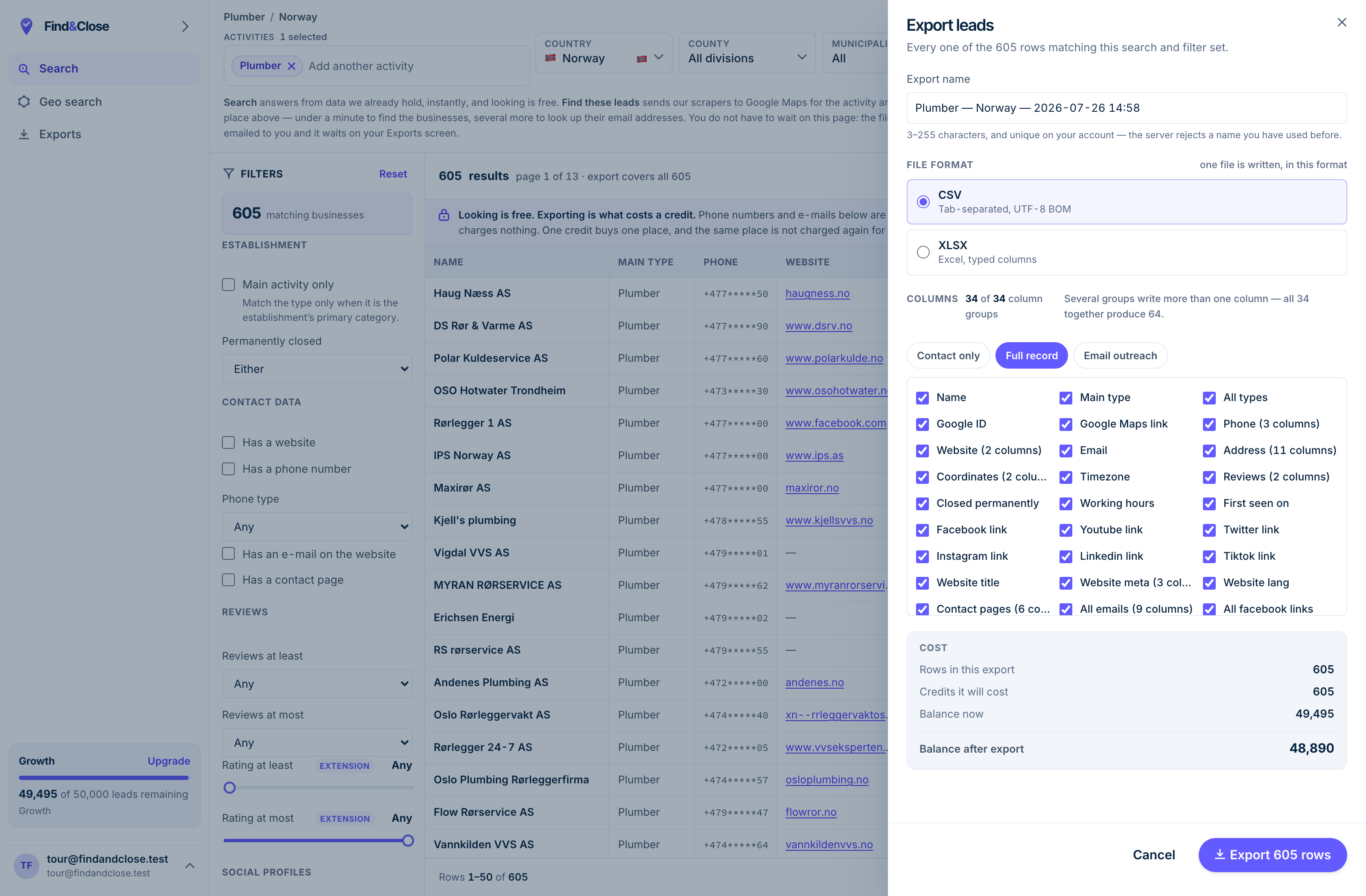
- It exports the whole result Every row the filter matched, not the page you happen to be looking at.
- CSV or XLSX Tab-separated UTF-8, or typed Excel columns. One file per job.
- 34 groups, 64 columns The same 64 on every plan. Nothing is held back for a higher tier.
- Three presets Contact only, full record, or the outreach set. Or tick your own.
- The cost, before you commit One credit per place, once per 30 days. Re-downloading is free.
Questions about retirement home lists
Why is there no count on this page?
Care homes are not a tracked trade in our file, and we publish counts only where the file backs them.
The homes are still searchable in the app. Pick the category, pick a country, and the live count shows before you export.
Who is the buyer at a care home?
A facility, operations or purchasing manager. The person who answers the phone at reception is almost never the one who signs.
Your first job is to find that name. The general inbox on the listing rarely reaches them.
Why is the sale so slow?
Budgets are set once a year, and larger homes run purchasing through procurement rules and sometimes tenders.
Switching a supplier means paperwork, so the current one has an edge. You win by being ready when the window opens, not by pushing.
What do care homes buy most often?
Food and catering top the list, followed by medical and hygiene supplies on a reorder cycle.
Software, care systems and maintenance sit behind them as slower, bigger decisions. Pick one lane and pitch only that.
I sell a service delivered inside the home. Is this list for me?
Yes. Homes hire physiotherapists, activity leads and counsellors for their residents, so the building is a venue as well as a buyer.
The buying is still procurement-led and slow. Treat it as a named-account sale, not a quick booking.
How do I reach a home that belongs to a chain?
The buyer often sits at head office, not on site, and a Maps row is a location, not a headquarters.
A company database reaches the head-office layer better. Our Apollo comparison explains when to use which tool.
Go deeper
The services sold into homes, the country hubs, and the guides for a slow, named-account sale.
- Physiotherapist email list A service care homes buy in for residents
- Counselor email list Another service delivered inside the home
- Local business leads in Norway Every tracked trade, one country
- Find business email addresses Reaching a named person inside a body
- GDPR and B2B cold email The rules before you press send
Find the homes, then work the calendar
Fourteen days, 100 leads, no card. Pull the care-home category in one country and start mapping the buyer behind each door.
- 14-day free trial
- 100 leads included
- No credit card