Guide · Tree services
Tree service email list: the storm-driven trade
A gale drops a tree on a roof, and the owner calls the first crew that answers. This trade sells by the weather, and that changes how you reach it.
Covers Norway, Sweden, Denmark and FinlandNo live count — this trade is not tracked yetA calendar built on storms and seasons
What we cover, and where the count stops
Say the scope first, so nobody buys the wrong map.
FindAndClose builds local business lists from Google Maps. We cover four countries: Norway, Sweden, Denmark and Finland.
Tree services and arborists are not one of our 27 tracked trades yet. So this page carries no live count. We will not dress a guess up as a real number.
You can still pull the trade in the app. Pick the tree-service category, pick a country, and the count shows before you spend a credit. The gate is on our pages, not on your search.
If you need a US or global tree-care list, we are the wrong shop. A worldwide scraper fits that better. Our Outscraper review says where they win and where they charge for it.
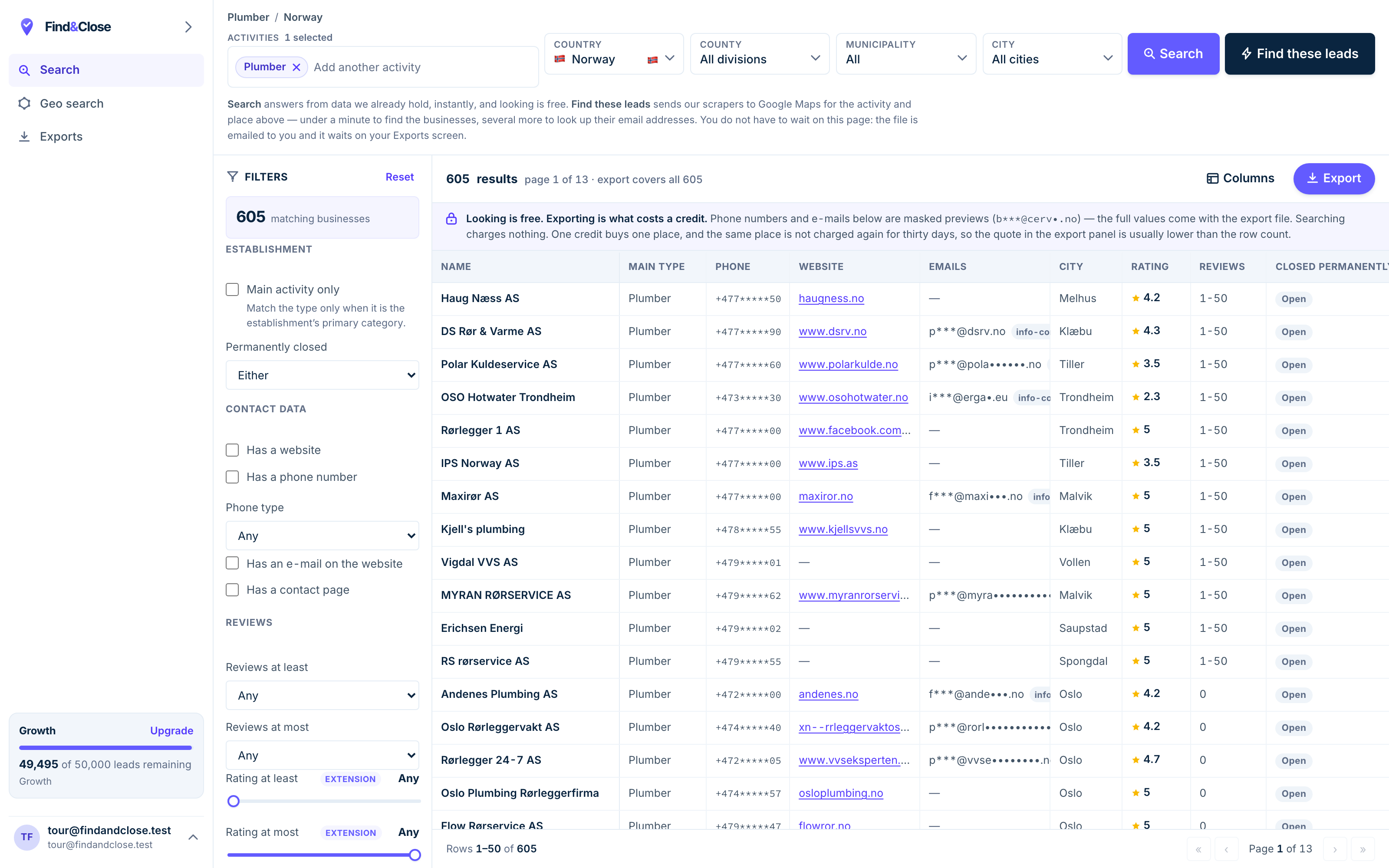
- Pick the trade Type it and take the match. One trade or twenty, on every plan.
- Pick the place Country, county, municipality, city. No plan gates the geography.
- The count moves first The number updates before you spend anything. Looking is free.
- Filter to the ones worth calling Has email, has phone, has a website, has a contact page. Combine them freely.
- Contacts are masked until export You can see a row exists and judge it. The address itself is the product.
- Export what you are looking at The file is exactly this filter set, with nothing dropped in between.
The weather writes the order book
Demand for tree work does not grow steadily. It arrives in bursts, and the burst sets your timing.
A calm month is quiet. Then a storm rolls through, and every crew is booked solid inside a day. Fallen limbs, split trunks, a tree leaning on a power line. The work is urgent and it all lands at once.
So the crew lives on the phone through those weeks. It rings in the truck, at the base of a tree, on the chainsaw belt. Nobody in that window reads a sales email.
- Storm weeks jam the phone. A pitch sent then dies unread.
- The quiet stretch between storms is when the owner can think.
- Most of these firms are a crew and a chipper, not an office.
- The one address on file, where it exists, lands on the owner’s own phone.
For anyone selling to this trade, the lesson is timing over volume. Sell in the calm. Go silent in the rush.
Insurance is the quiet engine under all of it. A tree through a roof is a claim, so the homeowner and the adjuster both want the job done fast and documented. A crew that writes clean reports and photos gets the repeat referral from the loss adjuster. If you sell them anything that speeds that paperwork, you are selling into the part of the job they hate.
The seasonal diary, past the storms
Even in a calm year, tree work moves with the calendar. Four windows, four different jobs.
Weather aside, this trade has a natural year, and the buying fits it.
- Late winter to early spring: the pruning season. Dormant trees are safe to cut. Crews book weeks of scheduled work before the sap rises.
- Summer: survey and quote. Owners see a dead or leaning tree in leaf and call for a look. Quotes go out, jobs get booked for autumn.
- Autumn: the clearing rush. Leaves down, storms coming, everyone wants the risky tree gone before winter. The diary fills.
- Deep winter: storm response only. Scheduled work stops. The phone rings for emergencies, and for nothing else.
Match your pitch to the window. A firm chasing spring pruning bookings in February has a different worry from one clearing storm debris in November. Name the season and you prove you know the trade.
Who buys from a tree crew, and who to reach
The homeowner is the one-off. The steady money sits with the people who own a lot of trees.
A homeowner calls once every few years. The buyers who keep a crew fed all season are the ones with land and liability.
- Municipalities and parks, with public trees they must keep safe.
- Property managers and housing firms, with grounds to maintain.
- Power and rail networks, who pay for line and track clearance by contract.
- Insurers and loss adjusters, who send the storm-damage work.
- Estate and forestry owners, with woodland to thin.
If you sell to the crew, this shapes your list. A firm that names municipal or utility contracts in its reviews runs an office and reads email. A firm with three reviews and a mobile number is one person and a saw, and the phone is the only door.
Sort the export by review count before you write a word. The top rows are the crews with an office. The tail is the solo operator. They do not buy the same way, and they do not answer the same channel.
A quiet-season cadence for a storm-driven trade
Written for someone selling job software, kit or an insurance-referral service to tree firms. Pitch in the calm, name the season, and back off in the rush. Run it in your own tool — we build lists and send nothing.
-
Subject before your autumn clearing rush
Hi — I work with tree crews, and I am writing now on purpose, before the autumn rush.
When the storms start, the jobs pile up faster than the paperwork.
[Your offer] keeps the quotes and claim photos straight while the crew cuts.
Worth fifteen minutes this month? If not, reply stop and I will not write again.
Naming the autumn rush proves you know the calendar. You are selling calm before the storm, not during it, which is the one time an owner can listen.
-
Call early, before the crew leaves the yard. A tree firm answers at seven or not until dark.
One question: what happened to the storm jobs you could not document last winter?
Every owner has a claim that got messy. The story is the opening.
Emergency work chooses whoever answers, so the phone is revenue and the calls come early. The messy claim is the sore spot every crew owns.
-
Subject not pitching you this week
The wind has arrived, so I know your week. I am not selling you anything today.
One line: when the clearing rush eases, I would like fifteen minutes. Reply yes now and I will chase the date, not you.
Backing off in the rush is the most credible move here. It shows you read the weather the way the owner does.
-
Subject the fifteen minutes, now the rush has passed
The clearing is done and the diary has cooled, so this is the call I asked about in autumn.
If the timing is still wrong, say next season and I will come back in summer. Say stop and I will close the file for good.
A seasonal trade thinks in seasons, so give it season-sized options. Next summer is a real answer here, not a brush-off.
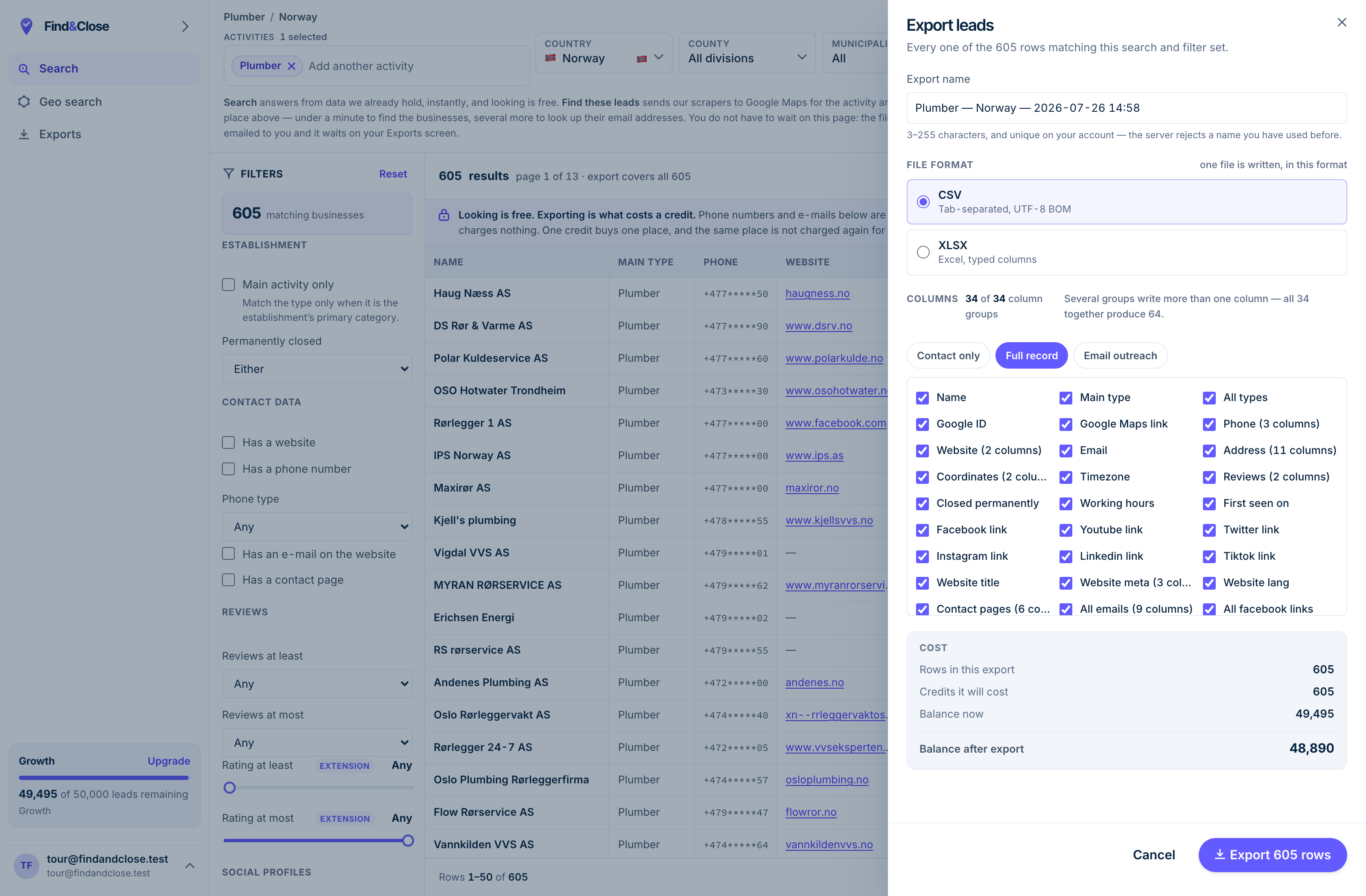
- It exports the whole result Every row the filter matched, not the page you happen to be looking at.
- CSV or XLSX Tab-separated UTF-8, or typed Excel columns. One file per job.
- 34 groups, 64 columns The same 64 on every plan. Nothing is held back for a higher tier.
- Three presets Contact only, full record, or the outreach set. Or tick your own.
- The cost, before you commit One credit per place, once per 30 days. Re-downloading is free.
Straight answers about tree-service lists
Why is there no live count on this page?
Because tree services are not one of our 27 tracked trades yet. Every count we publish comes from that tracked file, dated, and we do not pad the gaps.
The rows are still searchable in the app. Pick the category, pick a country, and the real number shows before you export.
When is the worst time to contact a tree firm?
During a storm week and the autumn clearing rush. The phone jams, every crew is booked, and your message dies unread.
The good windows are mid-summer, before autumn, and deep winter, once the emergency work settles. Those are when the owner can hear you.
Who gets replies from tree crews by email?
Firms selling to the office side: job software, insurance-referral services, equipment finance. The office reads email between jobs.
For the solo crews, the phone wins, called early in the day. The same list holds both, and the review count tells them apart.
How much of this trade’s work comes from insurance?
We do not publish a figure, because we do not measure it and will not invent one. But storm damage to a roof or a car is a claim, and the crew that documents the job well gets the repeat referral.
If your product speeds that paperwork, you are pitching the part of the job the crew least wants to do.
Is a tree crew a business or a consumer under the marketing rules?
It depends on the country and how the firm is set up. Some national rules treat sole traders like consumers for marketing email.
You cannot tell the legal form from a Maps pin, so treat every row with care. The GDPR guide walks through it. It is not legal advice.
Neighbours and next steps
The weather-driven trades with live pages, and the four country hubs.
- Roofing contractor email list The other trade the storm feeds
- Landscaping company email list The adjacent green trade
- Local business leads in Norway The country hub, 15,749 records
- Local business leads in Sweden The country hub and its trades
- Local business leads in Denmark The country hub, honest depth
- Local business leads in Finland The country hub, honest depth
Search the tree-service category and read the count
Fourteen days, 100 leads, no card. Pick the category, pick a country, and see the real number before you plan a single send.
- 14-day free trial
- 100 leads included
- No credit card