Guide · Money-transfer services
Money transfer service email list: two trades, one label
A remittance app and a corner-shop transfer counter share a category and almost nothing else. Both live under AML rules. The list only works if you split them.
Covers Norway, Sweden, Denmark and FinlandNo live per-trade count — this is not a tracked categoryTwo very different firms behind one word
Coverage, and no count to fake
The honest scope, first.
FindAndClose sells local business lists built from Google Maps. We cover Norway, Sweden, Denmark and Finland, and nothing outside.
Money transfer is not a tracked trade in our file yet. So we publish no live count, and we will not guess one.
Every figure on this site is a dated query against our own crawl. Where the query does not exist, we say so.
The category still searches in the app. Pick it, pick a country, and the count shows before you spend a credit.
For a US or global remittance list, a worldwide scraper is the right tool. Our Outscraper review is honest about where a global crawl wins.
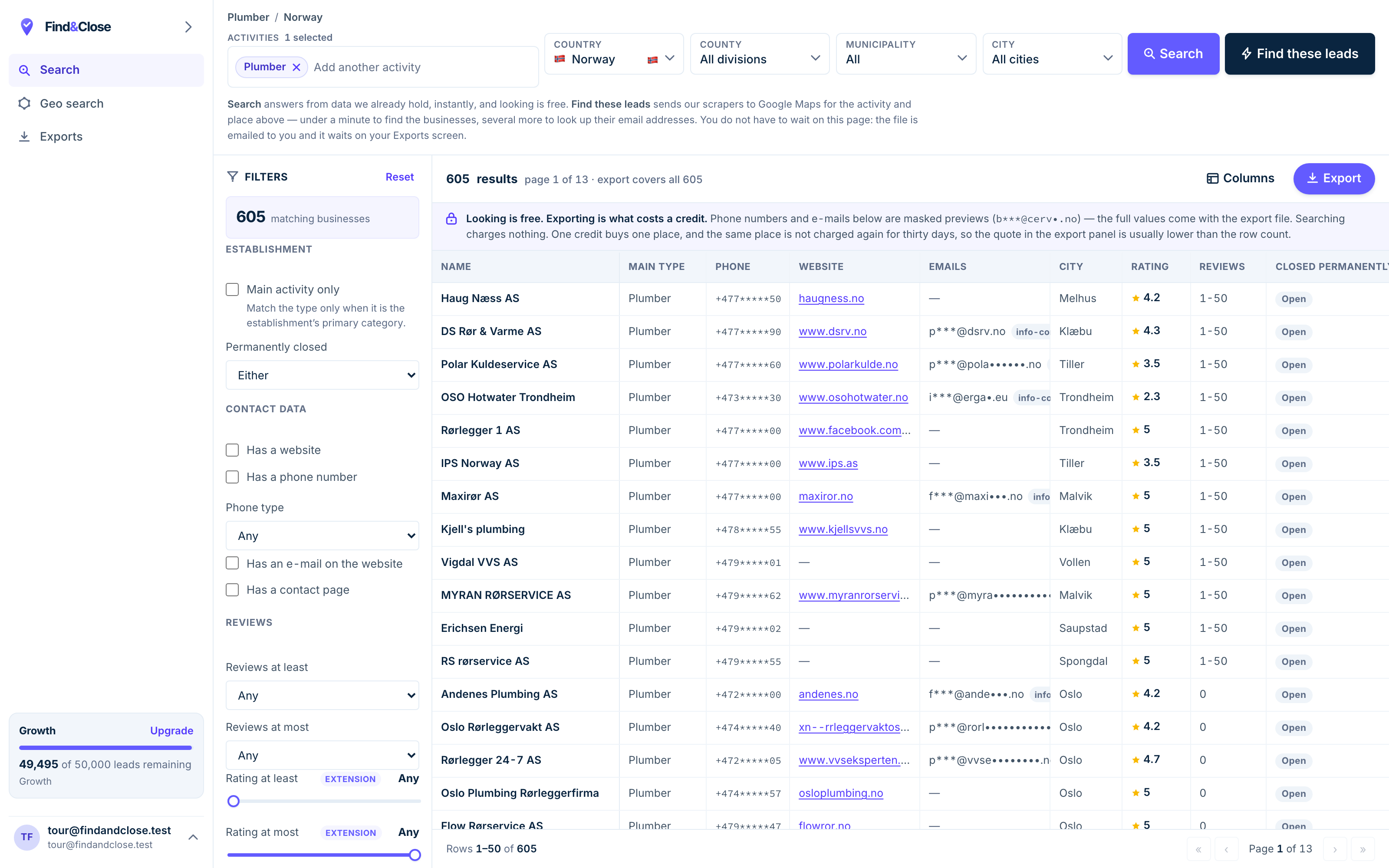
- Pick the trade Type it and take the match. One trade or twenty, on every plan.
- Pick the place Country, county, municipality, city. No plan gates the geography.
- The count moves first The number updates before you spend anything. Looking is free.
- Filter to the ones worth calling Has email, has phone, has a website, has a contact page. Combine them freely.
- Contacts are masked until export You can see a row exists and judge it. The address itself is the product.
- Export what you are looking at The file is exactly this filter set, with nothing dropped in between.
Two animals under one word
The label hides the split that decides your whole campaign.
One side is the licensed fintech. A remittance app or a payments company, run from an office, staffed by people at desks.
The other side is the shop front. A corner-shop counter, a bureau de change, an agent in a migrant-corridor high street.
They share a regulated activity and little else. Their day, their buyer and their inbox all differ.
- The fintech keeps an office, so it reads email during working hours.
- The bureau runs a counter, so it answers the phone and serves walk-ins.
- The fintech has a marketing or operations team. The shop has an owner behind the till.
- The fintech thinks in product. The shop thinks in cash flow and footfall.
So split the file on sight. Sort by name and website: a branded app with a full site is a fintech, a single shop with a thin listing is a bureau.
One message cannot fit both. Write two, or you waste half your sends on the wrong reader.
AML is the pressure they live under
Every firm on this list, big or small, is watched for money laundering. That fear is your opening.
Money transfer sits at the sharp end of financial rules. Anti-money-laundering and know-your-customer duties press on every operator.
The stakes are real. A failed check can cost a licence, a bank relationship, or the whole business.
- The fintech runs a compliance function and buys tools to keep it clean.
- The bureau owner does the checks by hand and dreads getting one wrong.
- Both need a bank that will keep their account open, which is never certain.
- Both feel the cost of every rule, in time or in software.
For a seller, that pressure is the whole angle. A tool or service that lowers AML risk speaks to the thing that keeps this trade awake.
A pitch that ignores compliance misses the point of the trade. Lead with risk and cost, not growth.
Who sells to money-transfer firms
The buyers here are specific. Match the offer to the risk, and to the side of the split.
This is a narrow, serious market. The vendors that win solve a compliance, payments or cash problem, not a soft one.
- AML and KYC software, aimed at the fintech’s compliance team.
- Payments rails and FX liquidity, for firms that move money across borders.
- Cash handling, security and back-office tools, for the shop-front side.
- Banking and account services, the thing every operator worries about losing.
Aim the software pitches at the fintech, where a team owns the problem. Aim the cash, security and banking pitches at the bureau, where the owner does.
For the mechanics of building and cleaning either split, the list-building guide is the method.
A two-track cadence for a split trade
Written for a seller of AML, payments or cash tools. Two openers, one for each side, then a shared close. Run it in your own tool — we build lists and send nothing.
-
Subject AML overhead at [firm name]
Hi. I am [name] at [company]. We cut the manual load in AML and KYC for licensed payment firms.
No client data leaves your side to start, and a short call needs no commitment.
Who owns compliance there? If this is not for you, reply stop and I will remove your details.
The fintech reads email at a desk and runs a compliance function. Naming AML overhead and asking for the owner routes the message to the person who feels the pain.
-
Call the shop mid-afternoon, between the lunch and evening rushes.
One line: "Are your money-transfer checks costing you time each day?" The owner behind the till will have a fast answer.
If a customer is at the counter, offer to call back and mean it.
The bureau answers the phone, not a cold inbox. The owner works the till, so a short, respectful call at a quiet hour beats an email they will not open.
-
Subject the overview, and who else uses it
Following up with the detail. Attached: what we do, who else in transfers uses it, and how we handle data.
For a shop, the short version: it saves time on the checks you already do by hand.
If the timing is wrong, reply stop and I will close the file.
Both sides forward proof before they act, one to compliance, one to a spouse or partner in the business. A single clear pack serves both readers.
-
Subject last note from me
I will close your file today and stop writing.
If a bank review or a rule change puts compliance on your desk, my details are below. Good luck out there.
This trade buys on a shock: a bank warning, a new rule, a near miss. A warm close leaves your name where they will search for it when the shock lands.
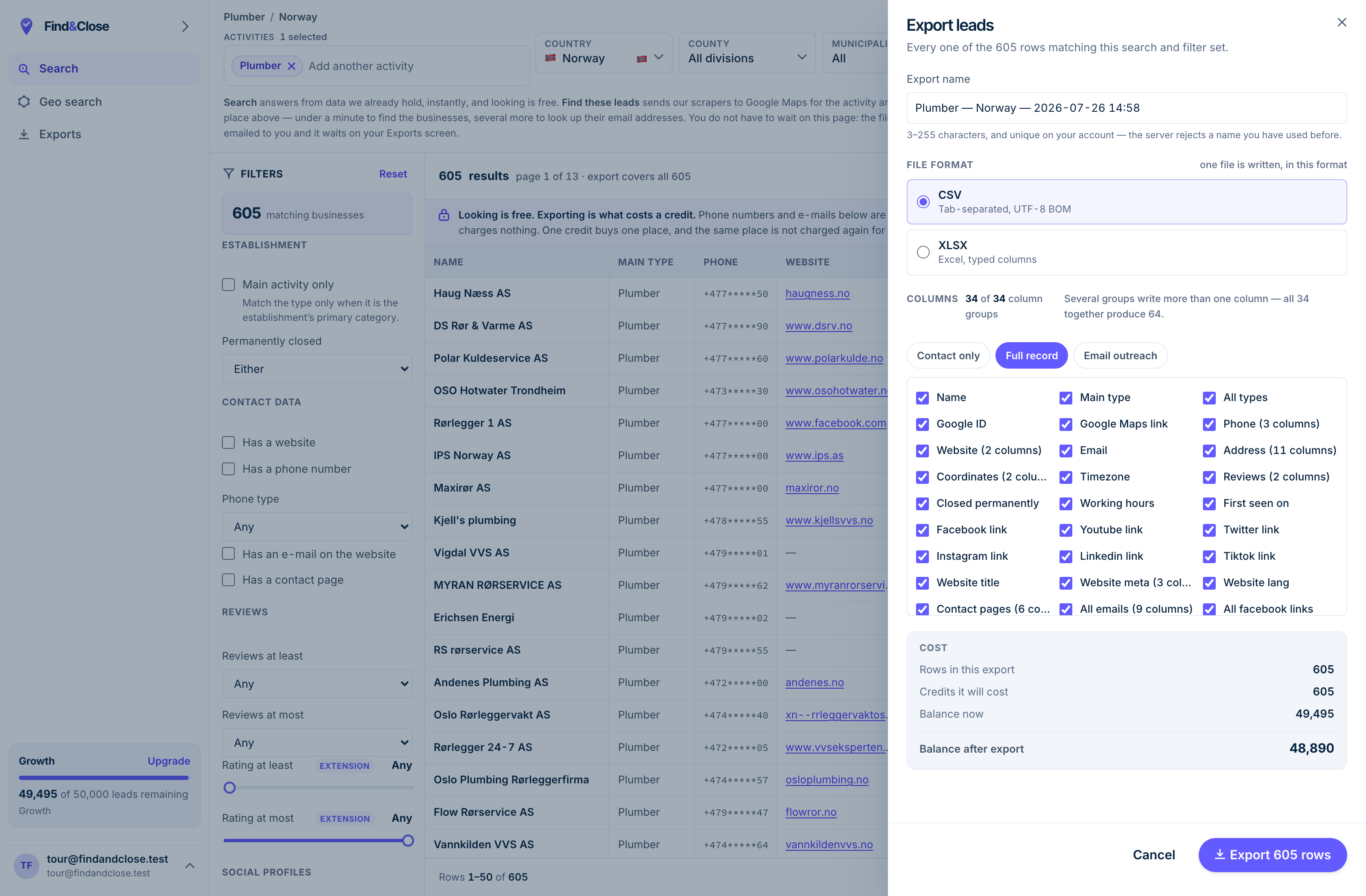
- It exports the whole result Every row the filter matched, not the page you happen to be looking at.
- CSV or XLSX Tab-separated UTF-8, or typed Excel columns. One file per job.
- 34 groups, 64 columns The same 64 on every plan. Nothing is held back for a higher tier.
- Three presets Contact only, full record, or the outreach set. Or tick your own.
- The cost, before you commit One credit per place, once per 30 days. Re-downloading is free.
Questions about money-transfer lists
Why do I have to split this list in two?
Because the category holds two different trades. A licensed fintech runs from an office and reads email. A high-street bureau runs a counter and answers the phone.
One message cannot fit both. Sort by name and website first, then write a track for each side.
How do I tell a fintech from a shop-front bureau in the export?
Read the name and the website flag. A branded app or payments company with a full site is a fintech. A single shop with a thin or missing listing is a bureau.
Reviews help too. A bureau’s reviews mention the counter and the queue. A fintech’s mention the app and the transfer.
What is the strongest angle with these firms?
Compliance and cost, not growth. Every operator lives under AML and KYC pressure, and a failed check can end the business.
A tool or service that lowers that risk speaks to the thing this trade fears most. Lead with it.
Who buys from money-transfer operators?
AML and KYC software, payments rails, FX liquidity, cash-handling and security tools, and banking services.
Aim software at the fintech, where a team owns compliance. Aim cash, security and banking at the bureau, where the owner does.
Is there a live count for this trade?
No. Money transfer is not a tracked category in our file, so we publish no count rather than fake one.
The category searches in the app on any plan. Pick it, pick a country, and the number shows before you export.
Do the AML rules affect my own outreach?
Your cold email still follows the normal B2B rules: say who you are, where you got the data, and offer an opt-out. Our GDPR guide covers it.
The firm’s own AML duties are their concern, not a limit on your list. But naming that pressure is what earns the reply.
Go deeper
The regulated neighbour, the guides for the split, and the country hubs.
- Financial planner email list The other regulated advice file
- Investment service email list The other compliance-gated file
- Local business leads in Norway The Norwegian country file
- Local business leads in Sweden The Swedish country file
- Local business leads in Denmark The Danish country file
- Local business leads in Finland The Finnish country file
Pull the money-transfer list and split it in two
Fourteen days, 100 leads, no card. Enough to sort fintechs from bureaux in one country and test a track against each.
- 14-day free trial
- 100 leads included
- No credit card