Guide · Manufacturers
Manufacturer email list
The pin is a factory gate, not a shop window. Behind it sits a purchasing process, not an owner with a phone. That one fact should shape your whole plan.
Covers Norway, Sweden, Denmark and FinlandNo live count — this trade is not tracked yetWritten for industrial suppliers and partners
What a manufacturer pin is
Coverage first, then the thing most buyers get wrong about this trade.
FindAndClose sells local business lists built from Google Maps. We cover Norway, Sweden, Denmark and Finland, from our own crawl.
A manufacturer does not run a shopfront. The Maps pin is a factory or a head office. Nobody walks in to buy.
That changes what the row is worth to you. The listing is a switchboard, not a sales counter.
If you need a US or global list, we are the wrong tool. A worldwide scraper such as Outscraper fits that job better.
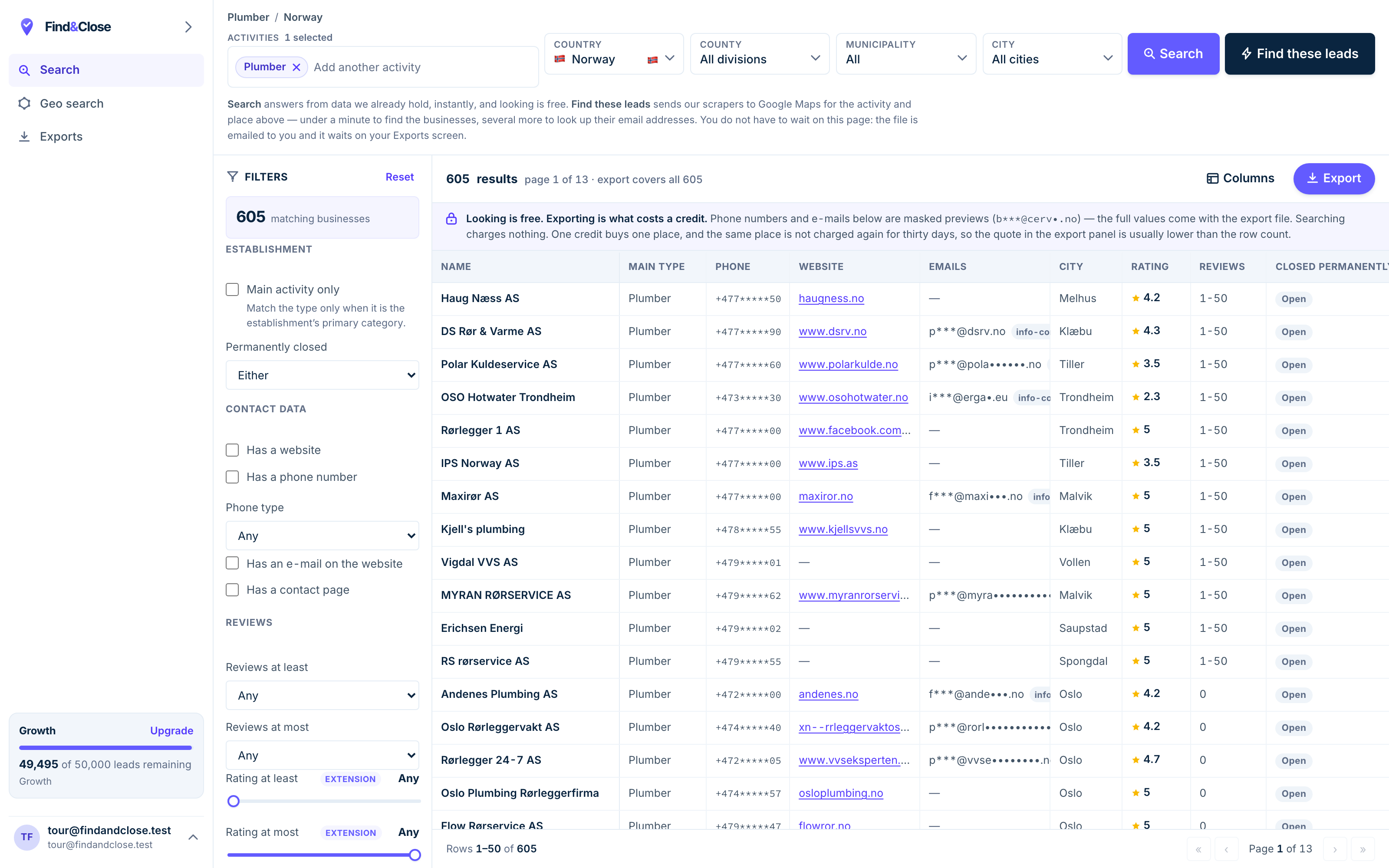
- Pick the trade Type it and take the match. One trade or twenty, on every plan.
- Pick the place Country, county, municipality, city. No plan gates the geography.
- The count moves first The number updates before you spend anything. Looking is free.
- Filter to the ones worth calling Has email, has phone, has a website, has a contact page. Combine them freely.
- Contacts are masked until export You can see a row exists and judge it. The address itself is the product.
- Export what you are looking at The file is exactly this filter set, with nothing dropped in between.
Two sides of the same firm: buyer and seller
A manufacturer both buys inputs and sells output. You are pitching one of those two doors.
On the buying side, the firm needs raw materials, parts, machines and services to run the line. That spend goes through procurement.
On the selling side, the firm wants distribution, export deals and bigger orders. That work runs through sales.
Know which door you are at before you write a word.
- Selling to the plant? You are pitching a purchasing manager, and the cycle is slow.
- Buying from the plant? You are pitching sales, and they want you to make it easy.
- The buyer you want is a named person, not the front-desk address.
- The email on a Maps row is often info@ or sales@, tuned for inbound.
So the firm-level email opens the building, not the deal. To reach the buyer you need a named contact.
The find business emails guide ranks the ways to get one, and names their failure rates.
The procurement wall
Industrial buying is slow on purpose. The process is the point, and it is built to filter you out.
A homeowner buys on a whim. A factory does not. A purchase runs through specs, quotes and sign-off.
That wall is why a single cold email seldom lands a manufacturer. The buyer guards a supply chain, and is not hunting for you.
- Buying is a role, not a mood. A named purchaser owns it.
- Approval crosses desks: engineering, finance, sometimes the board.
- A new supplier is a risk to a running line, so trust moves slow.
- The value per deal is high, which is why the guard is high too.
The upside is that a won account is sticky. A supplier that clears the wall stays for years, because switching is its own risk.
So plan a long, patient sequence. One clever subject line will not carry you past a purchasing process built to slow suppliers down.
Why there is no live count, and a Maps caveat
Our tracked page set does not hold a manufacturer category yet. And this trade sits awkwardly on Maps.
We publish counts only where our tracked file backs them. There is no manufacturer row in that file today.
This trade is also thin on Maps by nature. A factory gets no walk-ins, so many firms never tend the listing.
- Our four countries hold 44,684 local business records in total.
- Email coverage across our tracked trades: Norway 38%, Sweden 19%, Denmark 17%, Finland 16%.
- A factory has less reason than a shop to keep a listing current.
The manufacturer category on Maps is also broad. It spans a two-person workshop and a large plant under one word.
The app lets you search that category and read the count before you export. Filter hard by area and size, and the messy category tightens up fast.
An industrial supplier’s cadence for a slow buyer
Written for a firm selling materials, parts or services into a plant. Patience is the whole play. Run it in your own tool — we build lists, we send nothing.
-
Call the switchboard and ask one thing: who handles purchasing for [your category]?
Do not pitch reception. Get a name and a direct address, then thank them and go.
A named buyer is the goal of this call, nothing more.
The firm email reaches a desk, not the buyer. One short call turns the switchboard into a named contact, which is the only door that matters here.
-
Subject supplier enquiry, [your category]
Hi [name] — reception pointed me to you for [your category].
We supply [what you make] to plants like yours in [region]. Specs and lead times are on one page.
Would the spec sheet help? If not, reply stop and I will not write again.
Address the named buyer and reference the call, so the note reads as expected. A spec sheet is the document a purchaser files and keeps.
-
Subject when your next contract comes up for review
No rush on this. New suppliers get looked at when a contract is up.
Tell me when that falls and I will send a quote to land at the right week.
If we are not a fit, say stop and I will close the file.
Industrial buying moves on the contract calendar, not on your timeline. Asking when the review falls beats pushing for a meeting the buyer cannot grant.
-
Subject parking this until you need it
I will stop writing now and leave the door open.
When a current supplier slips on quality or lead time, my details are below.
A factory switches suppliers on a failure, not on a pitch. The long-dated breakup plants your name where the buyer looks the day a line goes down.
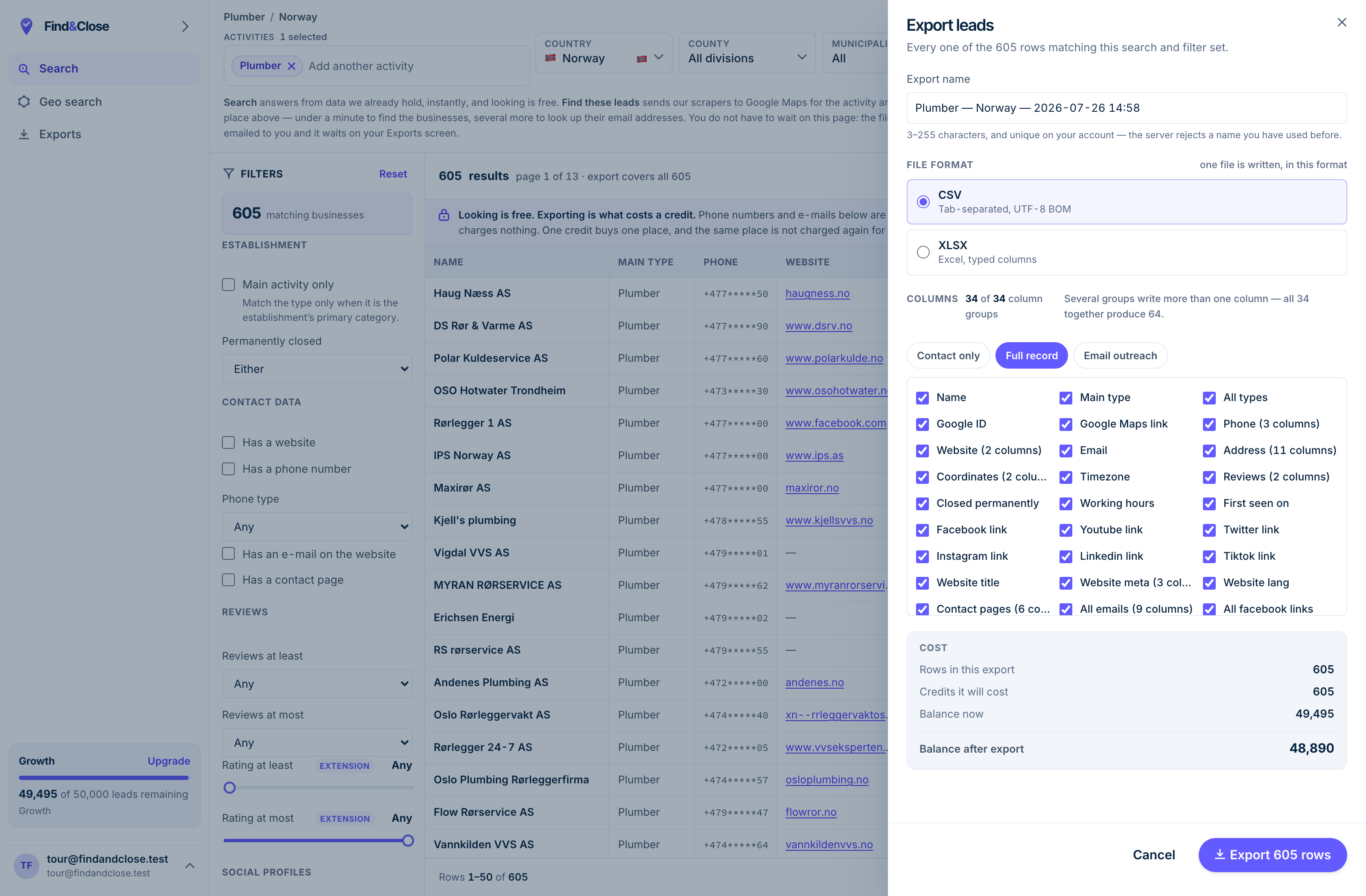
- It exports the whole result Every row the filter matched, not the page you happen to be looking at.
- CSV or XLSX Tab-separated UTF-8, or typed Excel columns. One file per job.
- 34 groups, 64 columns The same 64 on every plan. Nothing is held back for a higher tier.
- Three presets Contact only, full record, or the outreach set. Or tick your own.
- The cost, before you commit One credit per place, once per 30 days. Re-downloading is free.
Straight answers about manufacturer lists
Why is there no live count on this page?
Because our tracked page set does not hold a manufacturer category yet. Every count we publish comes from that file, dated.
The app still lets you search the category and read the count before you export. We would rather show nothing than invent a number.
Will the email on the row reach the buyer?
Not often. A manufacturer row carries a general or sales address, built for inbound.
The real buyer is a named purchasing person. Use the find business emails guide to reach one.
Who buys a manufacturer list?
Industrial suppliers of materials, parts and machines. Also freight and logistics firms, and industrial software sellers.
On the other side, distributors and export partners who want to carry the maker’s output.
Why is manufacturer data thin on Maps?
Because a factory gets no walk-in trade, so it has little reason to tend a listing.
Coverage is patchy as a result. Filter by area and firm size to tighten a broad, messy category.
How long should a manufacturer sequence run?
Longer than any consumer trade. Buying runs on a contract calendar and a sign-off chain.
Plan weeks between touches, not days, and time your quote to their review, not to yours.
Go deeper
The other end of the supply chain, the country hubs, and the guide for named contacts.
Filter the factory pins before you commit
Fourteen days, 100 leads, no card. Pick the manufacturer category, filter by area and size, and see what the crawl holds.
- 14-day free trial
- 100 leads included
- No credit card